
Voltage Matters More Than You Think — Here Is Why
Most golf cart owners know their cart is either 36-volt or 48-volt in the same way they know their car takes a certain fuel grade — they know it matters and they know not to get it wrong, but they are not entirely sure why. The voltage number on your battery pack is not just a label. It defines the performance ceiling of your motor, determines which charger will work on your cart, dictates which replacement parts are compatible, and controls whether a performance upgrade is even electrically possible.
The shift from 36V to 48V as the dominant golf cart standard happened gradually through the 1990s and was essentially complete by the early 2000s. Today, almost every new golf cart sold — Club Car, EZGO, Yamaha — ships as a 48-volt system. But there are still millions of 36-volt carts in active use, particularly older Club Car DS and EZGO Marathon models, and the owners of those carts face a consistent question: is it worth converting to 48V, or is maintaining the original 36V system the smarter path?
This guide gives you the complete technical answer to that question — plus the electrical engineering context that explains why voltage matters, how the two systems differ in real-world performance, what a conversion actually involves, and which platform is correct for your specific situation and usage patterns.
Table of Contents
| QUICK ANSWER36V vs 48V golf cart — which is better and should I upgrade?Performance: 48V systems deliver meaningfully better speed (15-19 mph vs 12-14 mph stock), stronger hill-climbing torque, and more consistent power throughout the discharge cycle.Parts & Batteries: 36V battery packs are cheaper to replace than 48V packs but require more individual batteries (six 6V vs six 8V). Controllers, motors, and chargers are not interchangeable between 36V and 48V.Should you convert? For a 36V cart under 10 years old in good mechanical condition, a 36V-to-48V voltage conversion adds $400-$800 in parts but delivers transformative performance gains. For an older cart needing significant other work, the economics may not support the conversion cost.New cart buyers: Buy 48V. There is no reason to choose 36V on a new cart purchase in 2025. All new Club Car, EZGO, and Yamaha models ship as 48V systems. |
The Electrical Engineering Foundation: Why Voltage Determines Performance

To understand why 48V outperforms 36V, you need one fundamental equation from electrical engineering: Power (watts) = Voltage (volts) x Current (amps). This equation defines everything about how electric motors perform in golf carts.
An electric golf cart motor draws a specific current from the battery pack based on the load it is under — how steep the hill, how heavy the cart and passengers, how fast the cart is moving. The power delivered to the motor is the product of that current and the supply voltage. At the same current draw, a 48V system delivers 33% more power to the motor than a 36V system. This translates directly to higher top speed, stronger acceleration, and better hill-climbing ability — at the same motor current, and therefore the same battery discharge rate in amp-hours.
The efficiency implication is the part most people miss. For a given power requirement — say, maintaining 12 mph on level ground — a 48V system achieves it at lower current than a 36V system. Lower current means lower resistive losses in the cables, lower heat generation in the motor and controller, and less stress on the battery terminals and connections. All of this contributes to the 48V system’s longer component lifespan and better energy efficiency over the life of the cart.
There is also a range implication. Electric motors and controllers have specific current ratings — maximum amps they can safely handle. A 48V system operating at the same current ceiling as a 36V system delivers more power and therefore more range per battery amp-hour consumed. A 48V 36Ah pack stores the same charge as a 36V 48Ah pack mathematically, but the 48V system extracts more useful work from that stored energy due to lower system losses.
Visualising the Difference: A Side-by-Side Electrical Comparison
| Parameter | 36-Volt System | 48-Volt System |
| Nominal System Voltage | 36V (6 x 6V batteries) | 48V (6 x 8V or 8 x 6V batteries) |
| Fully Charged Pack Voltage | 38.4V – 39.6V | 50.4V – 52.8V |
| Typical Motor Wattage | 2,800W – 3,500W | 3,800W – 5,000W |
| Typical Top Speed (stock) | 12 – 14 mph | 14 – 19 mph |
| Current Draw (level ground / 12 mph) | 95 – 120A | 65 – 85A |
| Cable Heat Generation at 100A | Higher (I² x R losses at high current) | Lower (less current for same power) |
| Motor / Controller Stress | Higher thermal load at equivalent power | Lower thermal load at equivalent power |
| Battery Pack Weight | ~198 – 240 lbs (6 x 6V batteries) | ~228 – 270 lbs (6 x 8V batteries) |
| Battery Pack Cost (replacement) | $780 – $1,020 (6 x Trojan T-105) | $990 – $1,170 (6 x Trojan T-875) |
| Charger Cost (replacement) | $200 – $350 | $250 – $450 |
| Performance Upgrade Ceiling | Limited — motor and controller ceiling lower | High — 25-30 mph upgradeable with controller swap |
36-Volt Systems: Who Still Has One and What You Need to Know
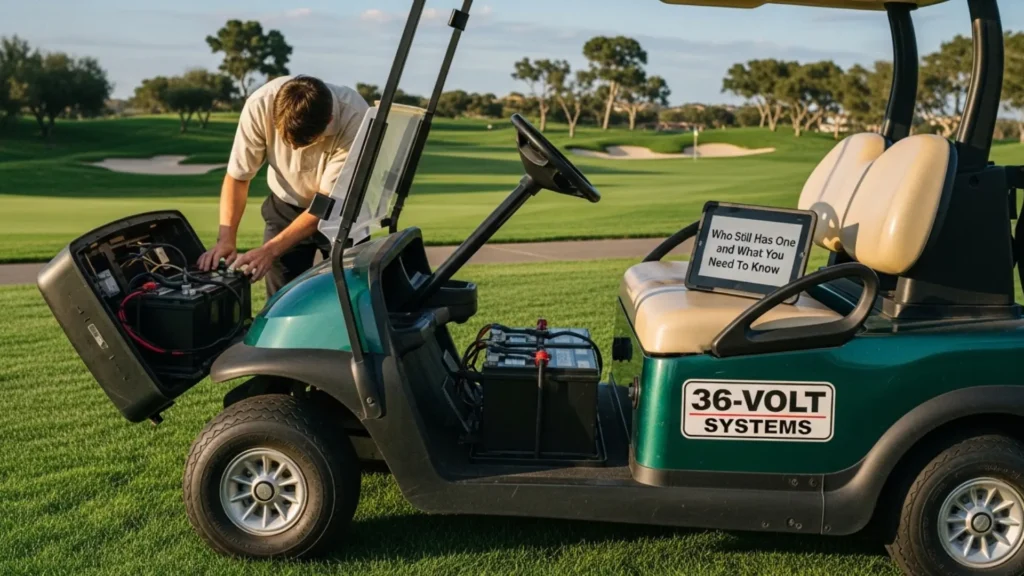
If your golf cart is 36-volt, it was almost certainly built before 2000. The 36-volt standard dominated the golf cart market from the industry’s early days through the mid-1990s, when manufacturers began transitioning to 48-volt as the performance and efficiency advantages became clear. Today, 36V is essentially a legacy standard kept alive by the large installed base of older carts still in service.
The most common 36-volt carts in active service today include: EZGO Marathon (1975-1994), early EZGO Medalist (1994-1996), Club Car DS (1981-1998 production years — check your serial number as described in our Club Car serial number guide to confirm), and Yamaha G-series from the same era. If your cart has six 6-volt batteries, you have a 36-volt system. This is the simplest identification check available.
36V Battery Configuration Options
A standard 36-volt system uses six 6-volt batteries wired in series. The options for replacement within the 36V standard are straightforward — Trojan T-105 (225Ah), US Battery US2200XC2 (232Ah), and Crown CR-235 (235Ah) are the three principal choices, as covered in our Trojan vs US Battery vs Crown comparison guide.
Some older 36V carts have been reconfigured with three 12-volt batteries (3 x 12V = 36V). This configuration was sometimes used as a budget conversion or when specific 6V batteries were unavailable. Three 12-volt batteries in series deliver the same nominal voltage but typically less capacity and shorter cycle life than six quality 6-volt deep-cycle batteries. If your 36V cart has three 12V batteries, replacing them with six quality 6V deep-cycle batteries is an upgrade worth making at the next pack replacement.
36V Performance Limitations — What They Actually Mean Day to Day
The performance limitations of a 36V system are real but not always relevant depending on how you use your cart. For a cart used on flat terrain at a golf resort, making occasional short trips around a community at 10-12 mph, a 36V system with fresh batteries is completely adequate. The limitations become noticeable in specific scenarios:
- Hills and inclines: a 36V cart on a moderate grade will slow to 7-9 mph where a 48V cart maintains 12-14 mph. On steep grades the difference is more dramatic.
- Loaded conditions: carrying four passengers or significant cargo, a 36V system bogs down noticeably at speeds the unloaded cart handles fine.
- Battery discharge sag: 36V systems show more voltage sag under load than 48V systems because the same power requires higher current, and higher current through the same resistance cables causes more voltage drop. The sag manifests as the cart feeling sluggish by the end of a ride even before the pack is technically depleted.
- Performance upgrade limits: if you want to exceed approximately 15 mph, a 36V system with any controller and motor combination available for standard golf carts is essentially at its ceiling. 48V gives you meaningful room to grow.
48-Volt Systems: The Modern Standard and Why It Dominates
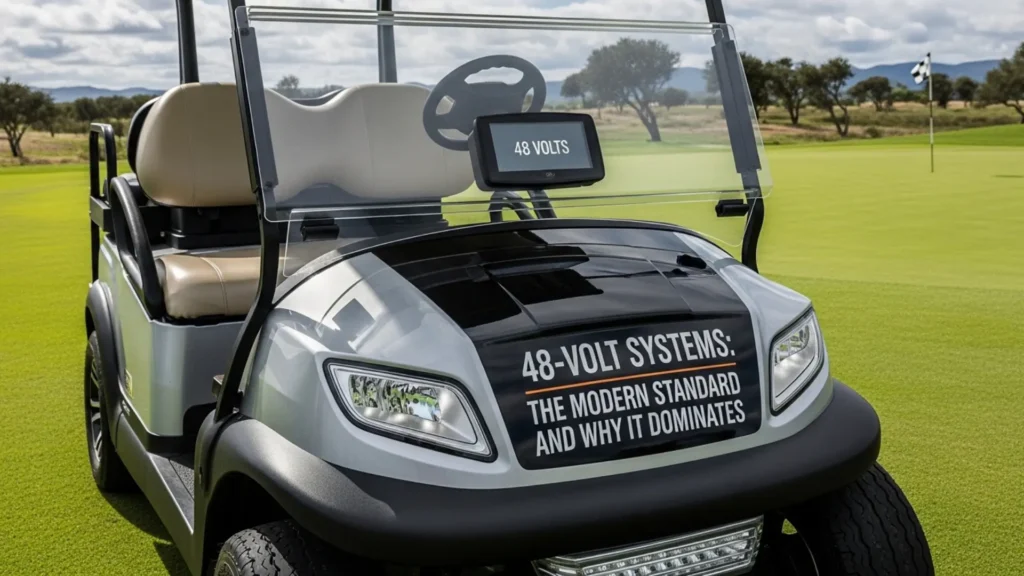
The 48-volt system has been the standard for new golf cart production for over two decades, and for good reason. Every performance metric that matters to the average golf cart owner is better at 48V: higher top speed, stronger hill performance, better range efficiency, lower thermal stress on components, and a substantially higher ceiling for performance upgrades.
The most common 48-volt configuration is six 8-volt batteries wired in series (6 x 8V = 48V). Some carts, particularly older Club Car DS models in the late 1990s transition period, used eight 6-volt batteries (8 x 6V = 48V). Both configurations deliver the same nominal voltage but differ in capacity and physical arrangement. The six-battery 8V configuration is more compact and is the current standard across Club Car, EZGO, and Yamaha production.
48V Battery Configuration Options
For the standard 6 x 8V configuration, replacement options include Trojan T-875 (170Ah), US Battery US8VGC (170Ah), and Crown CR-215 (180Ah). For the older 8 x 6V configuration, Trojan T-105 (225Ah), US Battery US2200XC2 (232Ah), and Crown CR-235 (235Ah) are the appropriate choices. Verifying your battery count before ordering is essential — the two configurations look similar in a cart and are sometimes confused.
Lithium iron phosphate packs for 48V systems from Dakota Lithium and Eco Battery are direct-replacement options that deliver all the performance advantages detailed in our Lithium vs AGM vs Flooded guide. The 48V lithium pack path is well-developed, with drop-in compatible packs available for all major platforms, whereas 36V lithium options are more limited and less commonly available.
48V Performance Ceiling: How High Can You Go?
One of the genuinely compelling advantages of 48V systems is the upgrade ceiling. With a controller upgrade, a 48V cart can be tuned to 20-25 mph on appropriate tires and suspension. The leading aftermarket controllers for golf cart performance upgrades — Alltrax AXE, Navitas, and Curtis 1234 series — are all available in 48V configurations with programmable speed and current limits.
The Alltrax AXE 4834 provides a significant performance upgrade for 48V DC motor carts by raising the controller’s current limit from the OEM’s conservative factory setting to a higher output ceiling. Real-world results: a stock EZGO TXT 48V at 14 mph typically reaches 18-19 mph with an Alltrax upgrade and appropriate programming, with noticeably improved acceleration and hill performance throughout.
The Navitas 48V AC kit for EZGO TXT takes this further — it replaces the original DC motor and controller with a brushless AC motor system, delivering 20-22 mph with dramatically improved torque and essentially zero ongoing motor maintenance (no brushes to replace). The cost is higher ($600-$900 for the complete kit) but the performance transformation is substantial and the AC motor has a much longer service life than the DC original.
None of these upgrade paths exist at 36V. The 36V motor and controller ecosystem simply does not have the aftermarket depth that 48V enjoys, because the manufacturer incentive to develop it has not existed since the industry moved on in the early 2000s.
| PERFORMANCE NOTE | The speed numbers quoted for stock 36V and 48V carts in this guide are for factory-configured, properly functioning carts with fresh batteries. A 48V cart with a failing battery pack or a degraded motor will underperform a 36V cart with fresh batteries. Voltage system is one performance variable — battery condition, motor health, and tire pressure are equally important factors that are often overlooked when owners compare carts. |
Converting 36V to 48V: Is It Worth It, and How Is It Done?
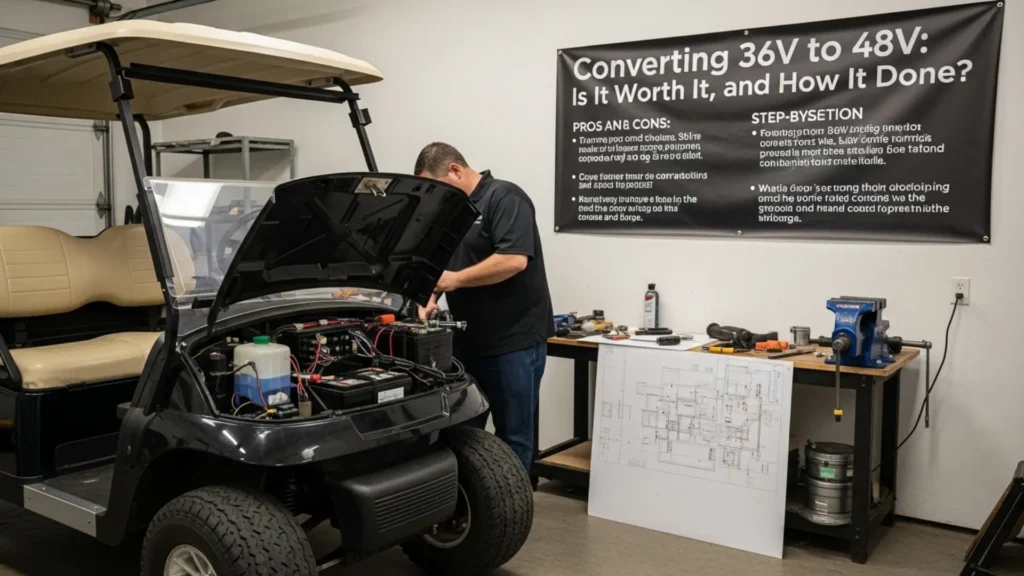
The 36V to 48V voltage conversion is one of the most commonly asked-about modifications in the golf cart world, and it is also one of the most frequently misunderstood in terms of what is actually involved. A voltage conversion is not simply swapping the batteries — it requires replacing every major electrical component in the drive system with 48V-rated equivalents.
What a Complete 36V to 48V Conversion Requires
| Component | Why It Needs Replacing | Typical Cost | Notes |
| Battery pack | New voltage spec | $990–$1,170 | Six 8V batteries replace six 6V batteries. Physical tray space must accommodate the slightly different footprint of 8V batteries in some carts. |
| Motor controller | 36V controller cannot accept 48V | $200–$450 | Critical component. 36V controller will be destroyed by 48V input. Alltrax or Navitas 48V controllers are the preferred aftermarket replacements. OEM 48V controllers are available but more expensive. |
| Solenoid | Coil voltage must match system voltage | $35–$85 | A 36V solenoid coil will attempt to run at 48V, drawing excess current and burning out quickly. A correct 48V solenoid is required. Low cost, easy to overlook. |
| Battery charger | Must match pack voltage | $250–$450 | 36V charger on a 48V pack will not charge correctly and may fault or cause damage. A 48V charger with OBC compatibility for your platform is required. |
| DC-DC converter (accessories circuit) | Powers 12V accessories from pack | $40–$80 | Most carts have a 12V tap for horn, lights, and accessories. The original DC-DC converter may be rated for 36V input only. Replace with a 48V-input DC-DC converter. |
| Motor (sometimes) | May be voltage-rated | $200–$450 | Many DC golf cart motors are dual-voltage rated and work on both 36V and 48V. Check the motor nameplate — if rated 36/48V or explicitly 48V, it can stay. If rated 36V only, replacement is needed. |
| Speed sensor / throttle pot (if voltage-dependent) | Some older sensors are voltage-referenced | $25–$60 | On older EZGO and Club Car models, the throttle potentiometer and associated electronics may need inspection. Most are low-voltage signal components unaffected by pack voltage change. |
Total conversion cost including all components: $1,700 to $2,700 depending on brand choices, whether the original motor is re-usable, and whether you perform any of the installation work yourself. For comparison, a new 48V golf cart at retail starts at approximately $8,000-$10,000. The conversion makes strong economic sense on a cart in good mechanical condition with a solid frame and working body — it does not make sense on a cart that also needs significant mechanical work.
The Conversion Decision Framework: Should You Convert?
| Scenario | Convert? | Reasoning |
| Cart under 8 years old, good body and frame, currently 36V | YES | Strong ROI. Conversion cost is $1,700-$2,700. Performance improvement is transformative. Cart life extended 8-10+ additional years. |
| Cart 8-12 years old, good mechanical condition, wanting more performance | CONSIDER | Evaluate frame condition and overall mechanical health. If other systems are sound, conversion remains cost-effective. If additional repairs are needed, consider total project cost. |
| Cart 12+ years old with worn body, tired suspension, high-hour motor | NO | At this age and condition, conversion cost approaches or exceeds value of a quality used 48V cart. Buy the used 48V cart instead. |
| 36V cart that only needs a battery replacement, no other issues | DEPENDS | If performance is satisfactory and the cart is only used casually on flat terrain, stay with 36V — battery replacement alone is $780-$1,000. If performance is a priority or you plan to keep the cart long-term, add the conversion cost now and do it once. |
| New cart purchase decision | BUY 48V | There is no reason to buy a new 36V cart in 2025. All new OEM production is 48V. If offered a 36V new cart at any price, it is surplus or old stock. |
Step-by-Step Voltage Conversion: What the Process Actually Looks Like
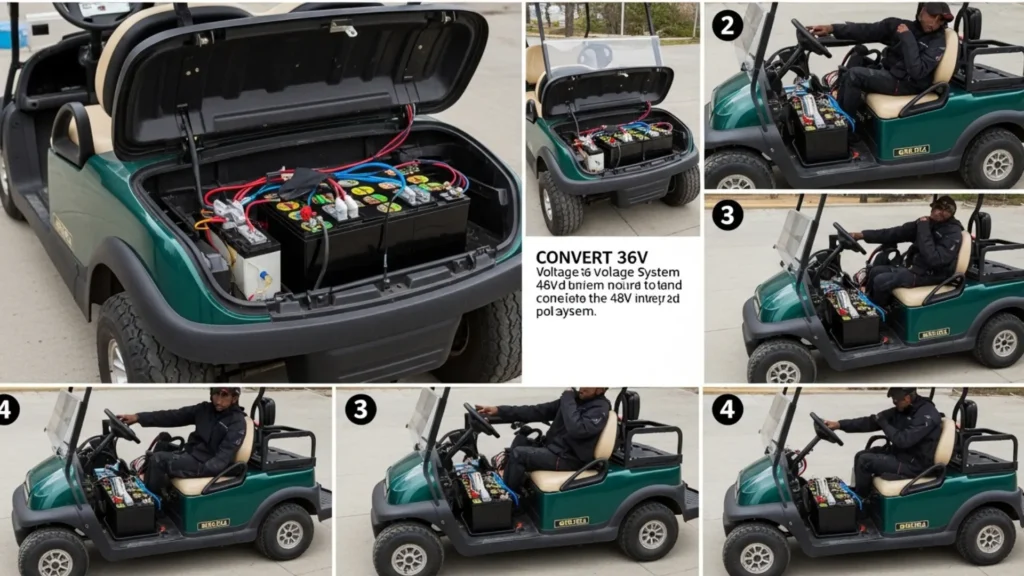
If you have decided to convert, here is the sequence an experienced technician follows. This is not a tutorial for inexperienced owners — it is a transparency document so you know what is involved and can evaluate whether to DIY or use a shop.
- Photograph all wiring connections, controller mounting positions, solenoid wiring, and the DC-DC converter installation. You will reference these photos during reassembly.Document everything before you start.
- Remove the negative cable from the main battery first to break the circuit. Remove all batteries from the tray.Disconnect the battery pack completely.
- The motor nameplate should list the voltage range. If it shows 36/48V or 48V, it can remain. If it shows 36V only, you need a replacement motor.Check motor nameplate voltage rating.
- The OEM 36V controller bolts to the frame. The replacement 48V controller (Alltrax, Navitas, or OEM) mounts in the same or similar location. Transfer all wiring connections from the old controller to the new one — reference your photographs.Remove and replace the controller.
- Remove the old 36V solenoid and install the 48V replacement. Solenoid wiring connections are standardised — large cables to main terminals, small wires to coil terminals. Match the connection configuration from the original.Replace the solenoid.
- If the existing converter is rated only for 36V input, replace it with a 48V-input unit. Connect the input leads to the full 48V pack output and the output leads to the existing 12V accessory circuit.Replace or verify the DC-DC converter.
- Install six 8V batteries in the tray. Wire in series: positive of battery 1 to negative of battery 2, positive of battery 2 to negative of battery 3, continuing through all six. The final negative and final positive are the main pack terminals.Install the new 48V battery pack.
- Connect the 48V charger to the charge port. Verify the correct OBC profile is selected if your cart has OBC.Install the 48V charger.
- Measure total pack voltage at the main terminals — should read 48-52V with fresh batteries. Turn the key on and confirm no fault codes. Press the accelerator gently and confirm solenoid click and motor engagement.Initial verification before first drive.
- Drive for 15-20 minutes on known terrain. Check that the cart achieves expected speed, that acceleration is smooth, and that the controller does not show fault indicators. Perform controller programming if using an Alltrax or Navitas unit — the factory settings may need adjustment for your specific motor.Test drive and calibration.
| SAFETY WARNING | Never mix 36V and 48V components in the same drive circuit. A 36V solenoid connected to a 48V pack may function briefly but will overheat and fail with potential for fire. A 36V controller connected to a 48V pack will likely fail immediately and catastrophically. The conversion must be complete — every voltage-rated component must be replaced. There is no partial-conversion shortcut that is safe. |
Lithium Batteries and Voltage: How LiFePO4 Changes the Picture
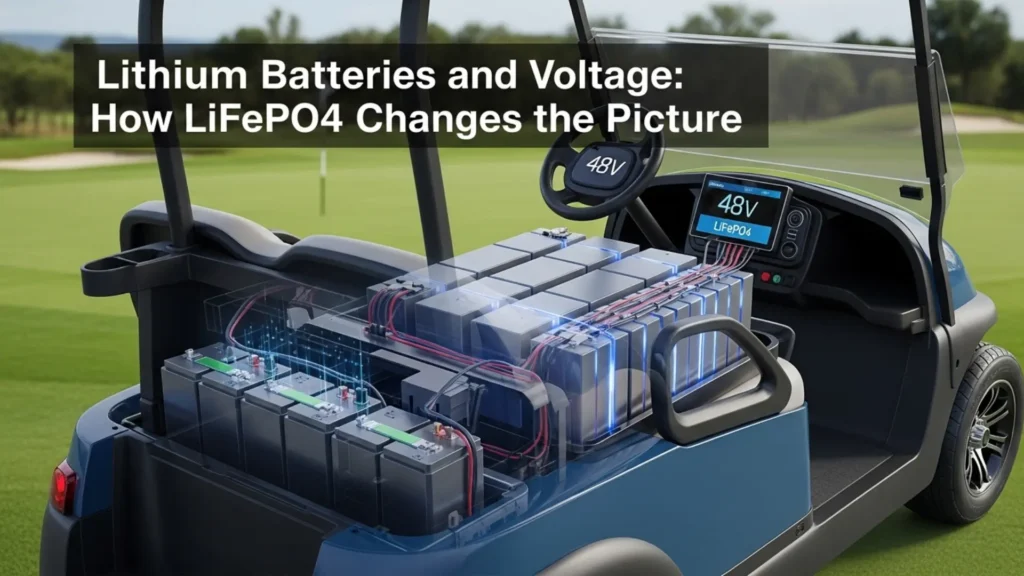
Lithium iron phosphate battery technology interacts with the 36V vs 48V decision in an interesting way. While 36V lithium packs exist, the availability and product development in golf cart lithium batteries is overwhelmingly concentrated at 48V. Dakota Lithium, Eco Battery, and Trojan Trillium all have well-developed, widely distributed 48V golf cart packs. 36V lithium options are more limited, less commonly available, and have a smaller aftermarket support ecosystem.
This creates an interesting decision point for 36V cart owners who are considering lithium: the best path to the best lithium pack available is often to convert to 48V first, then install a 48V lithium pack. The combined cost of the 36V-to-48V conversion and a 48V lithium pack is $2,400-$4,000 depending on component choices — a significant investment, but one that delivers a truly modern electrical system with essentially no maintenance requirements and a 10-15 year battery lifespan.
The alternative — installing a 36V lithium pack on a 36V cart — is certainly possible and delivers the lithium benefits of maintenance-free operation and consistent power. It is just a smaller product category with fewer options, less dealer support, and less development investment behind it. For a 36V cart that is in good condition and you plan to keep for many years, the full conversion to 48V lithium is the most forward-looking investment you can make in that vehicle.
Voltage by Platform: What Your Specific Cart Has and What to Know
| Cart Model | Standard Voltage | Battery Config | Production Years at 36V | Notes |
| Club Car DS Electric | 36V → 48V | 6x6V (36V) 6x8V (48V) | 1981 – ~1997 | 36V standard through mid-1990s. Transition to 48V began 1996-1998 and was complete by 2000. Check serial number: year digits 81-97 are likely 36V, 98+ are likely 48V. Always verify by counting batteries. |
| Club Car Precedent | 48V | 6x8V | N/A (48V only) | All Precedent models are 48V from introduction in 2004. No 36V Precedent was produced. |
| Club Car Onward | 48V | 6x8V or Lithium | N/A (48V only) | 48V from launch in 2017. Factory lithium option available on premium trims. |
| EZGO Marathon | 36V | 6x6V | 1975 – 1994 | All Marathon models are 36V. Well-supported conversion platform given the large installed base and aftermarket component availability. |
| EZGO Medalist | 36V → 48V | 6x6V (36V) 6x8V (48V) | 1994 – ~1996 | Early Medalist (1994-1996) is primarily 36V. Later Medalist (1997-2000) may be 48V. Verify by counting batteries — this is the only reliable method. |
| EZGO TXT | 48V | 6x8V | N/A (48V only) | All TXT models from 2001 introduction are 48V. The TXT was launched as a 48V platform and has remained so throughout production. |
| EZGO RXV | 48V | 6x8V | N/A (48V only) | 48V AC system from launch in 2008. More sophisticated electrical architecture — voltage conversion is not a standard modification path for the RXV. |
| Yamaha G1 – G9 | 36V | 6x6V | 1979 – 1994 | All G1 through G9 series Yamaha carts are 36V. Large and loyal owner base ensures aftermarket support remains strong for 36V components. |
| Yamaha G14 – G22 | 36V or 48V | Varies | 1995 – 2007 | Transition era models. Specific voltage varies by year and market. Verify by counting batteries. 1995-1999 predominantly 36V, 2000+ increasingly 48V. |
| Yamaha Drive / Drive2 | 48V | 6x8V | N/A (48V only) | All Drive and Drive2 models are 48V. Current production platform. Factory lithium-compatible. |
From the Shop: Patterns We See With 36V vs 48V Decisions
The most common conversation we have with owners of 36V carts is some version of: the batteries died again, should I just replace them or do something different? The honest answer depends on what ‘something different’ means to that specific owner.
For owners who use their 36V cart exclusively on flat terrain at moderate speeds and have no performance complaints — only the battery replacement cost is the issue — staying with 36V is often the correct choice. The battery pack costs less ($780-$1,020 vs $990-$1,170), the components are simpler, and the performance is adequate for their use case. Spending $1,700-$2,700 on a conversion for a cart that already does everything the owner needs it to do is not a good investment.
The owners for whom the conversion clearly pays off are those who live in communities with hills, who regularly carry four passengers, or who have been tolerating the sluggish performance of their 36V cart for years and assumed that was just how golf carts drove. When these owners experience a 48V cart — even a stock one with fresh batteries — the reaction is consistently the same: they had no idea golf carts could drive like that. The conversion for these owners transforms a cart from an appliance they use reluctantly into one they enjoy driving.
The one piece of advice we give to every 36V owner considering conversion: budget for the complete conversion, not just the batteries. The single most common conversion problem we hear about is an owner who replaced the batteries with 8V units but left the original 36V controller in place. The controller immediately enters a fault state or fails within a few weeks. The voltage conversion must be complete — batteries, controller, solenoid, charger, and DC-DC converter — or it is not a conversion, it is a damaged cart.
| E-E-A-T NOTE | Golf Cart Gears stocks conversion kits and individual components for 36V-to-48V conversions on Club Car DS, EZGO Marathon, EZGO Medalist, and Yamaha G-series platforms. Our toll-free team has guided hundreds of owners through voltage conversions and can advise on component selection for your specific cart, serial number, and performance goals. |
Frequently Asked Questions
How do I know if my golf cart is 36V or 48V?
Count the batteries and identify their voltage. Six 6-volt batteries wired in series equals 36V. Six 8-volt batteries equals 48V. Eight 6-volt batteries also equals 48V (less common but found on some older Club Car configurations). You can also check the serial number — as described in our EZGO and Club Car serial number guides — though counting batteries is the definitive physical confirmation.
Can I put 48V batteries in a 36V golf cart?
Not by simply swapping batteries. Six 8-volt batteries in a 36V system would produce 48V at the pack output, which would immediately damage or destroy the 36V-rated controller, solenoid, and charger. A voltage conversion requires replacing all voltage-rated electrical components simultaneously. The batteries are the last thing to change, not the first.
Is a 36V to 48V conversion worth doing?
For a cart in good mechanical condition that is under approximately 10-12 years old, yes — the conversion cost of $1,700-$2,700 is well below the cost of a replacement cart and delivers transformative performance improvement. For an older cart that also needs body work, suspension, or motor service, the total project cost may approach a used 48V cart price, and the used cart may be the better investment.
Do 36V and 48V motors look the same?
Many DC series-wound golf cart motors are externally identical whether rated for 36V or 48V. The voltage rating is on the nameplate — a small metal tag typically riveted to the motor housing. Check the nameplate for the voltage specification before assuming the motor needs replacement in a conversion. Many motors are rated for both voltages or specifically for 48V even when installed in a 36V cart after a previous conversion.
Will a 48V charger damage 36V batteries?
Yes — a 48V charger connected to a 36V pack will chronically overcharge the batteries because its absorption target voltage (approximately 39-40V on a 36V pack) is far below the charger’s design output. The charger will push current well past the correct absorption point, overcharging every cell in the pack. Always match charger voltage to pack voltage exactly.
What speed can I expect from a 36V vs 48V cart?
Stock 36V carts with fresh batteries typically achieve 12-14 mph on level ground. Stock 48V carts achieve 14-19 mph depending on motor configuration and controller settings. With aftermarket controller upgrades, a 48V cart can reach 20-25 mph on appropriate tire and suspension setups. 36V systems have very limited upgrade potential beyond stock speed, while 48V systems have a broad aftermarket ecosystem for performance enhancement.
Is 72V or 96V an option for golf carts?
Higher voltage systems (72V, 96V) exist primarily in custom-built or heavily modified golf carts and in commercial utility vehicles. They are not mainstream options for standard Club Car, EZGO, or Yamaha platforms and require significant custom fabrication for the battery tray, cable routing, and charger installation. For most owners seeking more performance, the 48V platform with a quality controller upgrade delivers excellent results without the complexity and cost of non-standard voltage systems.
The Verdict: 48V Is Better, but 36V Is Not Broken
The technical comparison is clear: 48V is the better platform by every meaningful performance metric. Higher top speed, stronger torque, lower thermal stress on components, better range efficiency, and a dramatically richer upgrade ecosystem all point in the same direction. If you are buying a new cart today, there is no reason to consider anything other than 48V.
For existing 36V cart owners, the decision is more nuanced. A 36V cart with fresh batteries on flat terrain in an application that does not push performance limits is doing its job well. The cost and disruption of a full voltage conversion does not make sense for that owner. For the owner who notices performance limitations every time they drive — uphill, with passengers, in conditions that demand more from the cart — the conversion economics are compelling when the cart’s mechanical condition supports the investment.
The single most important thing to avoid regardless of which path you choose: never partially convert a voltage system. Replace all voltage-rated components together, or replace none of them. A partial conversion with mismatched components is more expensive in the long run than either a complete conversion or staying with the original voltage system and maintaining it properly.