Buy Golf Cart Battery Cables — Model-Specific Cable Sets in 4 Gauge & 6 Gauge
Weak battery cables do not just slow your cart down — they waste power, create heat, and make your golf cart feel weaker than it should.
Golf Cart Gears We provide a wide range of golf cart batteries and battery accessories, including 4-gauge and 6-gauge golf cart battery cable sets from trusted brands like Madjax, NIVEL, and Red Hawk.
We provide model-specific battery cables for Club Car DS, Tempo, Onward, Precedent, EZGO Marathon, Medalist, TXT, RXV, Yamaha Drive, G14, G16, G19, and G22.
Pre-Cut Golf Cart Battery Cable Sets for Your Cart
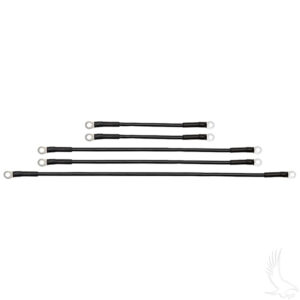
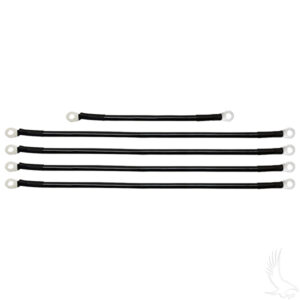
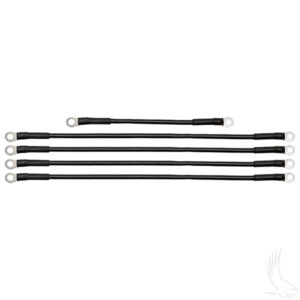
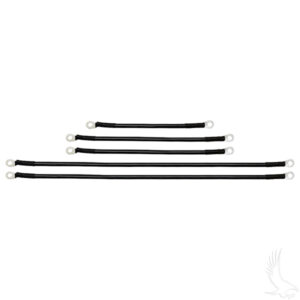
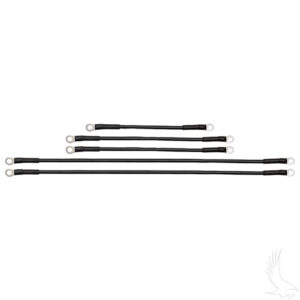
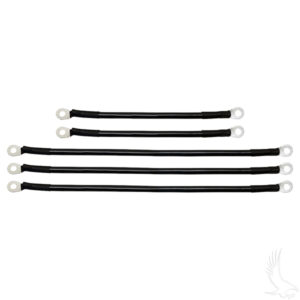
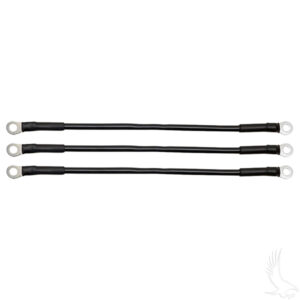
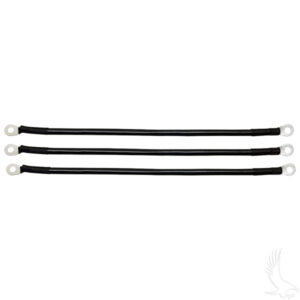
Every battery cable product in our store is a complete cable set — not individual cables. Each set is pre-cut to the exact lengths needed for a specific cart model and includes all the cables required to wire the full battery pack from terminal to terminal.
This matters because battery cable length is not universal. A cable set for an EZGO TXT 48V uses different cable lengths than one for a Yamaha G22 or a Club Car DS. A random cable that is too short puts tension on terminals. One that is too long creates unnecessary resistance from coiling. The model-specific sets in our store are cut to the exact dimensions of each platform — nothing more, nothing less.
Golf Cart Battery Cable Manufacture Brands We Carry:
We carry golf cart battery cable sets from Madjax, NIVEL, and Red Hawk. All three brands manufacture pre-cut, ready-to-install cable sets for major Club Car, EZGO, and Yamaha platforms.
4-Gauge vs. 6-Gauge Golf Cart Battery Cables
This is the most important decision before ordering. Every cable set in our store comes in two gauge options—4 gauge and 6 gauge. Understanding the difference helps you choose the right one for your cart’s battery system.
4 Gauge Golf Cart Battery Cables
4-gauge golf cart battery cables use a thicker copper conductor than 6-gauge. A thicker conductor means lower resistance, higher current capacity, and less heat buildup during heavy use. The 4-gauge option is the better choice for 48V systems, for carts with larger motors, for carts used on hills or rough terrain where higher current draw is common, and for owners who want the highest-performance cable set available.
6 Gauge Golf Cart Battery Cables
6-gauge golf cart battery cables are slightly thinner than 4-gauge and are appropriate for standard 36V systems and carts with standard motors used under normal conditions—flat terrain, light loads, and moderate distances. The 6-gauge sets are more affordable and work correctly for most standard-use golf carts.
Golf Cart Battery Cable Sets by Cart Brand
Club Car Battery Cables
We carry Club Car battery cables for Club Car DS with 12V batteries and Club Car Tempo, Onward, and Precedent with 8V batteries. Each set is pre-cut to the correct cable lengths for those specific configurations.
Club Car cable sets available:
- Battery Cable Set — Club Car DS with 12V Batteries
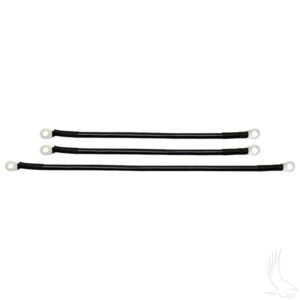
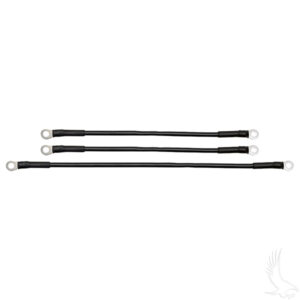
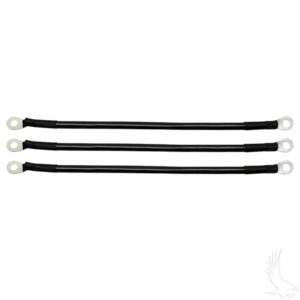
4 gauge, includes three 14-inch cables—$43.99
- Battery Cable Set—Club Car Tempo, Onward, Precedent with 8V Batteries
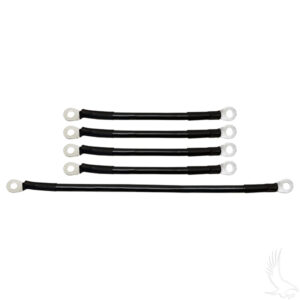
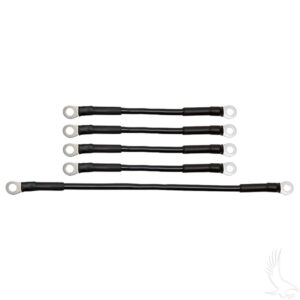
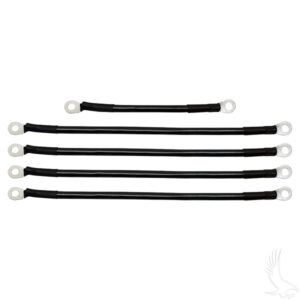
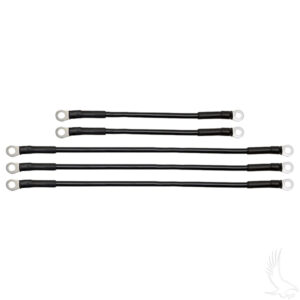
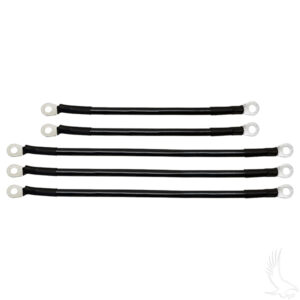
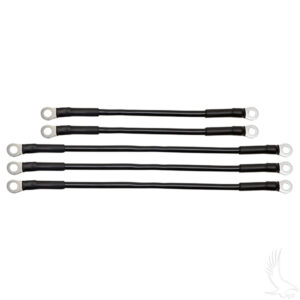
4 gauge, includes two 21-inch, two 12-inch, and one 9-inch cable—$52.99
- Battery Cable Set—Club Car Tempo, Onward, Precedent with 8V Batteries
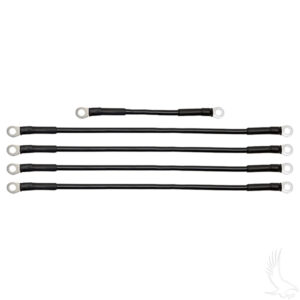
6 gauge, includes two 21-inch, two 12-inch, and one 9-inch cable—$54.99
Club Car Tempo, Onward, and Precedent use six 8V batteries in a 48V setup, so their cable set includes five cables of different lengths. Always confirm whether your Club Car uses 8V or 12V batteries before ordering because cable lengths are different.
EZGO Golf Cart Battery Cables
We carry the most complete range of EZGO golf cart battery cables in our store—covering EZGO Marathon, Medalist, TXT, and RXV in both 36V and 48V configurations.
EZGO cable sets available:
Yamaha Golf Cart Battery Cables
We carry Yamaha golf cart battery cables for Yamaha Drive, Yamaha G14, Yamaha G16, Yamaha G19, and Yamaha G22 platforms.
Yamaha cable sets available:
Golf Cart Battery Cables by Voltage
36V Golf Cart Battery Cables
36V golf cart battery cable sets in our store cover three platforms: EZGO Marathon (1994 and down), EZGO Medalist and TXT (1994 and up), and Yamaha G14 and G16 (36V, 1994 and up). These carts use six 6-volt batteries in series. Golf cart battery cables 36V sets include the correct number and length of cables for each 36V battery tray layout.
48 Volt Golf Cart Battery Cables
48V golf cart battery cable sets in our store cover EZGO TXT 48V, EZGO RXV 2008 and up, Club Car DS with 12V batteries, Club Car Tempo, Onward, and Precedent with 8V batteries, Yamaha G19, Yamaha G22, and Yamaha Drive. Each 48V set includes cables cut to the specific battery tray layout of that platform.
Battery Cable Terminals and Connections
Each cable set comes with pre-installed ring terminals, so the cables can bolt directly to your golf cart battery posts. Good terminal connections matter because loose or corroded ends can create resistance, heat, and power loss.
When replacing battery cables, check the old terminals for corrosion or damage. Always tighten the connectors properly, because loose battery terminals can cause weak power, random cut-outs, and hard-to-find electrical problems.
When to Replace Your Golf Cart Battery Cables
Golf cart battery wires wear out over time from heat, flexing, moisture, and battery acid corrosion. Replace your cable set if you see green or white powder on the terminals, cracked or melted insulation, slow acceleration, or power loss even with fully charged batteries. For best performance, replace old cables when installing new batteries.
Order Your Golf Cart Battery Cables Today
Ready to fix weak power or replace old corroded cables? Order your golf cart battery cable set from Golf Cart Gears and choose the right 4-gauge or 6-gauge option for your Club Car, EZGO, or Yamaha cart.
If you are not sure which cable set fits your model, call 1-888-385-4708 or email support@golfcartgears.com. Our team can help you confirm the right fit before you order.
Why Buy Golf Cart Battery Cables from Golf Cart Gears?
Golf Cart Gears is a trusted American source for golf cart parts and accessories, built to help cart owners find the right repair, replacement, and upgrade products with confidence.
- Trusted American source for golf cart parts and accessories
- Secure checkout with fast USA shipping
- Price Match Guarantee for better buying confidence
- Refund/returns support and fitment help before ordering
FAQs
What gauge should golf cart battery cables be?
Most golf carts use 4-gauge or 6-gauge battery cables. 4 gauge is thicker and is the better choice for 48V systems, carts with larger motors, or carts used on hills and rough terrain. 6 gauge is appropriate for standard 36V systems under normal use conditions. All cable sets in our store are available in both 4-gauge and 6-gauge.
What is the difference between 4 gauge and 6 gauge golf cart battery cables?
4-gauge cables have a thicker copper conductor—lower resistance, higher current capacity, and less heat under load. 6-gauge cables are thinner, less expensive, and appropriate for standard power golf carts. For 48V systems, 4 gauge is the recommended choice. For 36V standard-use carts, 6 gauge is acceptable.
Where can I buy golf cart battery cables near me?
You can buy golf cart battery cables near you online from Golf Cart Gears, a trusted American source for golf cart parts and accessories. We offer model-specific cable sets for Club Car, EZGO, and Yamaha with fast USA shipping and fitment help.
What size wire do I need for 48-volt golf cart batteries?
For a 48-volt golf cart battery system, 4-gauge cable is the recommended size. The higher current demand of a 48V system benefits from the lower resistance of 4-gauge compared to 6-gauge. We carry 48-volt golf cart battery cable sets for EZGO TXT, EZGO RXV, Club Car Tempo, Onward, Precedent, Yamaha G19, G22, and Drive in 4 gauge.
Are golf cart battery cable sets model-specific?
Yes. Cable set lengths are cut to the specific battery tray layout of each cart model. An EZGO TXT 48V cable set uses different lengths than a Yamaha G22 or Club Car DS set. Always confirm your cart’s brand, model, voltage, and battery type before ordering.
How do I know if my golf cart needs new battery cables?
Replace your golf cart battery cables when you see corrosion on the terminal ends, cracked or brittle insulation, or broken strands inside the cable jacket, or when the cart performs poorly despite a full charge. New batteries should always be paired with new cables.
Do lithium golf cart batteries need different cables?
Lithium battery packs deliver higher peak current than standard lead-acid batteries. Most golf cart lithium conversions benefit from 4 gauge or heavier cables to handle the increased current capacity. Contact our team for guidance on cable compatibility when converting to a lithium battery system.
What brands of golf cart battery cables do you carry?
We carry golf cart battery cable sets from MadJax, NIVEL, and Red Hawk, covering Club Car, EZGO, and Yamaha platforms in 4-gauge and 6-gauge.
What is the price of golf cart battery cable sets?
Golf cart battery cable sets in our store range from $28.99 for the EZGO RXV 6-gauge setup to $62.99 for the EZGO TXT 48V 4-gauge set. Most sets are priced between $35.99 and $57.99.
What about 2-gauge golf cart battery cables?
Many customers ask about 2-gauge golf cart battery cables for high-power carts or custom builds. At Golf Cart Gears, we currently carry 4 gauge and 6 gauge golf cart battery cable sets for most standard Club Car, EZGO, and Yamaha carts.
How do you wire golf cart batteries?