
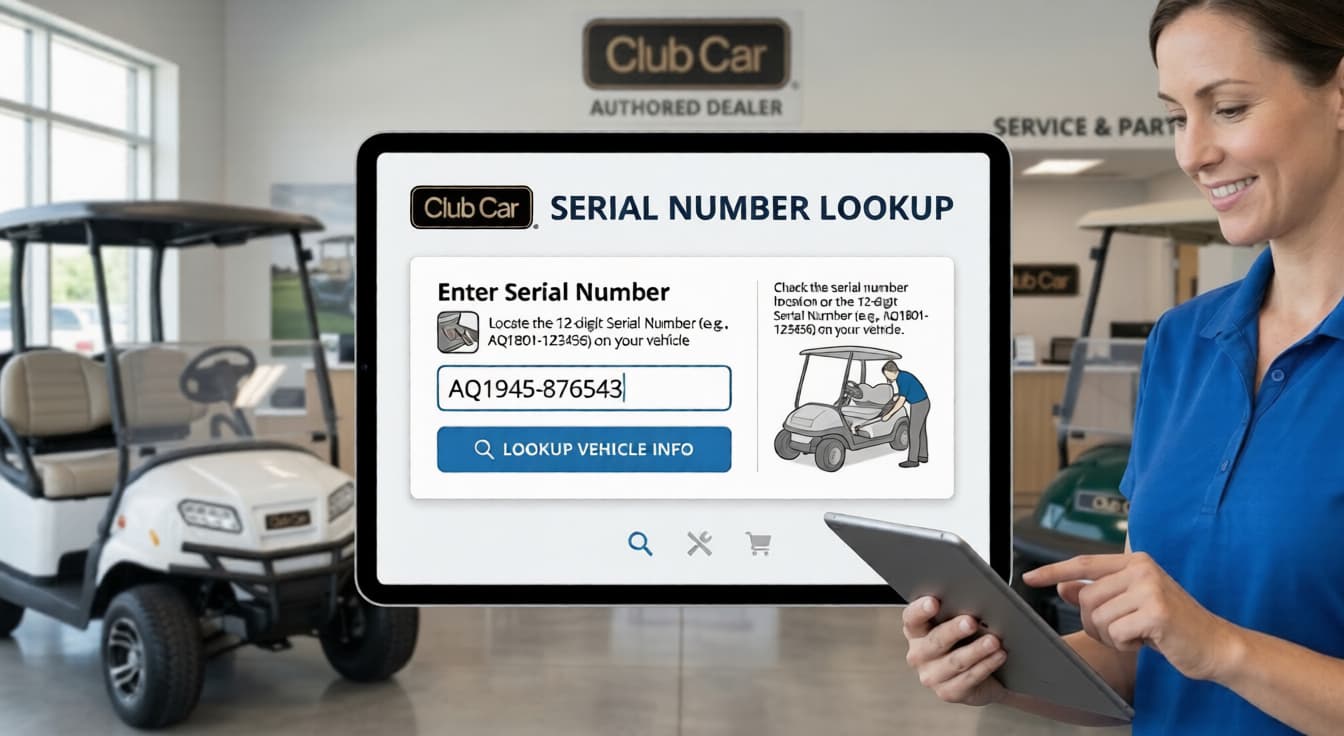
Club Car’s Serial Number Is Easier to Read Than You Think — Once You Know the System
Club Car has been manufacturing golf carts since 1958, and over that time the company has used several different serial number formats across its DS, Precedent, Onward, Carryall, and utility lines. Getting a Club Car serial number wrong — or misidentifying the platform — is one of the costliest mistakes an owner can make when ordering replacement parts.
Here is why this matters more on Club Car than on most other brands. Club Car changed its core vehicle architecture three times in fifty years: the original cassette-style DS platform (1981-present), the Precedent platform (2004-present), and the Onward (2017-present). Body panels, battery systems, OBC charger setups, motors, and controllers are generally not compatible across these platforms even though they look broadly similar to someone buying parts online for the first time.
Club Car also uses one of the most logically structured serial number formats in the industry — once you understand it, you can decode a Club Car serial number in under thirty seconds. This guide will give you that skill, along with the complete reference tables for every Club Car platform from 1975 through the current 2025 model year.
Whether you are ordering batteries, a charger, a solenoid, body panels, or a complete motor — knowing your serial number and understanding what it tells you is the foundation of getting the right part the first time.
| QUICK ANSWERWhere is the Club Car serial number and how do I decode it?Location: On DS models: on the passenger side of the frame, just below the glove box. On Precedent and Onward models: on the passenger-side frame under the seat, near the battery compartment.DS Format (1981–present): A letter followed by four numbers, then a dash, then a six-digit sequence. Example: A8904-123456. The letter = model type. The first two digits after = production year (89 = 1989). Next two digits = production month.Precedent / Onward Format (2004–present): Begins with ‘PH’ or similar two-letter code, followed by year digits. Example: PH1204-654321 = Precedent, 2012 model year, April production. |
Where to Find Your Club Car Serial Number: Complete Location Guide
Club Car has been reasonably consistent with serial number placement compared to some competitors, but the exact location does shift between platforms. Here is where to look on every major platform:
| Platform / Era | Location | What to Look For |
| DS (1981–present) | Passenger-side frame rail, under glove box | A metal plate riveted or welded to the aluminium frame rail on the passenger side, just below the front dash area. May be a stamped plate or a printed sticker depending on year. Look on the vertical face of the frame rail. |
| DS (pre-1981 / early models) | Frame rail, driver side | Earlier DS models used a different mounting location. Check the driver-side frame rail near the front battery compartment if the passenger-side location is blank. |
| Precedent (2004–2016) | Passenger side, under seat, on frame | White or silver sticker mounted on the aluminium frame under the passenger seat, facing upward or toward the front of the cart. Visible when the seat is lifted. Serial format changes from DS — first two characters are letters. |
| Precedent (2017–present) | Under seat frame rail, same as earlier Precedent | Same location as pre-2017. The sticker format is identical. Body styling changes in 2017 do not affect serial number placement. |
| Onward (2017–present) | Passenger side under seat OR passenger door jam area | Onward models introduced a second serial sticker location on the door jam area of the passenger side. Check both locations — the under-seat sticker may be the more legible of the two on older Onward models. |
| Carryall / Utility (all years) | Frame rail, driver side near cargo area | Utility platform carts (Carryall 2, 6, 500, 700 series) retain a frame-stamped or riveted serial plate on the driver-side main frame rail. Also check for an under-seat sticker on newer Carryall models. |
| Villager LSV (all years) | Door jam or under seat — plus VIN plate | Villager LSV models have both a standard Club Car serial number AND a separate federal VIN plate (required for LSV classification). The VIN plate is typically on the driver-side door jam. Both numbers are useful for different purposes. |
| STICKER CONDITION TIP | Club Car uses an aluminium riveted plate on DS models in addition to a printed sticker on newer platforms. The riveted plate is almost always readable even after decades of use — it is the sticker that fades and becomes illegible over time. If the sticker on a newer Precedent or Onward is unreadable, look for a second stamped plate on the frame itself. |
Decoding a Club Car DS Serial Number (1981–Present)
The DS is Club Car’s longest-running platform and the most common Club Car in existence today. The serial number format is consistent and readable once you know the key. Here is the complete decode:
| Position | Character(s) | What It Encodes | Values and Meaning |
| 1 | One letter | Model / Power system | A = Electric DS (most common). G = Gas DS. B = Electric DS variant. J = Electric industrial. See full model code table below. |
| 2–3 | Two digits | Production year (2-digit) | 81 = 1981, 95 = 1995, 08 = 2008. Club Car model years run from January to December (unlike EZGO’s August offset), so year digits correspond directly to calendar year in most cases. |
| 4–5 | Two digits | Production month | 01 = January through 12 = December. Useful for confirming production window and warranty dating. |
| 6 (dash) | Dash separator | Visual separator only | No encoded information. Present in all DS serial numbers from 1981 onwards. |
| 7–12 | Six digits | Production sequence | Individual unit identification within the production run. Used for warranty registration, recall tracking, and manufacturer records. |
A worked example: Serial number A9504-654321 decodes as: A = Electric DS. 95 = production year 1995. 04 = production month April. 654321 = unit sequence number. This is an April 1995 Electric Club Car DS.
A second example: G0308-112233 decodes as: G = Gas DS. 03 = production year 2003. 08 = production month August. 112233 = sequence number. This is an August 2003 Gas Club Car DS.
DS Model Letter Codes (First Character)
| Letter | Platform / Model | Power System | Notes |
| A | DS Electric (standard passenger) | Electric 36V or 48V | Most common Club Car serial prefix. Pre-2000 is typically 36V. Post-2000 is typically 48V. Verify battery count. |
| B | DS Electric (export / special build) | Electric | Less common. Used for some export configurations and special-order variants. Parts compatibility generally matches standard A-series. |
| G | DS Gas | Gas | Gas engine DS. FE290 engine pre-2003. FE350 engine 2003-2008. FE290 twin-cylinder on some years. Check engine tag for definitive identification. |
| H | DS Gas (special configuration) | Gas | H-prefix used for some gas variants and export models. Same general parts compatibility as G-series DS gas. |
| J | DS Electric Industrial | Electric 48V | Industrial or commercial duty electric. Heavier duty motor and controller in some years. Body and chassis match standard DS. |
| K | Villager / LSV Electric | Electric | K-prefix typically denotes Villager family or special LSV configuration. Confirm with year and body style to distinguish from standard DS. |
| M | Carryall / Utility Electric | Electric | Carryall utility platform. Body, cargo bed, and suspension components differ significantly from passenger DS. |
| N | Carryall / Utility Gas | Gas | Gas utility Carryall. Same frame as M-series but engine drivetrain. Very different parts from passenger DS. |
Club Car DS: Year-by-Year Specification and Compatibility Reference (1981–2025)
The DS platform has been in continuous production since 1981 — an extraordinary longevity record. Despite this, it has gone through multiple significant changes in electrical system, motor type, and body design that make year identification critical for parts ordering. This table covers the key compatibility breaks you need to know:
| Year Range | Serial Year Digits | Voltage / Batteries | Motor Type | Charger Type | Key Compatibility Notes |
| 1981–1995 | 81–95 | 36V / 6x6V | DC Series (GE or Prestolite) | Standard 36V auto charger | Classic DS era. Aluminium frame standard throughout. 36V only. PowerDrive 36V charger compatible. Body panels differ from post-1999 restyled DS. |
| 1996–1999 | 96–99 | 36V or 48V (transitional) | DC Series | Standard 36V or 48V auto | Voltage transition years. Some 1996-1997 are still 36V; 1998-1999 increasingly 48V. Body restyled 1999. Verify by counting batteries. Parts compatibility split at 1999. |
| 2000–2003 | 00–03 | 48V / 6x8V | DC Series | PowerDrive Plus 48V | New body style from 2000. Full 48V standardised. PowerDrive Plus OBC introduced. Body panels compatible within this range. OBC version requires matching charger. |
| 2004–2006 | 04–06 | 48V / 6x8V | DC Series | PowerDrive Plus 48V OBC | OBC II system. Improved charger communication. Delta-Q IC650 aftermarket charger recommended. Body panels forward compatible with 2007-2013. |
| 2007–2009 | 07–09 | 48V / 6x8V | DC Series | PowerDrive Plus 3 48V OBC | Significant controller update 2007. PowerDrive Plus 3 charger. Solenoid upgrade. Body compatible with 2004-2013 DS in most areas. |
| 2010–2013 | 10–13 | 48V / 6x8V | DC Series | PowerDrive Plus 3 | Controller update to DCS system. Improved hill performance. Same charger as 2007-2009. Body and electrical components cross-compatible within 2007-2013 range. |
| 2014–2016 | 14–16 | 48V / 6x8V | DC Series | PowerDrive Plus 3 | Updated rear body and dashboard for 2014. Front body compatible with prior generation. Wiring harness updated — may affect aftermarket accessory installation. |
| 2017–2019 | 17–19 | 48V / 6x8V | DC Series | PowerDrive Plus 4 | PowerDrive Plus 4 charger introduced. LED headlights standard. New wiring architecture. Lithium-compatible charger option available. Body updated front and rear. |
| 2020–2022 | 20–22 | 48V / 6x8V or Lithium | DC Series | PD Plus 4 / Smart | Factory lithium pack option introduced. Smart charger with battery chemistry detection. Body styling consistent with 2017-2019. |
| 2023–2025 | 23–25 | 48V / 6x8V or Lithium | DC or AC (select models) | Smart Charger | AC motor option available on higher trim DS variants. Smart charger standard. OTA connectivity on premium models. Most current DS generation. |
Decoding a Club Car Precedent Serial Number (2004–Present)
The Precedent was Club Car’s major platform refresh launched in 2004, and it remains in production today alongside the Onward. The serial number format changed from the DS’s single-letter prefix to a two-letter prefix system, making platform identification easier — but also creating new confusion for owners who search for DS parts and receive Precedent-spec components that look identical but are not.
| Position | Character(s) | What It Encodes | Values and Meaning |
| 1–2 | Two letters | Platform and power system | PH = Precedent Electric (most common). PG = Precedent Gas. See platform code table below for full list. |
| 3–4 | Two digits | Production year (2-digit) | 04 = 2004, 10 = 2010, 20 = 2020. Club Car model years are calendar-year aligned — a cart showing 14 was built in 2014. |
| 5–6 | Two digits | Production month | 01 = January through 12 = December. |
| 7 (dash) | Dash separator | Visual separator | No encoded information — present on all Precedent serial numbers. |
| 8–13 | Six digits | Production sequence | Unit identification within the production run. |
A worked example: PH1206-789012 decodes as: PH = Precedent Electric. 12 = production year 2012. 06 = June. 789012 = sequence number. This is a June 2012 Club Car Precedent electric golf cart.
A second example: PG0809-334455 decodes as: PG = Precedent Gas. 08 = production year 2008. 09 = September. 334455 = sequence number. This is a September 2008 Precedent gas cart.
Club Car Precedent: Year-by-Year Specification Reference (2004–2025)
The Precedent is Club Car’s premium passenger platform, featuring a more advanced OBC system, improved suspension, and enhanced styling over the DS. The OBC charging system is particularly important — it communicates directly with the battery pack, and using the wrong charger or switching to lithium without the correct OBC bypass module is a frequent and expensive mistake.
| Year Range | Serial Year Digits | Battery System | OBC Version | Charger Type | Key Notes |
| 2004–2006 | 04–06 | 48V / 6x8V | OBC Gen 1 | PowerDrive Plus 2 | First Precedent generation. New body style over DS. OBC Gen 1 communicates at 200Hz. Rear suspension redesigned vs DS. Front cowl unique to Precedent. |
| 2007–2009 | 07–09 | 48V / 6x8V | OBC Gen 2 | PowerDrive Plus 3 | OBC Gen 2 with improved fault tolerance. Charger upgraded to PowerDrive Plus 3. Solenoid rating increased. Body panels same as 2004-2006. |
| 2010–2013 | 10–13 | 48V / 6x8V | OBC Gen 3 (Flash upgradeable) | PowerDrive Plus 3 | OBC now flash-upgradeable via dealer tool. DCS controller update. Body restyled 2012 (new front cowl — not backward compatible with 2004-2011 front body). |
| 2014–2016 | 14–16 | 48V / 6x8V | OBC Gen 4 | PowerDrive Plus 3 | Comfort package standard on higher trims. LED headlights optional. OBC Gen 4 with improved lithium compatibility pathway. Most Precedent parts available for this era. |
| 2017–2019 | 17–19 | 48V / 6x8V | OBC Gen 5 | PowerDrive Plus 4 | OBC Gen 5 with lithium bypass protocol built in. Factory lithium pack available. PowerDrive Plus 4 charger. Bluetooth diagnostics option introduced. |
| 2020–2022 | 20–22 | 48V / 6x8V or Lithium | OBC Gen 5+ | Smart Charger | Current body style. Factory Lithium (Club Car IntelliGrip) pack standard on premium trim. Smart charger auto-detects chemistry. USB and 12V outlets standard. |
| 2023–2025 | 23–25 | Lithium std or 6x8V FLA | OBC Gen 6 | Smart Charger 2 | Most current Precedent generation. OBC Gen 6 with OTA update capability. AC motor option on select variants. Widest lithium pack compatibility. |
| CRITICAL FOR LITHIUM BUYERS | Every Club Car Precedent equipped with OBC requires an OBC bypass module when switching to a lithium battery pack. The OBC sends a handshake signal to the battery pack during charging — if the OBC does not receive the correct response from a lithium pack, it will not initiate charging. Most quality lithium conversion kits for Precedent include this module. If yours did not come with one, it is a required add-on, not an optional upgrade. Golf Cart Gears stocks OBC bypass modules for all Precedent generations. |
Club Car Onward: Serial Number and Specification Guide (2017–Present)
The Onward is Club Car’s current flagship passenger cart, launched in 2017 as the premium evolution of the Precedent platform. It features a more consumer-oriented design with greater customisation options, a higher-quality interior, and the most advanced OBC and charging system Club Car has ever produced. It is also the most lithium-friendly Club Car from the factory.
| Serial Prefix | Platform | Power | Notes |
| OH | Onward 2-Passenger Electric | Electric 48V | Most common Onward configuration. 48V AC or DC depending on year and trim. OBC Gen 5-6. Full lithium pack compatibility from launch. |
| OG | Onward 2-Passenger Gas | Gas | Gas Onward. EFI engine standard. Larger body option available. Different drivetrain parts from electric — do not cross-order. |
| OF | Onward 4-Passenger Electric | Electric 48V | Extended body for 4-passenger seating. Body panels not compatible with 2-passenger Onward or any Precedent or DS. |
| OL | Onward Lifted Electric | Electric 48V | Factory-lifted Onward. Suspension components, wheel arches, and control arms specific to lifted configuration. Parts not compatible with standard-height Onward. |
| VH | Villager 4 / 6 Electric (LSV) | Electric LSV | LSV-certified multi-passenger. VIN-assigned. Seat belts, full lighting, windshield standard. Insurance and registration required. Parts are Onward-derived. |
| Year Range | Serial Year | Battery | Motor Type | OBC / Charger | Notes |
| 2017–2018 | 17–18 | 48V / 6x8V | DC Series | OBC Gen 5 / PD+4 | Launch generation Onward. New body style, premium interior, wider colour options. OBC Gen 5 — same as late Precedent for charger compatibility. |
| 2019–2021 | 19–21 | 48V / 6x8V or Lithium | DC / AC option | OBC Gen 5+ / Smart | AC motor option introduced on premium trim. Factory lithium pack available. Smart charger auto-detects battery chemistry. Colour-matched trim packages. |
| 2022–2025 | 22–25 | Lithium std or FLA | AC (std) or DC | OBC Gen 6 / Smart 2 | Current generation. AC motor standard on electric. Lithium standard on higher trims. OBC Gen 6 with OTA updates. Club Car IntelliGrip Lithium fully integrated. |
DS vs Precedent vs Onward: Parts Compatibility Matrix
This is the table that prevents the most expensive ordering mistakes. Many Club Car parts look visually similar across platforms but are not interchangeable. Use this matrix before ordering any component:
| Component | DS Compatible | Precedent Compatible | Onward Compatible | Notes |
| 48V Battery Pack | Yes (6x8V) | Yes (6x8V) | Yes (6x8V or Lithium) | All share same 48V 6x8V layout. Physical battery size may vary — verify tray fit. |
| OBC / Charger System | No OBC (standard auto charger) | OBC Gen 1-6 (OBC-specific charger required) | OBC Gen 5-6 (Smart Charger) | Critical incompatibility. Never use a Precedent OBC charger on a DS without OBC. |
| Solenoid | DS 48V solenoid | Precedent 48V solenoid | Onward 48V solenoid | NOT interchangeable between platforms. Current thresholds differ. Order by platform and year. |
| Motor Controller | DS DCS / Alltrax | Precedent DCS / IQ | Onward IQ / AC | NOT interchangeable. Each platform’s controller is calibrated for its specific motor and voltage system. |
| Body Panels (Front) | DS-specific (1981–2025) | Precedent-specific (per generation) | Onward-specific | Body panels do NOT cross between platforms. Also check generation within each platform — major restyling creates further splits. |
| Seats (standard) | DS seats | Precedent seats (wider base) | Onward seats (premium bolster) | Seat frames are platform-specific. Seat cushions and covers can sometimes transfer with bracket adapters. |
| Windshield | DS fold-down or fixed | Precedent fold-down or fixed | Onward fixed or panoramic | Platform-specific mounting. Precedent windshield mounting changed with 2012 body restyle. Verify generation within Precedent. |
| Lift Kit | DS-specific (3″ or 4″ kits) | Precedent-specific | Onward-specific or factory-lifted | Lift kits are platform-specific and year-specific. Do not order a DS lift kit for a Precedent. |
| Wheels / Tires (hub pattern) | 4×4 hub (standard) | 4×4 hub (standard) | 4×4 hub (standard) | All three platforms share the 4×4 bolt pattern — wheels are the most freely interchangeable component across Club Car platforms. |
Using Your Club Car Serial Number to Order Parts Confidently
Now that you can decode the serial number, here is the fastest practical path from serial number to correct parts order for the three most commonly purchased components.
Batteries — Club Car 48V Pack Replacement
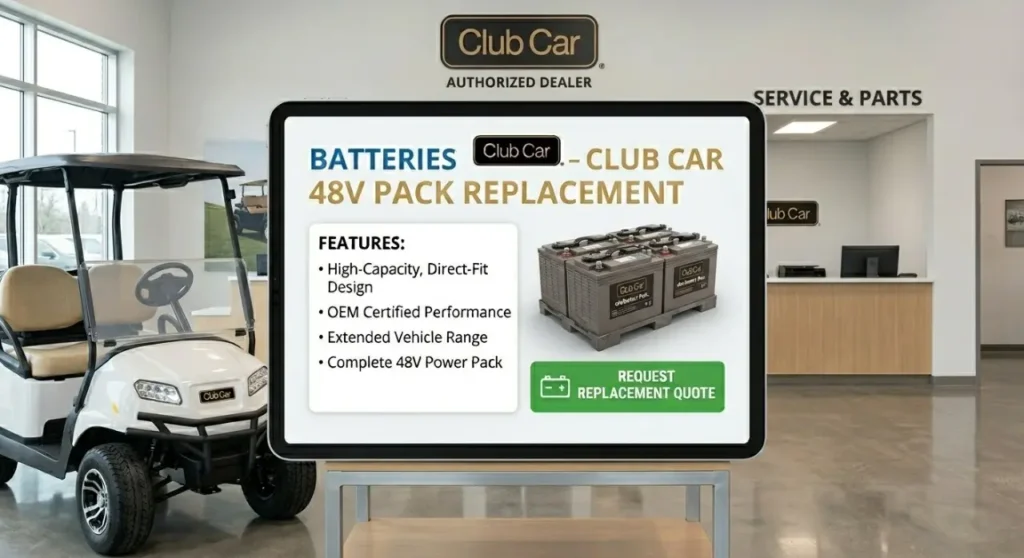
All modern Club Car DS, Precedent, and Onward electric carts use a 48-volt system built from six 8-volt batteries (6x8V). The battery configuration has been standardised across these platforms since the late 1990s, which means battery selection is the same regardless of whether you have a DS or a Precedent for post-1999 carts.
The primary battery choice is Trojan T-875 (the industry benchmark for Club Car 48V), US Battery US8VGC (slightly higher rated capacity at 170Ah vs Trojan’s 165Ah), or a lithium conversion pack from Dakota Lithium or Eco Battery. If your DS was built before 1998, verify whether it is 36V (six 6V batteries) before ordering a 48V battery set.
For any Club Car Precedent receiving a lithium conversion: confirm you have an OBC bypass module before the batteries arrive. The OBC bypass must be installed before the lithium pack is connected for the first time, not retrofitted afterward. This is the single most commonly skipped step in Club Car lithium conversions and the one that generates the most post-installation support calls.
Chargers — Matching OBC Generation
Club Car DS models without OBC (typically pre-2000) use standard 48V automatic chargers. The Delta-Q IC650 and Lester Summit II are both excellent aftermarket upgrades for non-OBC DS carts.
Club Car DS models with OBC (2000 onwards) and all Precedent models require a charger with Club Car OBC communication protocol. The Club Car PowerDrive Plus 3 and PowerDrive Plus 4 are the OEM options. The Delta-Q IC650 with the Club Car algorithm selected is the recommended high-quality aftermarket alternative and provides improved charging profiles over the OEM charger on most platforms.
Onward models with Smart Charger compatibility should use the Club Car Smart Charger or the Lester Summit II with the appropriate Club Car Onward profile selected. For Onward models with factory lithium packs, use only the Club Car IntelliGrip charger or an aftermarket equivalent specifically approved for the IntelliGrip chemistry.
Solenoids — Why Platform and Year Both Matter
Club Car solenoids are a model-and-year specific item far more than most buyers realise. The DS and Precedent use different solenoid mounting configurations, different coil voltage ratings, and different contact current ratings that were updated across generations. Using a solenoid from the wrong generation causes either immediate failure (if the current rating is too low) or controller communication faults (if the coil voltage is wrong).
When ordering a solenoid from GolfCartGears.com, always enter both the serial year digits and the platform prefix (A = DS electric, PH = Precedent electric, OH = Onward electric) to ensure the correct generation is selected. A solenoid that physically fits but is rated for a different current threshold is the definition of a part that looks right and fails within six months.
| E-E-A-T NOTE | GolfCartGears.com stocks parts for every Club Car platform from 1981 through the current 2025 model year. Our parts catalogue is cross-referenced by serial number prefix and year, and every listing displays the specific serial year range the part fits. Our toll-free team verifies serial compatibility on every electrical component order before it ships. |
The Most Common Club Car Serial Number Mistakes We See
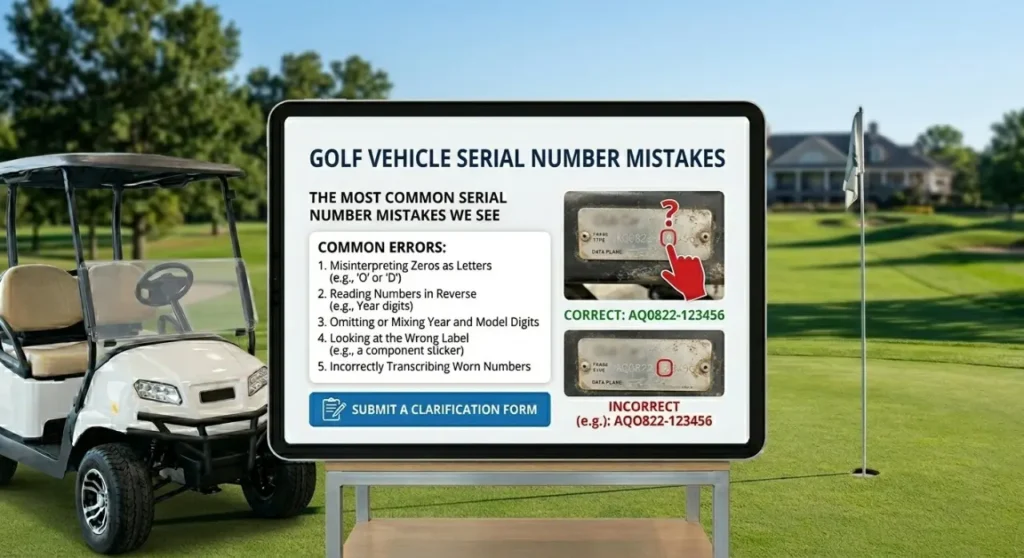
After years of helping Club Car owners with parts orders and lithium conversions, three mistakes dominate the call patterns on our support line.
The first is ordering DS parts for a Precedent, or vice versa, based on what the previous owner said the cart was. The DS and Precedent share Club Car branding and a similar general layout, but their body panels, solenoids, controllers, and OBC systems are not compatible. The two-letter serial prefix (A versus PH) solves this entirely — read the first two characters before you order anything.
The second is attempting a lithium conversion on a Precedent without verifying OBC compatibility. The Precedent OBC is designed to communicate with a lead-acid battery pack and will refuse to charge a lithium pack without the bypass module installed. This is a $80-$120 part that turns a $0 problem into a $0 problem, and skipping it turns a $2,500 lithium investment into a cart that sits uncharged in the garage while the owner troubleshoots.
The third is buying parts from a listing that says ‘fits all years’ on a year-sensitive component like a solenoid, charger, or controller. No solenoid fits all years of Club Car. No charger fits all Club Car models and OBC generations. If a listing says ‘fits all years,’ the seller does not understand Club Car’s platform evolution, and you should find a specialist supplier who does.
Frequently Asked Questions
Where is the serial number on a Club Car DS golf cart?
On the Club Car DS, the serial number is on a metal plate or sticker on the passenger-side frame rail, visible below the glove box area on the front right of the cart. It is typically a riveted aluminium plate on older models and a printed sticker on newer ones. If the sticker is unreadable, look for a stamped number on the frame metal itself.
How do I find the year of my Club Car from the serial number?
On Club Car DS models, the second and third characters of the serial number are the two-digit production year. A serial beginning with A9504 was produced in 1995. On Precedent and Onward models, the third and fourth characters are the production year — PH1206 was produced in 2012.
What is the difference between a Club Car DS and a Precedent by serial number?
DS serial numbers begin with a single letter (most commonly A for electric or G for gas). Precedent serial numbers begin with two letters (PH for electric, PG for gas). This is the fastest way to identify which platform you have without needing to look at body styling.
Does my Club Car Precedent need an OBC bypass for a lithium battery conversion?
Yes. All Club Car Precedent models with OBC require an OBC bypass module when installing a lithium battery pack. The OBC communicates with the battery pack during charging and will not initiate a charge cycle if it does not receive the expected response from a lead-acid pack. The bypass module intercepts this communication and allows the charger to proceed normally. This module must be installed before the lithium pack is connected.
My Club Car serial number starts with M. What model is it?
An M-prefix serial number indicates a Carryall utility model — Club Car’s commercial and cargo-use platform. Carryall models share the same aluminium frame philosophy as DS passenger carts but have a cargo bed, different suspension calibration, and utility-specific body panels. Most electrical components (motor, controller, battery voltage) are shared with contemporary DS passenger models of the same year.
Can I use a Precedent charger on a DS?
Only if the DS has an OBC installed. A Precedent OBC-specific charger sent to a DS without OBC will likely not initiate charging at all, since it is looking for the OBC handshake signal and not receiving it. A DS without OBC needs a standard 48V automatic charger — Club Car PowerDrive or a compatible aftermarket unit — not a Precedent OBC charger.
How do I tell if my Club Car is 36V or 48V from the serial number?
Club Car serial numbers do not directly encode voltage in the letter prefix — both 36V and 48V DS models use the A prefix. The most reliable method is to count the batteries: six 6V batteries = 36V, six 8V batteries = 48V. As a general guide, DS carts produced before approximately 1997-1998 are most likely 36V. Post-1999 DS and all Precedent and Onward models are 48V.
Where can I look up Club Car parts by serial number?
GolfCartGears.com allows filtering by Club Car platform (DS, Precedent, Onward) and production year derived from your serial number. Every electrical component listing specifies the exact serial year range it is compatible with. Our toll-free support team also provides serial number verification for any order where there is any doubt about compatibility.
The Practical Takeaway
Club Car’s serial number format is one of the cleanest in the golf cart industry — once you know that the first character (or two characters on Precedent and Onward) tells you the platform, and that characters two through five tell you the year and month, you can decode any Club Car serial in thirty seconds.
The three practical facts to extract from your serial number before any parts purchase: which platform (DS, Precedent, or Onward), which production year, and whether the cart has an OBC system (any Precedent does; DS models from 2000 onwards typically do). Those three data points determine compatibility for batteries, chargers, solenoids, and controllers — the four components that generate the most wrong-order returns in the golf cart parts market.
Use the tables in this guide to decode your serial number, confirm your platform generation, and order with confidence. If you are ever uncertain about compatibility for a specific component, GolfCartGears.com’s toll-free support team cross-references serial numbers against our catalogue before any order ships.