
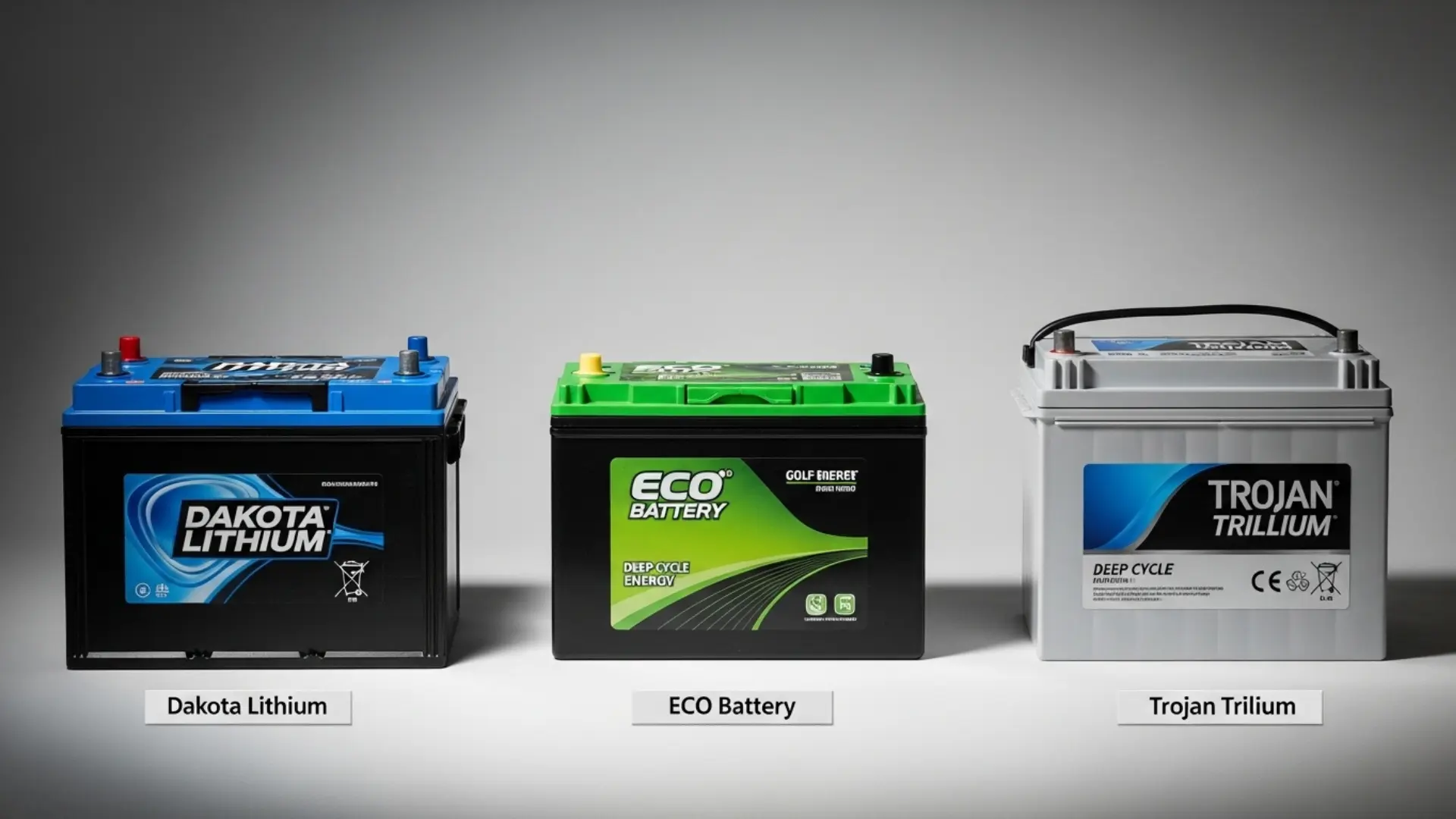
The Lithium Market Grew Up — But Most Comparison Guides Did Not
The golf cart lithium battery market in 2025 looks nothing like it did in 2018. What was once a fringe upgrade favoured by tech-forward early adopters has become the mainstream choice for anyone planning to keep their cart for more than five years. Dakota Lithium, Eco Battery, and Trojan Trillium have emerged as the three most serious players in the golf cart LiFePO4 segment — and yet almost every comparison guide that mentions all three manages to treat them as interchangeable alternatives that differ only in price.
They are not interchangeable. The BMS architecture, the cell chemistry sourcing, the charger compatibility approach, the cold-weather management strategy, the warranty terms, and the practical installation experience differ meaningfully between these three brands. Making the right choice requires understanding those differences — not just looking at the sticker price and the amp-hour number.
This guide is designed specifically to be the comparison resource that does not exist anywhere else. We cover the engineering differences between these three packs with the same technical depth we bring to our flooded lead-acid comparisons. We examine the BMS capabilities that actually determine long-term performance. We compare warranty terms with the same contractual rigour a lawyer would apply. And we give you an honest buyer’s guide section that tells you which brand fits which type of owner, not which brand we sell the most of.
By the end, you will have everything you need to make a confident decision that accounts for your specific cart platform, your charger situation, your usage patterns, and your budget horizon.
Table of Contents
| QUICK ANSWER Dakota Lithium vs Eco Battery vs Trojan Trillium — which should you buy?Dakota Lithium: Best for cold-climate owners and buyers who prioritise warranty length above everything else. Industry-leading 11-year warranty. Best cold-weather LiFePO4 performance. Drop-in compatible across all major platforms.Eco Battery: Best for buyers who want the most golf-cart-specific LiFePO4 engineering, built-in Bluetooth SOC monitoring, and the smoothest OEM charger integration on Club Car and EZGO platforms. Purpose-built for golf carts from the ground up.Trojan Trillium: Best for buyers who want the Trojan brand reputation behind their lithium investment and value the widest dealer service network in the golf cart industry. Premium price, premium brand confidence. Ideal for fleet operators already in the Trojan ecosystem. |
LiFePO4 Chemistry: Why It Is the Right Lithium for Golf Carts
Before comparing brands, it is worth establishing why lithium iron phosphate specifically — and not other lithium chemistries — is the right technology for golf cart battery packs. This matters because the word ‘lithium’ covers a family of chemistries with very different safety and performance profiles, and some battery marketing conflates them in ways that create confusion.
Lithium cobalt oxide (LCO), lithium manganese oxide (LMO), and lithium nickel manganese cobalt oxide (NMC) are the chemistries behind laptop batteries, power tools, and early electric vehicle packs. These chemistries offer high energy density — a lot of stored energy per kilogram — but they are thermally unstable under overcharge, physical damage, or high temperatures. Thermal runaway, the self-sustaining exothermic reaction that causes lithium battery fires, is a genuine risk in these chemistries under fault conditions.
Lithium iron phosphate (LiFePO4) is fundamentally different at the molecular level. The phosphate chemical bond in the cathode material requires significantly more activation energy to break down than the oxide bonds in LCO or NMC chemistries. Under overcharge, high temperature, or physical damage conditions that would trigger thermal runaway in other lithium chemistries, LiFePO4 cells degrade gracefully rather than catastrophically. They do not produce the self-sustaining fire reaction. This is not a marketing distinction — it is a documented electrochemical property that makes LiFePO4 the correct and only responsible choice for a battery pack that sits under the seat of a golf cart carrying family members.
The tradeoff is energy density: LiFePO4 stores slightly less energy per kilogram than NMC. For golf cart applications where the battery tray has physical space constraints but absolute weight minimisation is not the primary design goal, this tradeoff is completely acceptable. The safety and longevity advantages of LiFePO4 vastly outweigh the modest energy density disadvantage for this application.
All three brands in this comparison — Dakota Lithium, Eco Battery, and Trojan Trillium — use LiFePO4 chemistry exclusively for their golf cart products. Any supplier offering a golf cart lithium battery built on NMC or other high-energy-density chemistry should be treated with significant caution.
The Three Brands: Who They Are and What They Stand For
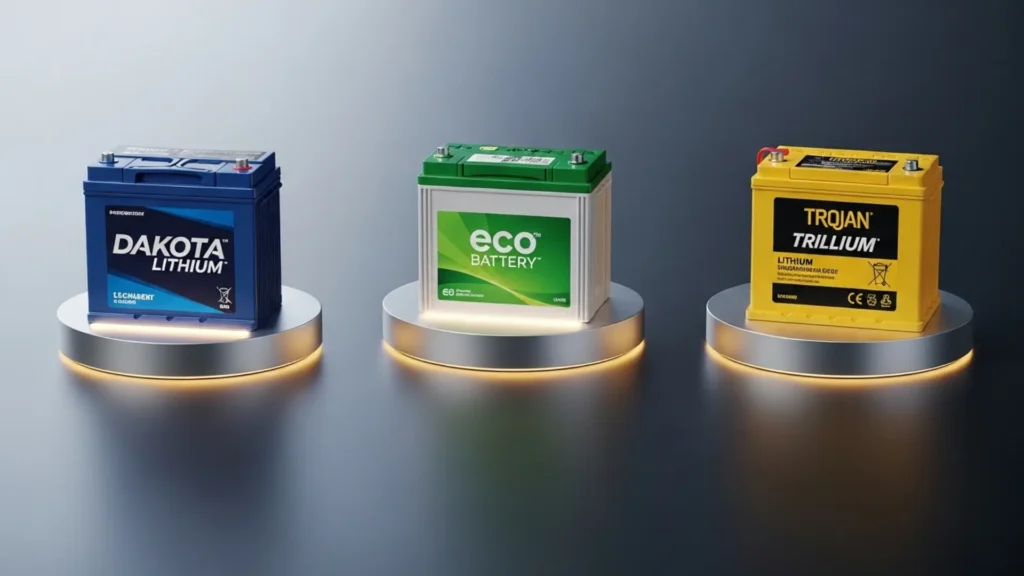
Dakota Lithium: The Warranty and Cold-Weather Specialist
Dakota Lithium was founded in 2016 with a focus on producing LiFePO4 batteries for demanding outdoor applications — fishing, hunting, camping, and marine use — where cold-weather performance and extended warranty coverage matter more than any other specification. The company applied this same engineering philosophy to the golf cart market and has built a strong reputation specifically around two differentiators: cold-weather capability and warranty length.
The 11-year warranty on Dakota Lithium’s golf cart products is the longest offered by any major lithium battery brand in this category. This is not a marketing number that is immediately undermined by fine print — the warranty genuinely covers manufacturing defects in materials and workmanship for 11 years, with a prorated replacement policy that provides meaningful coverage throughout the warranty period. For a product designed to outlast its warranty in most use cases, this level of coverage reflects genuine manufacturing confidence.
Dakota Lithium’s cold-weather engineering focuses on the BMS thermal management system. The company has invested specifically in low-temperature charge inhibit algorithms that are more finely calibrated than competitors — allowing charging at slightly lower temperatures before cutoff activates, and managing cell temperatures more aggressively during cold-weather discharge to maintain capacity. For owners in northern states or mountain communities where winter temperatures regularly approach or fall below freezing, this engineering matters.
The company sources cells from reputable manufacturers including EVE Energy and CATL, with quality control processes that verify cell-level specifications before pack assembly. Dakota Lithium is not manufacturing cells — no golf cart battery brand does — but their cell sourcing and quality verification processes are among the more transparent in the market.
Eco Battery: The Golf Cart Specialist
Eco Battery was purpose-built for the golf cart market from day one, and it shows in the product design in ways that matter practically. While Dakota Lithium and Trojan Trillium adapted their LiFePO4 technology from adjacent markets (outdoor/marine and industrial respectively), Eco Battery’s engineering team started with the specific requirements of golf cart electrical systems and designed backward from those requirements.
The practical result of this golf-cart-first design philosophy is visible in two areas. First, the BMS in Eco Battery’s B-Plus series is calibrated specifically for the voltage and current profiles of golf cart motor systems, OBC communication protocols, and charger handshake requirements. The result is the most seamless OEM charger integration in the market — Eco Battery packs work with Club Car’s PowerDrive OBC system and EZGO’s Powerwise OBC system with fewer compatibility issues than either Dakota Lithium or Trojan Trillium packs, particularly on pre-2018 carts where OBC communication is more demanding.
Second, Eco Battery’s B-Plus series includes built-in Bluetooth connectivity as standard equipment, not an add-on. The accompanying smartphone app provides real-time state of charge as a percentage, individual cell voltage monitoring, temperature data, cycle count, and fault history — all accessible from the driver’s seat without any additional hardware. For owners who want visibility into their battery system without any technical complexity, this is genuinely useful daily functionality that neither Dakota Lithium nor Trojan Trillium match at the same level of accessibility.
Eco Battery also offers a lithium conversion kit service — working with dealers to provide complete conversion packages that include not just the battery but the charger profile, OBC bypass module (where needed), and installation guidance for specific cart platforms. This turnkey approach reduces the compatibility uncertainty that causes the most post-purchase problems in lithium conversions.
Trojan Trillium: The Premium Brand Play
Trojan Trillium is Trojan Battery Company’s entry into the golf cart LiFePO4 market, launched to capture buyers in the premium segment who want the confidence of the most trusted name in golf cart batteries behind their lithium investment. The Trillium packs use LiFePO4 cells from verified tier-one suppliers with Trojan’s quality control processes applied to final pack assembly and testing.
The Trillium’s strongest differentiator is not a specific engineering feature — it is the Trojan dealer network. Trojan has the widest and most established authorised dealer and service network in the golf cart battery market. For a fleet operator or commercial buyer who needs a battery product backed by a service organisation with global reach, the Trojan ecosystem is the most mature option available. When something goes wrong with a Trojan product anywhere in North America, there is almost certainly an authorised service provider within a reasonable distance.
The Trillium pack is also engineered to slot into Trojan’s existing commercial service infrastructure — which means technicians who have been trained on Trojan’s lead-acid products can service and troubleshoot Trillium packs with minimal additional training. For large fleet operators transitioning from flooded lead-acid to lithium, this compatibility with existing service relationships is a genuine practical advantage.
The weakness of the Trillium offering is price. It is the most expensive option in this comparison at $2,500-$3,500 for a 48V pack, and the engineering justification for that premium over Dakota Lithium and Eco Battery is primarily the brand and service network rather than a meaningfully superior technical specification. For the right buyer, that premium is justified. For the residential owner without commercial service requirements, it is harder to defend.
BMS Engineering: The Invisible Differentiator That Matters Most
The Battery Management System is the electronic brain of every lithium golf cart pack. It determines what happens to the cells under every possible operating condition — overcharge, over-discharge, high temperature, low temperature, high current draw, cell imbalance. The quality of the BMS is arguably the most important differentiator between lithium battery products, and it is the least visible one in marketing materials.
Every BMS performs the same basic functions: cell voltage monitoring, temperature monitoring, current monitoring, charge cutoff, discharge cutoff, and cell balancing. The differences between BMS implementations lie in how precisely these functions are performed, how the BMS responds to fault conditions, how it communicates with the charger and cart systems, and how it protects cells under the specific stress conditions that golf cart use creates.
| BMS Feature | Dakota Lithium | Eco Battery B-Plus | Trojan Trillium |
| Cell monitoring granularity | Individual cell voltage monitoring, ±10mV accuracy | Individual cell voltage monitoring, ±5mV accuracy | Individual cell voltage monitoring, ±10mV accuracy |
| Temperature sensors | 2 sensors per pack | 4 sensors per pack (higher spatial coverage) | 2 sensors per pack |
| Low-temp charge cutoff | 32°F (0°C) — industry standard cutoff | 32°F (0°C) — same cutoff | 32°F (0°C) — same cutoff |
| Cold-weather discharge performance | Best in class — optimised for cold cycling | Standard LiFePO4 cold performance | Standard LiFePO4 cold performance |
| Cell balancing type | Passive balancing | Active balancing — more efficient | Passive balancing |
| OBC communication | Compatible with bypass module | Native OBC protocol integration — fewest compatibility issues | Compatible with Trojan OBC module |
| Bluetooth monitoring | Optional Bluetooth module (add-on cost) | Standard — built into B-Plus series | Available on Trillium Pro variant |
| Fault history logging | Limited fault logging | Full fault history accessible via app | Accessible via Trojan service tool |
| State of charge accuracy | ±5% SOC accuracy | ±3% SOC accuracy via Bluetooth app | ±5% SOC accuracy |
| Over-discharge recovery | Standard recovery after connection to charger | Guided recovery with app instructions | Standard recovery via Trojan charger |
The BMS comparison reveals a clear pattern: Eco Battery’s B-Plus series leads on monitoring precision and smart features, Dakota Lithium leads specifically on cold-weather management, and Trojan Trillium matches the technical baseline of Dakota Lithium with the addition of Trojan’s service infrastructure. For most residential buyers, Eco Battery’s active cell balancing and Bluetooth integration represent a meaningful quality-of-ownership advantage. For cold-climate buyers, Dakota Lithium’s cold-weather BMS optimisation is the specific differentiator worth paying attention to.
| BMS NOTE | Active cell balancing — used by Eco Battery — continuously transfers charge between cells to maintain uniform voltage across the pack during both charging and discharging. Passive balancing — used by Dakota Lithium and Trojan Trillium — dissipates excess charge from higher cells as heat during the absorption phase of charging. Over a 10-year service life, active balancing maintains more consistent cell-to-cell performance, which contributes to better capacity retention in the later years of the pack’s life. |
Complete Specification Comparison: The Numbers Side by Side
| Specification | Dakota Lithium 48V 60Ah | Eco Battery B-Plus 48V | Trojan Trillium 48V |
| Nominal Voltage | 48V | 48V | 48V |
| Capacity (Ah) | 60 Ah | 56 Ah – 105 Ah (multiple models) | 56 Ah – 100 Ah (multiple models) |
| Usable Energy (kWh) | 2.88 kWh | 2.69 – 5.04 kWh | 2.69 – 4.80 kWh |
| Peak Discharge Current | 100A continuous 200A peak | 200A continuous 400A peak | 150A continuous 300A peak |
| Weight (48V pack) | 28 – 32 lbs | 38 – 62 lbs (varies by Ah) | 42 – 65 lbs (varies by Ah) |
| Charge Temperature Range | 32°F – 122°F (0°C – 50°C) | 32°F – 122°F (0°C – 50°C) | 32°F – 113°F (0°C – 45°C) |
| Discharge Temperature Range | -4°F – 140°F (-20°C – 60°C) | 14°F – 140°F (-10°C – 60°C) | 14°F – 140°F (-10°C – 60°C) |
| Rated Cycle Life | 2,000+ cycles at 80% DoD | 3,000+ cycles at 80% DoD | 2,000+ cycles at 80% DoD |
| Warranty | 11 years | 5 years | 3 years |
| Retail Price (48V) | $1,800 – $2,500 | $2,100 – $3,200 | $2,500 – $3,500 |
| Bluetooth / App | Optional add-on | Standard on B-Plus | Available on Pro |
| Drop-in compatibility | Club Car, EZGO, Yamaha | Club Car, EZGO, Yamaha | Club Car, EZGO, Yamaha |
Several figures in this table deserve direct commentary. Dakota Lithium’s discharge temperature floor of -4°F (-20°C) is genuinely better than Eco Battery and Trojan Trillium’s -14°F floor — a meaningful advantage for cold-climate owners. Eco Battery’s 3,000+ rated cycle life is higher than both competitors at 2,000+, which contributes to its long-term cost efficiency. And Dakota Lithium’s lower weight (28-32 lbs for the 48V pack versus 38-65 lbs for comparable Eco Battery and Trillium packs) is a real physical difference — Dakota achieves this partly through higher cell energy density and partly through a smaller enclosure design that is compact but less protected than the heavier enclosures competitors use.
The warranty comparison is stark: 11 years versus 5 years versus 3 years. This is not a minor difference in paper terms. It is also worth noting that the longer warranty window disproportionately benefits buyers in the statistical tail of early failures — the kind of rare manufacturing defect that might not manifest until year three or four of service. Dakota Lithium’s 11-year window means those buyers are fully covered. Trojan Trillium’s 3-year window leaves a long unwarranted period during which the pack may still have many years of useful life.
Charger Compatibility: The Most Critical Pre-Purchase Check

Charger compatibility is the issue that generates the most post-installation support calls in the lithium golf cart battery market, and it is the factor most buyers research least thoroughly before purchase. Every lithium pack in this comparison requires a charger that outputs a LiFePO4-compatible charge profile — but the specific compatibility requirements differ between brands and between cart platforms.
The LiFePO4 Charge Profile Requirement
A LiFePO4 battery pack requires a Constant Current / Constant Voltage (CC/CV) charge profile with a specific absorption cutoff voltage. For a 48V pack, this is typically 58.4V. The charger must not use the float charging stage that is standard in lead-acid chargers — LiFePO4 cells do not benefit from float charging and some BMS systems interpret the float voltage as an overcharge condition, repeatedly disconnecting and reconnecting. The result looks like a faulty charger or battery when it is actually a protocol mismatch.
Beyond the charge profile, OBC-equipped carts add a communication layer. The OBC sends a handshake signal that the charger must respond to before charging initiates. Lithium packs do not respond to this signal the same way lead-acid packs do, which is why most Precedent and post-2007 EZGO lithium conversions require an OBC bypass module that intercepts the communication and allows charging to proceed.
| Cart Platform | Dakota Lithium Compatibility | Eco Battery Compatibility | Trojan Trillium Compatibility | Notes |
| EZGO TXT (2001-2006) No OBC | Full compatibility No bypass needed | Full compatibility No bypass needed | Full compatibility No bypass needed | Pre-OBC EZGO is the simplest lithium conversion. Any LiFePO4 charger with correct 48V profile works. Lester Summit II strongly recommended. |
| EZGO TXT (2007+) Powerwise OBC | Compatible with OBC bypass | Native protocol integration — best | Compatible with Trojan OBC module | Eco Battery achieves the smoothest OBC integration on EZGO platforms. Fewer click-off and charging-not-initiating complaints vs other brands. |
| EZGO RXV (2008+) AC motor / OBC | Compatible with OBC bypass | Best integration for RXV platform | Compatible | RXV’s AC motor system and IQ OBC is the most complex OBC integration in the market. Eco Battery has invested the most in RXV-specific compatibility. |
| Club Car DS (pre-2000) No OBC | Full compatibility | Full compatibility | Full compatibility | Simple conversion. No OBC bypass needed. All three brands work cleanly on non-OBC Club Car DS. |
| Club Car Precedent All years — OBC | Requires OBC bypass module | Best — golf-cart OBC integration | Trojan OBC module included | Precedent OBC is the most demanding compatibility scenario. Eco Battery’s native OBC integration reduces bypass module dependency vs Dakota and Trojan. |
| Yamaha Drive2 (2007+ electric) | Compatible | Compatible | Compatible | Yamaha Drive2 electric has its own charge interface. All three brands report good compatibility with Yamaha platforms — fewer OBC issues than Club Car or EZGO. |
| CHARGER GUIDANCE | Regardless of which lithium brand you choose, the Lester Summit II with LiFePO4 profile selected is our recommended aftermarket charger. It provides selectable algorithm support for all three brands, outputs 25A for fast charging, and its built-in fault display makes diagnosing any post-installation charging issues straightforward. If your OEM charger is over 5 years old, budget for a Lester Summit II alongside your battery purchase — it is battery insurance. |
Installation Experience: Drop-In vs Custom Fit
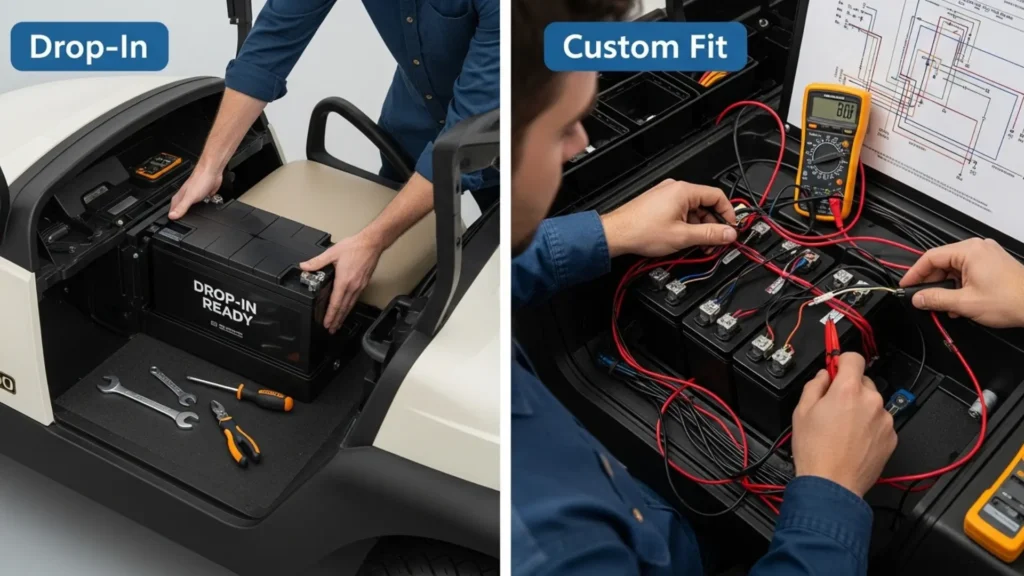
All three brands market their products as ‘drop-in’ replacements, but the practical installation experience varies enough that this deserves direct examination. Drop-in compatibility means the pack fits the battery tray without modification, connects to the existing cable configuration, and works with the charging system with at most a minor adjustment. True drop-in simplicity depends on your specific cart generation.
Dakota Lithium Installation
Dakota Lithium packs are among the most physically compact lithium options in the market, which is a double-edged characteristic. The compact footprint means they fit cleanly in battery trays designed for taller lead-acid batteries — there is rarely a physical fitment issue. However, the compact form factor does mean that the pack will move around slightly in a tray designed for a full-size lead-acid layout unless securing straps or brackets are used. Dakota Lithium includes mounting hardware in most packages, and their installation documentation specifically addresses securing the pack in the tray.
For most EZGO TXT and Club Car DS pre-OBC installations, Dakota Lithium genuinely is drop-in simple: remove the old batteries, clean the tray, install the Dakota pack, connect the existing cables, and install the OBC bypass module if applicable. Most owners with basic mechanical confidence report completing the installation in 90-120 minutes.
Eco Battery Installation
Eco Battery’s B-Plus packs are physically larger than Dakota Lithium — sized to more closely match the footprint of a full lead-acid battery string in the tray, which means better physical stability and fewer concerns about pack movement. The trade-off is that the larger footprint occasionally requires checking tray dimensions on specific cart models, particularly older EZGO and Club Car DS carts that have slightly different tray layouts than the current standard.
Eco Battery provides the most comprehensive installation documentation of the three brands, including platform-specific guides for each major cart model that address OBC bypass, cable routing, and charger pairing. The Bluetooth app adds a useful installation verification step — after connecting the pack, the app can confirm all cells are within acceptable voltage range and that the BMS is communicating correctly before the first charge cycle.
Trojan Trillium Installation
Trojan Trillium installations are typically performed by authorised Trojan dealers, and the documentation and support materials are designed around the dealer service model rather than DIY installation. This is deliberate — Trojan’s commercial focus means their install support is channelled through their dealer network rather than directly to end users. For fleet operators with an existing Trojan dealer relationship, this is perfectly fine. For residential buyers doing a self-installation, it means relying more heavily on the general lithium installation guidance in this guide rather than Trojan-specific DIY resources.
The Trojan Trillium OBC module (included in the kit for OBC-equipped cart purchases) is well-engineered and plug-and-play in design. The physical installation involves connecting the module inline with the OBC harness, which is a five-minute task requiring no tools. Trojan’s dealer network also provides post-installation support that the other two brands match less consistently — for buyers who want ongoing service support, this is a legitimate differentiator.
Real-World Performance: What Each Pack Delivers in Practice
Range Per Charge
Range per charge comparisons between lithium brands are genuinely difficult to make objectively because the major variables — cart weight, passenger load, terrain, temperature, and driving speed — dwarf the cell-chemistry differences between packs of similar capacity. What the specifications tell us is that Eco Battery’s higher rated cycle life (3,000+ vs 2,000+) suggests better capacity retention over the later years of the pack’s service life — the range you get in year eight will likely be closer to your year-one range with Eco Battery than with either competitor.
In practical terms, all three brands in comparable capacity configurations deliver the same order of magnitude range improvement over a quality lead-acid pack: approximately 25-40 miles per charge on a standard two-passenger cart under moderate driving conditions, compared to 18-25 miles for a healthy lead-acid pack. The usable-capacity advantage of lithium (80-100% usable vs 50% for lead-acid) is the dominant factor here — not differences between lithium brands.
Power Delivery and Motor Performance
Eco Battery’s higher continuous and peak discharge current ratings (200A continuous / 400A peak vs Dakota Lithium’s 100A continuous / 200A peak) are worth understanding in context. A stock EZGO TXT or Club Car DS with OEM controller draws approximately 150-200A peak under hard acceleration. Dakota Lithium’s 200A peak is technically sufficient for stock carts but leaves less headroom.
For owners who have upgraded their controller (Alltrax AXE 4845, Navitas) and are running higher current demand, Eco Battery’s higher discharge current rating provides better support for the upgraded drive system. A Dakota Lithium pack connected to an aggressive Alltrax controller profile that demands 350A peaks is operating beyond the battery’s peak current rating — the BMS will limit current and the cart will feel less responsive than a comparable setup on Eco Battery.
For stock carts with no performance modifications, all three brands deliver equivalent practical performance. The current rating difference matters specifically in upgraded performance applications.
Temperature Performance
Dakota Lithium’s cold-weather advantage is real and measurable. In temperatures between 20°F and 32°F, Dakota Lithium packs maintain approximately 75-80% of rated capacity — notably better than the 60-70% maintained by standard LiFePO4 packs (including Eco Battery and Trojan Trillium configurations) in the same temperature range. This difference is meaningful for owners in northern communities, ski resort areas, or mountain properties where winter temperatures regularly test the lower bounds of lithium performance.
At temperatures below 20°F, all three brands show significant capacity reduction — Dakota Lithium included. The advantage narrows as temperatures drop further below the design range. The discharge temperature floor of -4°F for Dakota Lithium versus -14°F for Eco Battery and Trojan Trillium is a real specification difference, but operating any golf cart battery pack at -14°F is an edge case that applies to very few real-world users.
In hot-climate environments — Florida, Texas, Arizona — all three brands perform comparably. LiFePO4 chemistry’s thermal stability advantage over lead-acid is the primary benefit at high temperatures, and this advantage is shared equally across all three brands.
Warranty Comparison: What the Terms Actually Mean
The warranty comparison between these three brands is dramatic on the surface — 11 years versus 5 years versus 3 years. But warranty terms are only as valuable as the coverage they actually provide and the process for making claims. Here is the real breakdown.
| Warranty Term | Dakota Lithium | Eco Battery | Trojan Trillium |
| Full replacement period | 2 years full replacement | 2 years full replacement | 1 year full replacement |
| Pro-rated coverage | Years 3-11 pro-rated credit toward replacement | Years 3-5 pro-rated | Years 2-3 pro-rated |
| Total warranty period | 11 years | 5 years | 3 years |
| Capacity degradation covered? | Yes — below 70% original capacity within warranty | Yes — below 70% original capacity within 5 years | Manufacturing defects only after year 1 |
| Transferable to new owner? | Yes — fully transferable | No — original owner only | Yes — with dealer transfer |
| Claim process | Direct to Dakota Lithium — no dealer required | Through authorised Eco Battery dealer | Through authorised Trojan dealer |
| Pro-rated year 5 value | ~55% credit remaining | ~20% credit remaining | Warranty expired |
Dakota Lithium’s transferable warranty is a genuinely distinctive feature with real resale value implications. When you sell a cart with a Dakota Lithium pack that still has 7 years of warranty remaining, that warranty transfers to the new owner — it is a tangible asset that increases the cart’s market value above what it would otherwise command. Neither Eco Battery nor Trojan Trillium offers this, which means warranty value is locked to the original purchaser.
Trojan Trillium’s 3-year warranty is the weakest in this comparison. For a product positioned as the premium option in the market, a 3-year warranty is a significant limitation. To be fair, a LiFePO4 pack that fails in year 4 or 5 is experiencing either extreme bad luck or user-inflicted damage — the chemistry is stable enough that design-life failures in the 3-8 year window are rare. But warranty is also insurance against the unexpected, and Trojan’s shorter window means less insurance coverage at a higher price.
The Honest Buyer’s Guide: Which Lithium Pack for Which Buyer
Buy Dakota Lithium If…
- You live in a northern state, mountain community, or any location where winter temperatures regularly fall below 32°F (0°C)
- Warranty length is your primary purchase criterion and you want the longest coverage available in the market
- You plan to sell the cart within 5-8 years and want the transferable warranty to add resale value
- Your cart is a pre-OBC EZGO or Club Car DS where the simplest possible installation is appealing
- You want the lightest weight lithium pack available (28-32 lbs vs 38-65 lbs for comparable alternatives)
Dakota Lithium’s cold-weather engineering and 11-year transferable warranty are genuinely differentiated offerings that justify its position in the market. For the right buyer — particularly anyone in a climate where winter performance matters — Dakota Lithium is the most logical choice. For buyers in warm climates prioritising monitoring features and OBC integration, the calculus changes.
Buy Eco Battery If…
- Your cart has an OBC system (Club Car Precedent or post-2007 EZGO TXT/RXV) and you want the smoothest charger integration
- You want built-in Bluetooth state-of-charge monitoring without adding an aftermarket module
- You have upgraded your cart’s controller and want a battery pack with higher peak discharge current capability
- You prioritise the highest rated cycle life (3,000+ cycles) for long-term capacity retention
- You want the most comprehensive golf-cart-specific installation documentation and compatibility verification
Eco Battery is the most purposefully engineered product in this comparison for golf cart specific use. The native OBC integration, active cell balancing, higher discharge current ratings, and Bluetooth monitoring all reflect a company that studied the specific demands of golf cart electrical systems and designed to meet them. For buyers with OBC-equipped carts who want the best technical fit for the platform, Eco Battery has a compelling case.
Buy Trojan Trillium If…
- You are a fleet operator or commercial user who needs batteries backed by the most established dealer and service network in the industry
- Your current battery maintenance and service relationship is with a Trojan authorised dealer and you want to stay in that ecosystem
- Brand confidence and the security of Trojan’s 90-year reputation matters more than price or feature differentiation
- You need a dealer-installed and dealer-warranted solution rather than a direct-to-consumer product
The honest Trojan Trillium case is primarily about the Trojan name and network, not about a technically superior product. For the right buyer — a fleet operator, a commercial resort, a large community with a Trojan service agreement — those factors carry genuine weight. For a residential buyer evaluating on technical merit, price, and warranty terms, the Trillium’s premium is hard to justify against Dakota Lithium’s warranty advantage and Eco Battery’s technical feature set.
What We Have Learned Supporting Lithium Conversions
After supporting hundreds of lithium conversions across all three brands, several patterns emerge consistently that the marketing materials for none of these brands will tell you directly.
The first is that the OBC bypass module is the most commonly skipped installation step and the most commonly cited cause of post-installation problems. Every Precedent and post-2007 EZGO that receives any lithium pack needs an OBC bypass module installed before the battery is connected for the first time. This is not optional, it is not platform-specific, and it is not something you can add later if charging does not work. If you are installing any lithium pack on an OBC-equipped cart, confirm the bypass module is in the box or on the invoice before the installation begins.
The second is about charger timing. A lithium pack that arrives and is connected to a charger immediately without allowing the pack to rest at ambient temperature for 2-4 hours may show early fault codes — particularly if the pack was stored or shipped in cold conditions. The BMS low-temperature charge protection activates if the cells are below 32°F when the charger connects. Allowing the pack to warm to room temperature before the first charge cycle prevents this and sets a cleaner baseline for the initial charge.
The third is about the comparison between Dakota Lithium’s lighter weight and Eco Battery’s heavier but more physically stable pack format. The weight difference (28-32 lbs vs 38-62 lbs) is real and noticeable when handling the packs. But in a cart context, the heavier Eco Battery pack sits more stably in the battery tray without the securing straps that the lighter Dakota pack requires. Both approaches work reliably — the securing step with Dakota is simple and the provided hardware is adequate — but it is worth knowing about before installation day.
| E-E-A-T NOTE | Golf Cart Gears stocks Dakota Lithium, Eco Battery, and Trojan Trillium alongside the OBC bypass modules, Lester Summit II chargers, and platform-specific installation accessories needed for complete conversions. Our toll-free team verifies compatibility for your specific cart serial number and configuration before any order ships, and provides post-installation support on all three brands. |
Frequently Asked Questions
Are Dakota Lithium, Eco Battery, and Trojan Trillium all LiFePO4 chemistry?
Yes. All three brands use lithium iron phosphate chemistry for their golf cart products. This is the only appropriate lithium chemistry for golf cart applications due to its thermal stability, safety profile, and cycle life characteristics. Any supplier offering a golf cart lithium battery built on NMC or other high-energy-density chemistry should be evaluated carefully — LiFePO4 is the correct choice for this application.
Do I need a new charger when I switch to lithium?
Almost certainly yes if your current charger is more than 5 years old, is the original OEM unit, or does not have a selectable LiFePO4 charge profile. The Lester Summit II with LiFePO4 mode selected is the most universally compatible aftermarket charger and our standard recommendation for any lithium conversion. For very recent carts with modern smart chargers, verify the charger has an explicit LiFePO4 algorithm before assuming compatibility.
Which lithium brand has the best cold-weather performance?
Dakota Lithium, unambiguously. Their cold-weather BMS engineering and -4°F (-20°C) discharge temperature floor outperform both Eco Battery and Trojan Trillium in cold conditions. If winter performance is a meaningful consideration in your use case, Dakota Lithium is the correct choice.
Why is Dakota Lithium’s warranty 11 years when others are only 3-5 years?
Dakota Lithium’s business model is built around long-warranty, premium-quality products for demanding outdoor applications. The 11-year warranty reflects both genuine confidence in cell and BMS quality and a deliberate brand positioning strategy. The warranty being transferable to a new owner also has a resale value benefit that functions as a marketing differentiator. Trojan Trillium’s 3-year warranty reflects a commercial product designed for fleet replacement cycles rather than residential ownership longevity.
Can I mix one brand of lithium with another in the same cart?
No. Never mix different battery brands, chemistries, ages, or configurations in a golf cart pack. Each lithium pack has its own BMS with specific voltage calibration and balancing parameters. Mixing two different brand packs in a series configuration creates an uncontrolled interaction between two BMS systems that can produce dangerous fault conditions. Always use a single complete pack from one manufacturer.
Is the Eco Battery Bluetooth app actually useful in daily use?
Yes — for owners who care about their battery’s state. The app shows real-time state of charge as a percentage (far more useful than a voltage reading for daily range planning), individual cell voltages for monitoring cell balance over time, temperature data, cycle count, and a fault history log. For the average owner who charges nightly and drives regularly, checking the app takes 15 seconds and provides the same quality of battery visibility that EV owners take for granted. Whether that level of visibility is worth the price premium over Dakota Lithium depends on the individual buyer.
At 10 years into ownership, how much capacity will each brand have retained?
At 2,000 cycles (Dakota Lithium and Trojan Trillium rated minimum), most LiFePO4 packs retain 70-80% of original capacity. At 3,000+ cycles (Eco Battery’s higher rating), capacity retention is expected to be slightly better at the same calendar age due to less degradation per cycle. In practical terms, at year 10 of moderate residential use (approximately 300-400 cycles for a daily driver): all three brands should retain 85-90% of original capacity, with Eco Battery’s higher cycle life rating providing marginally better retention at very high cycle counts.
The Verdict: Three Strong Products, Three Different Strengths
The golf cart lithium market has matured to the point where there is no bad choice among these three brands — only better matches for specific buyer profiles. The days when any lithium pack was a gamble are over. Dakota Lithium, Eco Battery, and Trojan Trillium are all credible, warranted, well-engineered products that will serve most buyers far longer than their warranty periods.
Dakota Lithium wins on warranty length, cold-weather performance, and weight. If you live where it gets genuinely cold in winter, if resale value matters to you, or if you want the lightest possible pack, Dakota Lithium is the correct choice.
Eco Battery wins on OBC integration, BMS sophistication, Bluetooth monitoring, and discharge current headroom for performance builds. If your cart has an OBC system, if you have upgraded the drive system, or if you simply want the most data visibility available in the market, Eco Battery is the better technical fit.
Trojan Trillium wins on brand confidence and dealer service infrastructure. If you are a fleet operator, if your maintenance relationship is Trojan-centred, or if the Trojan name genuinely matters to your purchase decision, Trillium delivers a quality product with the backing of the industry’s most established battery company.For every buyer: confirm charger compatibility before installation, install the OBC bypass module if your cart requires it, and allow the pack to reach ambient temperature before the first charge. Done correctly, any of these three packs will transform your electric golf cart into a vehicle you will not need to think about again for a decade.