
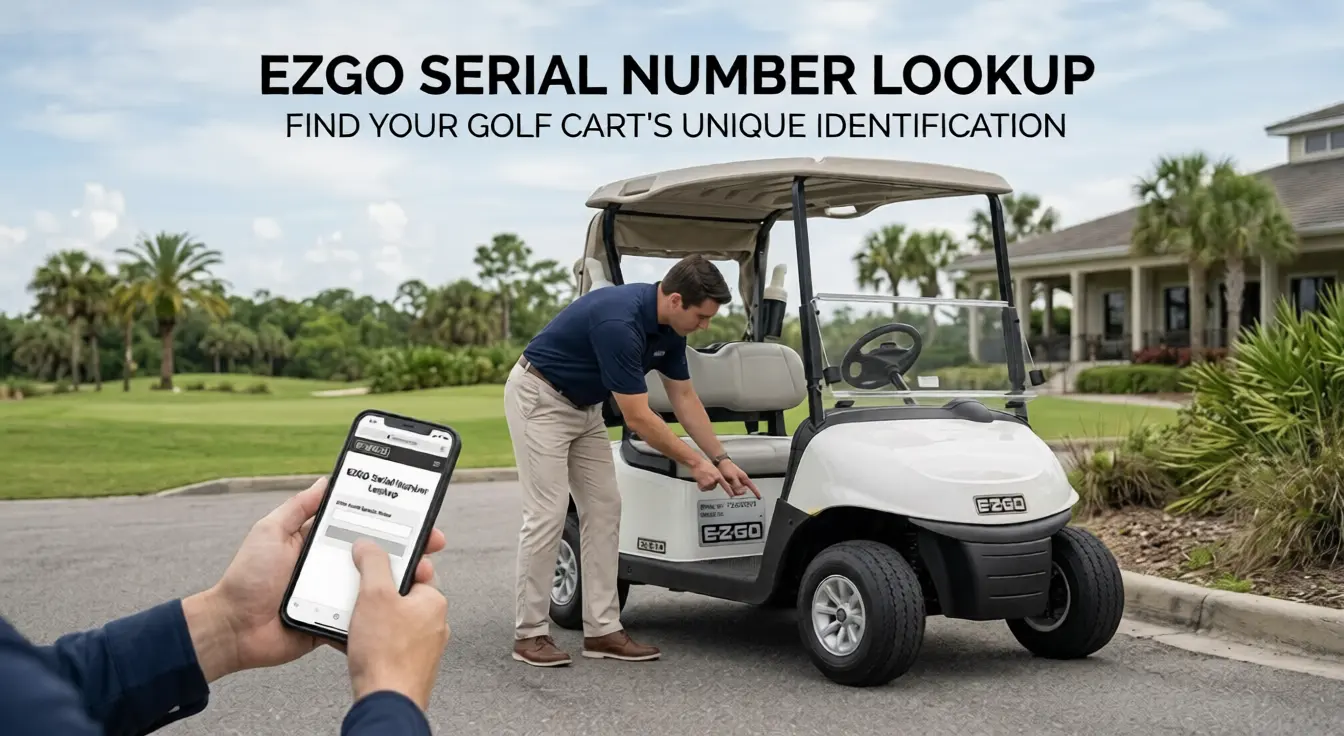
Why Your EZGO Serial Number Is the Most Useful Number on the Cart
Your EZGO serial number is a direct line into your cart’s entire identity. Buried in that string of letters and digits is the manufacturing year, the model platform, the production sequence, and sometimes the battery configuration — information that determines which parts fit, which charger is correct, which motor and controller your cart actually has, and in some cases which upgrades are compatible.
The problem is that EZGO has used at least five different serial number formats across nearly fifty years of production, and decoding a number from a 1989 TXT requires a completely different approach than decoding a 2019 RXV. The format changed significantly in 1994, again in 2001, and the RXV platform introduced a separate numbering convention when it launched in 2008.
Every week, we talk to EZGO owners who ordered parts based on what they thought their cart was, only to discover that their actual model year or battery configuration is different from what the previous owner told them. A 2001 TXT and a 2005 TXT are not the same cart in any meaningful way for parts purchasing — but they can look nearly identical to someone who did not own them from new.
This guide solves that problem once and for all. By the end of it, you will know exactly where to find your serial number, how to decode every digit, and what that tells you about compatible parts, battery systems, and upgrades. We cover every EZGO platform produced from 1976 through the 2025 model year.
| QUICK ANSWERWhere is the EZGO serial number and how do I decode it?Location: Under the passenger-side glove box or seat on the dash area (TXT/RXV). On older models (pre-1994), on the frame rail below the battery compartment.Format (1994–2025): The serial number begins with two letters identifying the model, followed by digits for the production year and sequence. Example: PH0812-123456 = Passenger Cart, H-series motor, built in 2008, month 12.Model Year: On post-2001 carts, the 4th and 5th digits of the serial number encode the two-digit production year. On 1994–2001 carts, a manufacturer’s code plate carries the year separately. Pre-1994 carts use a frame-stamped sequence with a different decode table. |
Where to Find Your EZGO Serial Number: All Locations by Model
EZGO moved the serial number plate location several times over the decades. If you know roughly when your cart was built, start with the most likely location for that era.
| Era / Model | Serial Number Location | What to Look For |
| 1976–1993 (Pre-TXT) | Frame rail, driver’s side | Stamped or riveted aluminium plate on the main frame rail under the battery box. May be covered by corrosion or paint. Look for a 6-8 digit number with no letter prefix. |
| 1994–2000 (TXT/Medalist) | Passenger side dash panel | White or silver sticker on the vertical face of the dash, passenger side. Also a metal tag on the frame rail. Serial number format changes to letter-prefix in this era. |
| 2001–2013 (TXT) | Driver’s side dash, below steering column | White sticker printed on the underside of the dash, driver’s side. TXT serial numbers begin with ‘PH’, ‘PG’, or ‘PC’ depending on model variant. 12-character format. |
| 2008–2025 (RXV) | Driver’s side dash, same as TXT | White sticker, driver side dash. RXV serials begin with ‘EH’ or ‘EC’. Easily confused with TXT serials — always confirm the first two letters to identify which platform. |
| 2014–2025 (Freedom/Express) | Passenger side glove box door or dash | Newer Freedom-series carts often have the serial sticker on the inside of the glove box door or on the dash near the ignition. Same format as post-2001 TXT. |
| All utility models (WorkHorse/ST) | Frame rail, driver’s side | Utility carts retain the frame-stamped serial plate tradition longer than passenger models. Check both the frame rail and any dash-area sticker if present. |
| MISSING PLATE? | If the serial number plate or sticker is missing, damaged, or unreadable, look for the serial number stamped directly into the frame rail on the driver’s side, near the battery compartment. It is usually still present even when the plate is gone. A torch and a wire brush will often reveal a stamped number that appears blank at first glance. |
Understanding the EZGO Serial Number Format
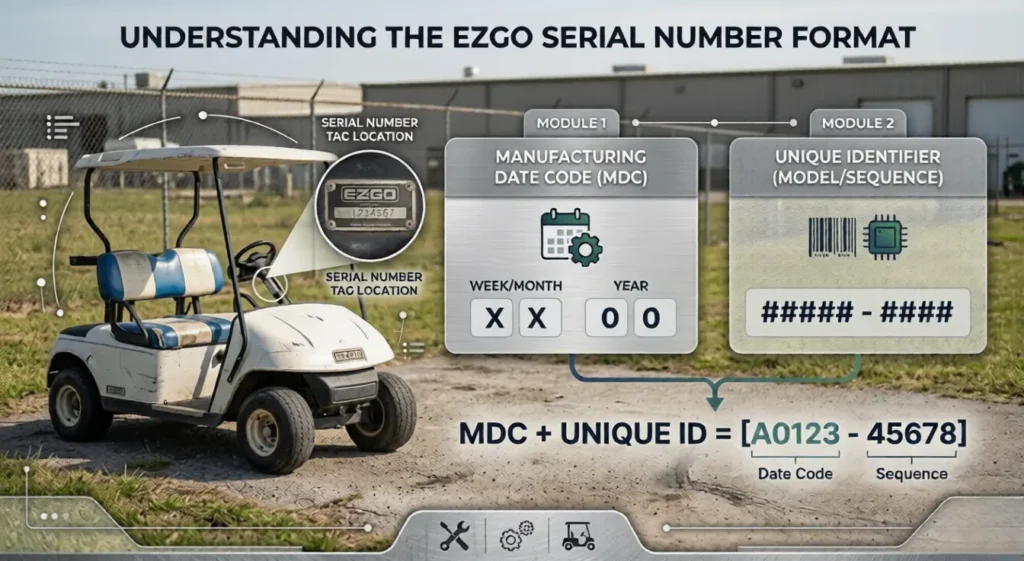
Post-2001 EZGO Serial Number Format (The Most Common)
The majority of EZGO carts in current use were built after 2001, and they all share a consistent 12-character serial number format. Here is how to decode every part of it:
| Position | Characters | What It Encodes | Example Values |
| 1–2 | Two letters | Model / Platform code | PH = TXT Passenger (electric), PC = TXT Passenger (gas), EH = RXV Electric, EC = RXV Gas, ST = ST Sport, EX = Express |
| 3 | One letter | Motor / Drive system | H = High-torque DC motor, C = AC motor (RXV), G = Gas engine, S = Series-wound DC motor |
| 4–5 | Two digits | Production year (2-digit) | 01 = 2001, 08 = 2008, 14 = 2014, 24 = 2024. EZGO model years run Aug–July, so ’08’ may indicate a cart assembled Aug 2007 for the 2008 model year. |
| 6–7 | Two digits | Production month | 01 = January, 06 = June, 12 = December. Useful for confirming specific production windows and warranty start dates. |
| 8–12 | Six digits | Production sequence number | Identifies the individual unit within that month’s production run. Used for warranty claims and manufacturer records. |
A worked example: Serial number PH0812-123456 decodes as follows. PH = TXT Passenger (electric). 0 = the third character indicating the motor variant. 8 = production year (but within the full string, positions 4-5 give the year, so we read the full serial carefully). Reapplying the correct reading: PH (model) + 08 (year 2008) + 12 (December) + 123456 (production sequence). This is a 2008-model-year TXT electric golf cart built in December 2008.
| EZGO MODEL YEAR NOTE | EZGO defines its model year as beginning in August of the prior calendar year. An EZGO cart with production month 08 (August) through 12 (December) of a given year is typically sold as the following model year. A cart built September 2019 is a 2020 model year EZGO. This causes significant confusion when matching parts, particularly for battery chargers and motor controllers which changed between model years. |
Pre-2001 EZGO Serial Number Decode (1976–2000)
Older EZGO carts use a different format that was less standardised. Here is the most practical decode approach for carts built before the 2001 format change:
1994–2000 TXT and Medalist Era
In this era, the serial number on the dash sticker typically follows a format like: TXT-123456-94. The suffix after the main sequence number represents the model year. A sticker reading 94 in the final position is a 1994 model year cart. This was a transitional format before EZGO embedded the year into the main serial string.
Some 1994-2000 carts also have a separate Manufacturer’s Code Plate near the battery area that lists the model, year, and voltage system separately from the serial number. If your cart has this plate, it is far more reliable for year identification than attempting to decode a worn serial sticker.
Pre-1994 EZGO (1976–1993) — The Marathon and Early Carts
| Serial Format | Model Year | Platform | Notes |
| 1xxxxx (6 digits) | 1976–1978 | Original EZGO | Earliest EZGO production. 36-volt DC systems only. Extremely rare in active use today. |
| 2xxxxx | 1979–1981 | EZGO Classic | 36V systems. Cassette-style battery arrangement. Very limited parts availability for original components. |
| 3xxxxx | 1982–1984 | EZGO Classic | Transition to improved drive system. Still 36V. Some parts cross-compatible with later Marathon. |
| 4xxxxx | 1985–1987 | Marathon | First Marathon-branded carts. 36V. Solenoid and motor components still available aftermarket. |
| 5xxxxx | 1988–1990 | Marathon | Marathon production peak. 36V systems standard. Widely parts-supported by aftermarket suppliers. |
| 6xxxxx | 1991–1993 | Marathon / Medalist | Late Marathon and early Medalist. Transition year includes both 36V and early 48V configurations. |
| 7xxxxx | 1994–1995 | Medalist | First Medalist production. Format in transition from frame-stamped to dash-sticker serials. |
EZGO Model Code Reference: What the First Two Letters Mean
Once you have your serial number, the first two characters tell you the platform and power system. This is the single most important piece of information for parts compatibility.
| Code | Full Model Name | Platform Era | Power System | Key Notes |
| PH | TXT Passenger Electric | 2001–present | Electric 48V | Most common platform. DC motor pre-2009, AC option available post-2016 on ELiTE. 6x8V battery standard. |
| PC | TXT Passenger Gas | 2001–present | Gas (Robin/Subaru) | Air-cooled single-cylinder engine. Carburetor pre-2008, EFI option post-2014 on some models. |
| EH | RXV Electric | 2008–present | Electric 48V AC | AC motor with regen braking. IQ motor controller. Completely different parts from TXT. Do not cross-order. |
| EC | RXV Gas | 2008–present | Gas (EFI) | EFI engine standard on RXV gas. Different service requirements than TXT gas. EFI diagnostics required for fuel system work. |
| ST | ST Sport / ST Workhorse | 1996–2015 | Electric or Gas | EFI engine standard on RXV gas. Different service requirements than TXT gas. EFI diagnostics are required for fuel system work. |
| EX | Express / Freedom | 2014–present | Electric or Gas | Utility platform. Different body and suspension from TXT. Shares some drivetrain components, but body parts do not transfer. |
| WH | WorkHorse Utility | 2008–present | Electric or Gas | Heavy-duty utility. Cargo bed standard. Frame and suspension components differ from passenger platforms. |
| MH | Medalist (Legacy) | 1994–2000 | Electric 36V/48V | Multi-passenger extended platform. 4-6 seat configurations. Rear seat and body parts are unique to this platform. |
EZGO TXT: Year-by-Year Specification Reference (2001–2025)
The TXT is the most common EZGO in the field. This table covers the key specification changes by year that affect parts compatibility — particularly battery system, motor type, and controller generation, which are the three most commonly mismatched components when ordering parts.
| Model Year | Serial Prefix | Battery System | Motor Type | Controller | Key Parts Notes |
| 2001–02 | PH01–02 | 48V / 6x8V | DC Series Novak 350A | Navitas 350 | Early TXT generation. Solenoid: 48V Curtis. Charger: Powerwise 48V. Body panels compatible with 2001-2013 TXT. |
| 2003–04 | PH03–04 | 48V / 6x8V | DC Series | Alltrax | Controller upgrade from prior gen. Alltrax AXE 4834/4845 compatible. Same battery and charger as 2001-02. |
| 2005–08 | PH05–08 | 48V / 6x8V | DC Series | Alltrax | IQ system was introduced 2010. DCS controller fault codes via blink code. Powerwise II QE charger. Body unchanged. |
| 2009–13 | PH09–13 | 48V / 6x8V | DC Series | DCS / IQ | IQ system was introduced in 2010. DCS controller fault codes via blink code. Powerwise II QE charger. Body unchanged. |
| 2014–16 | PH14–16 | 48V / 6x8V | DC Series | DCS Gen 2 | Powerwise II charger was introduced 2007. OBC-equipped. Solenoid upgrade in 2007. Rear body improved. |
| 2017–19 | PH17–19 | 48V / 6x8V | DC or AC (ELiTE) | DCS / AC | ELiTE AC-motor version introduced. ELiTE has completely different motor, controller, and charger requirements from standard TXT. |
| 2020–22 | PH20–22 | 48V / 6x8V | AC (ELiTE) or DC | AC/DCS | Updated body styling for 2020. USB port standard. Lithium pack option available from the factory. Body panels changed again — not backwards compatible. |
| 2023–25 | PH23–25 | 48V / 6x8V or Lithium | AC (ELiTE) or DC | AC / DCS Latest Gen | Freedom model year branding. New rear body panel for 2014+. Not compatible with the pre-2014 rear body. Charger port relocated. |
EZGO RXV: Year-by-Year Specification Reference (2008–2025)
The RXV is a fundamentally different cart from the TXT despite sharing the brand and general appearance. The AC motor, regenerative braking, and IQ system make it a more sophisticated platform with distinct parts requirements. Use this table to confirm which generation of RXV components you need.
| Model Year | Serial Prefix | Battery System | Motor / Controller | Charger Type | Key Notes |
| 2008–09 | EH08–09 | 48V / 6x8V | AC / IQ System Gen 1 | Powerwise QE | First RXV generation. Gen 1 IQ controller. Regen braking as standard. Key-card ignition. Body style 1. |
| 2010–13 | EH10–13 | 48V / 6x8V | AC / IQ System Gen 2 | Powerwise QE | Gen 2 IQ controller with improved fault detection. Blink code diagnostics. Wider front cowl option. |
| 2014–16 | EH14–16 | 48V / 6x8V | AC / IQ System Gen 3 | Powerwise QE2 | Updated IQ Gen 3. New body styling — rear panels not backward compatible. Improved regenerative braking calibration. |
| 2017–19 | EH17–19 | 48V / 6x8V | AC / IQ System Gen 4 | Powerwise QE2 | Gen 4 IQ. USB standard. Improved sound insulation. Lithium-compatible charger option introduced. |
| 2020–22 | EH20–22 | 48V / 6x8V or Lithium | AC / IQ System Gen 5 | Powerwise QE3 | Gen 5 IQ with Bluetooth connectivity option. Factory lithium pack compatible. Body refresh. |
| 2023–25 | EH23–25 | Lithium std or 6x8V FLA | AC / IQ Gen 5+ | QE3 / Smart | Current generation. Lithium standard on premium trim. Smart charging integration. OTA updates on connected models. |
Using Your Serial Number to Order the Right Parts
Now that you know how to decode your serial number, here is how to translate that information into confident parts ordering. The three most critical components where year and platform confusion causes wrong orders are batteries, chargers, and motor controllers.
Batteries: Year and Voltage Confirmation

The EZGO TXT has been 48V since its introduction in 2001. If your serial number decodes to a post-2001 TXT, your cart is a 48-volt system using six 8-volt batteries (6x8V = 48V). The standard replacement is Trojan T-875 or US Battery US8VGC.
If your serial decodes to a 1994-2000 Medalist, voltage can be either 36V or 48V, depending on production year. A Medalist produced before 1996 is almost certainly 36V (six 6V batteries). A Medalist produced 1998 or later may be either, and the only definitive confirmation is counting the batteries and multiplying the voltage per battery. Do not assume.
If your cart has had a voltage conversion performed — a 36V cart converted to 48V, which is common — the serial number will still show the original voltage configuration. Physical battery count and voltage measurement always override serial-derived assumptions when there is any doubt.
Chargers: OBC vs Non-OBC and Profile Matching
EZGO introduced the Powerwise II charger with an OBC (On Board Computer) interface in 2007. Carts produced from 2007 onwards communicate with the charger through the OBC port and require a charger that sends the correct handshake signal. Using a generic 48V charger on a post-2007 EZGO with an OBC will result in either no charging at all, or incomplete charging.
The correct charger for your EZGO is determined primarily by model year and power system. The table below gives the direct charger match by era:
| EZGO Era | Serial Year Digits | Correct Charger | Notes |
| 1994–2000 (Medalist) | Pre-2001 | Standard 36V or 48V (no OBC required) | No OBC communication required. Standard automatic charger compatible. Verify voltage (36V or 48V) before purchase. |
| 2001–2006 (TXT) | 01–06 | Powerwise 48V or Delta-Q 48V | No OBC in this era. Standard Powerwise 48V direct-current charger. Delta-Q IC650 is an excellent aftermarket upgrade. |
| 2007–2013 (TXT/RXV) | 07–13 | Powerwise II QE (OBC required) | OBC equipped. Must use Powerwise II QE or a compatible charger with Textron handshake signal. Generic chargers will not initiate. |
| 2014–2019 (TXT/RXV) | 14–19 | Powerwise QE2 or Lester Summit II | Updated QE2 charger with improved algorithm. Lester Summit II with EZGO profile selected is the recommended aftermarket upgrade. |
| 2020–2025 (TXT/RXV ELiTE) | 20–25 | Powerwise QE3 or Smart Charger | QE3 with Bluetooth option. Lithium-equipped models require lithium profile charger. Confirm battery chemistry before ordering charger. |
| PARTS WARNING | The most expensive mistake EZGO owners make when ordering parts online is entering the wrong model year and receiving a controller, solenoid, or charger that physically fits but is calibrated for a different generation. Always verify the year digits (positions 4-5) of your serial number before ordering any electrical component. A $250 controller ordered for the wrong year is not returnable once opened. |
What If You Cannot Find the Serial Number?
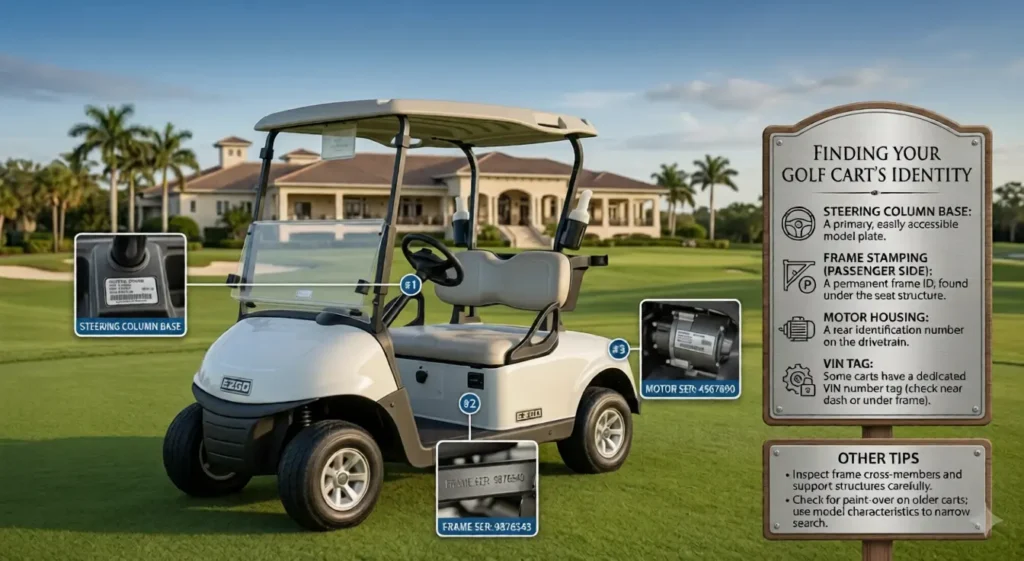
Worn stickers, missing plates, and obscured frame stamps are a reality on older carts. Here are the best alternative identification methods when the serial number is genuinely unreadable:
- Six batteries at approximately 8V each = 48V TXT or RXV. Eight batteries at 6V each = 48V alternative configuration. Six batteries at 6V = 36V Medalist or older. Count the batteries and measure voltage:
- The electric motor has a separate identification tag with manufacturer, model, and voltage information. This confirms the drive system even when the serial is unreadable. Check the motor tag:
- The motor controller (usually mounted under the seat near the motor) carries its own part number and voltage rating. Cross-reference with EZGO’s part number lookup to identify the generation. Inspect the controller:
- EZGO changed the front body profile in 2014. If the nose is the rounded ‘banana’ style, it is pre-2014. If it has a sharper, more angular profile, it is 2014 or newer. This narrows the year range significantly. Look at the front cowl body style:
- With the motor serial number or controller part number, EZGO’s customer support team can often identify the cart’s original configuration even without the vehicle serial number. Contact EZGO customer support:
Expert Insights: The Most Common Serial Number Mistakes We See
After helping thousands of EZGO owners with parts orders, the same mistakes come up repeatedly. Here are the three most expensive ones and exactly how to avoid them.
The first is ordering TXT parts for an RXV, or vice versa, based on the cart’s general appearance. The TXT and RXV look similar from the outside — same body lines, same seating position, same general footprint. But the motor, controller, solenoid, and charger systems are completely different between platforms. Ordering a TXT solenoid for an RXV results in a part that physically mounts but operates at different current thresholds and will fail prematurely or cause controller faults. Always confirm whether your serial starts with PH (TXT) or EH (RXV) before ordering any electrical component.
The second is assuming a cart with no model year information is the latest generation. We frequently see owners of 2008-2012 TXT carts order 2020-generation parts because they just picked ‘current model’ on a parts website. The OBC versions, controller generations, and body panel designs are not backward compatible, and the resulting mismatch causes everything from physical fitment failures to electrical faults.
The third is forgetting that EZGO model years do not align with calendar years. An EZGO built in October 2019 is a 2020 model year cart. This creates a consistent one-year offset that catches out buyers who assume the production year and the model year are the same. Always use the serial number year digits as the primary reference and verify against our tables above before placing any parts order.
| E-E-A-T NOTE | Golf Cart Gears stocks EZGO parts for every platform from 1994 through current production. Every parts listing on our site is cross-referenced by serial number prefix and model year to prevent compatibility errors. If you have confirmed your serial number and are uncertain about compatibility, our toll-free support team verifies orders before they ship. |
Frequently Asked Questions
Where is the serial number on an EZGO golf cart?
On most post-2001 EZGO carts, the serial number is on a white sticker on the driver’s side of the dash, below the steering column. On some models it is on the passenger side dash or inside the glove box. On pre-1994 carts, it is stamped into the frame rail on the driver’s side near the battery compartment.
How do I find the year of my EZGO golf cart from the serial number?
On post-2001 EZGO serial numbers, characters four and five (the third and fourth characters after the two-letter model prefix) are the two-digit model year. PH1205-123456 indicates a 2012 model year. Remember that EZGO’s model year starts in August, so a serial showing 12 may have been physically built in late 2011 for the 2012 model year.
What is the difference between an EZGO TXT and an EZGO RXV by serial number?
TXT serial numbers begin with PH (electric) or PC (gas). RXV serial numbers begin with EH (electric) or EC (gas). This is the fastest and most reliable way to distinguish between the two platforms. The platforms share almost no electrical components despite their similar appearance.
My EZGO serial number starts with MH. What model is this?
MH prefix indicates a Medalist — the predecessor to the TXT, produced from approximately 1994 to 2000. Medalist carts are 36V or 48V, depending on production year. Late Medalists (1998-2000) are most commonly 48V. Early Medalists (1994-1997) are predominantly 36V. Always verify by counting batteries before ordering electrical components.
Can I use a newer EZGO charger on an older EZGO cart?
It depends on the OBC status. Pre-2007 EZGO carts do not have an OBC and accept standard automatic chargers. Post-2007 EZGO carts with OBC require a charger that sends the correct Textron handshake signal. A new OBC-capable charger may be able to charge an older cart in bypass mode, but check charger specifications before purchasing — not all chargers include a bypass mode.
My EZGO was converted from 36V to 48V. What does my serial number say about my battery system?
The serial number reflects the original factory configuration, not any subsequent modifications. A converted cart’s serial number will still show the original 36V designation. For all parts ordering purposes after a voltage conversion, use the actual current battery configuration — not the serial-derived information — to determine correct charger, controller, and motor specifications.
Where can I find parts for my EZGO using the serial number?
Golf Cart Gears allows you to filter EZGO parts by model and year. Use the serial number to confirm your exact year and platform (TXT vs RXV, electric vs gas), then use the year and platform filters to show only compatible parts for your cart. Our support team is also available by phone to cross-reference serial numbers against our parts catalogue before any order is placed.
The Practical Takeaway
Your EZGO serial number is a seven-second lookup that saves hours of wrong-part frustration. The four things it reliably tells you — model platform, production year, motor system, and voltage configuration — are the four things that determine compatibility for every electrical component on the cart.
Locate it on your dash sticker, decode the first two letters and positions four through five, and you have everything you need to order the right battery, the right charger, and the right controller without ever having to guess or trust the previous owner’s description of what the cart is.