
The Reconditioning Industry Has an Honesty Problem
Type ‘golf cart battery reconditioning‘ into any search engine, and you will find a robust industry of guides, products, and services promising to restore your old batteries to like-new condition for a fraction of the cost of replacement. Desulfation chargers. Epsom salt treatments. Golf Cart Battery conditioner additives. Pulse charging devices. Electrolyte replacement kits. The marketing is confident and the testimonials are enthusiastic.
The electrochemistry tells a more complicated story — one that these guides almost never engage with honestly.
Some reconditioning techniques are legitimate and effective for specific, well-defined failure modes. Equalization charging is genuinely valuable for reversing early-stage sulfation. Electrolyte refresh for batteries with dried-out cells has a real scientific basis. Deep slow discharge followed by controlled recharge can recover some capacity in batteries with minor plate stratification.
Other techniques — Epsom salt treatments, copper sulphate additives, most pulse conditioning devices — have a theoretical basis that sounds plausible in marketing copy and fails to produce the claimed results in controlled testing. The reason these products persist in the market despite their limited efficacy is that batteries sometimes improve on their own after any intervention involving watering, charging, and equalizing, and owners naturally attribute the improvement to whichever product they just purchased.
This guide cuts through the noise with honest electrochemistry. We explain exactly what happens inside a lead-acid battery as it ages and degrades, which reconditioning techniques have genuine scientific support, which ones do not, what the realistic recovery potential is at different stages of battery degradation, and when the honest answer is that no reconditioning technique will help — and new batteries are the right call.
| QUICK ANSWERCan you actually recondition golf cart batteries? What actually works?What genuinely works: Equalization charging (controlled overcharge) for early-to-mid stage sulfation. Proper electrolyte refilling for dried cells. Multi-cycle deep conditioning sequences for stratified electrolyte. These restore 10-30% of lost capacity in recoverable batteries.What has limited evidence: Pulse desulfation devices (mixed results, works occasionally on lightly sulfated batteries). Epsom salt treatments (theoretical basis exists but controlled testing shows minimal benefit in practice).What does not work and cannot work: Reconditioning batteries with corroded or physically damaged plates, collapsed separators, cracked cases, or shorted cells. No chemical or electrical technique recovers from mechanical plate failure. Replacement is the only option. |
The Chemistry of Lead-Acid Battery Degradation: What Is Actually Happening Inside
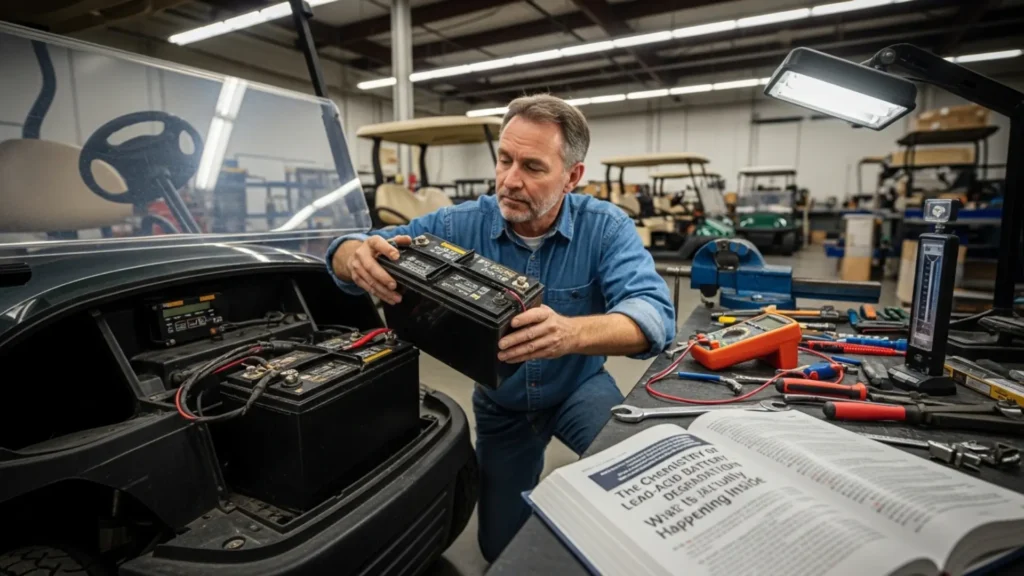
To evaluate any reconditioning technique intelligently, you need to understand the specific failure modes that cause lead-acid batteries to lose capacity over time. There are four primary mechanisms, and they are not equally recoverable. Knowing which one you are dealing with determines whether reconditioning is worth attempting.
Failure Mode 1: Sulfation — The Recoverable One (Sometimes)
Sulfation is the accumulation of lead sulfate crystals on the battery’s plate surfaces. During every discharge cycle, the chemical reaction produces lead sulfate on both the positive and negative plates. During charging, that lead sulfate is supposed to dissolve back into the electrolyte and reconvert to lead dioxide (positive plate) and sponge lead (negative plate). This reversible cycle is the battery’s fundamental energy storage mechanism.
The problem arises when a battery is not fully recharged between cycles, or sits in a discharged state for extended periods. In these conditions, the lead sulfate crystals do not fully dissolve during the partial recharge — they begin to recrystallize into larger, harder formations called hard sulfate or passivation sulfate. These larger crystals are less soluble than fresh lead sulfate, require higher voltage to dissolve, and occupy surface area on the plates that is no longer participating in the charge-discharge reaction.
The degree of sulfation is the critical variable for reconditioning viability. Early-stage sulfation — where the crystals are relatively small and have not yet fully passivated — can be reversed through equalization charging. Mid-stage sulfation responds partially to extended high-voltage charging cycles and pulse conditioning. Late-stage sulfation with thick, fully passivated crystalline deposits on large portions of the plate surface is essentially irreversible — the crystals are too large and too strongly bonded to the plate to dissolve under any practical charging protocol.
Here is the practical test for sulfation stage: if a battery reads 6.3 volts at rest (for a 6-volt battery) but collapses to below 5.8 volts after a moderate load is applied for 30 seconds, the battery has mid-to-late stage sulfation reducing its available capacity. If it collapses to below 5.5 volts or drops immediately on any load application, the sulfation is severe enough that reconditioning is unlikely to produce meaningful recovery.
Failure Mode 2: Plate Corrosion — Not Recoverable
The positive plates in a lead-acid battery are in a permanently oxidising environment. Over time, the grid structure supporting the active material — typically lead-antimony or lead-calcium alloy — undergoes corrosion that converts the grid metal itself into lead compounds with different electrical properties. The grid physically grows slightly as it corrodes, causing the plate to expand and stress the battery case, and the corroded grid material conducts electricity less efficiently than the original lead alloy.
Grid corrosion is accelerated by elevated temperatures, overcharging, and the normal aging process that occurs over many charge-discharge cycles. It is a fundamental electrochemical process that cannot be reversed by any external treatment. A battery with significant grid corrosion has permanently lost a portion of its positive plate capacity, and no reconditioning technique addresses this mechanism. The corroded grid material cannot be restored to its original lead alloy composition.
The practical implication: a battery that has been running hot due to chronic overcharging, or that has been in service for many years in a hot climate, is likely exhibiting grid corrosion alongside any sulfation. Even if the sulfation component is successfully treated, the grid corrosion contribution to capacity loss remains. This is why reconditioning results are always partial on older, hot-climate batteries.
Failure Mode 3: Active Material Shedding — Partially Recoverable
The active material on the positive plates — lead dioxide — gradually falls from the plate surface during cycling. This shedding occurs because the physical expansion and contraction of the active material during charge and discharge cycles progressively weakens its adhesion to the grid. Over many cycles, fine particles of lead dioxide accumulate as sediment at the bottom of each cell.
Initially, this sediment is harmless — it sits below the plates in the sediment space specifically designed into the battery’s cell design. As shedding progresses, the sediment level rises until it eventually contacts the bottom of the plates. At this point, the sediment can bridge the gap between positive and negative plates, creating a soft short circuit that permanently drains that cell.
There is no reconditioning technique that puts shed active material back onto the plate. The capacity loss from shedding is permanent. However, batteries with significant shedding can sometimes be used longer if the shedding has not yet reached the point of bridging the plate gap — regular equalization and full charging slows the rate at which remaining active material is lost.
Failure Mode 4: Electrolyte Depletion — Recoverable with Limits
Flooded lead-acid batteries lose water from the electrolyte during charging — the charging process electrolyses water into hydrogen and oxygen gas that vents through the cell caps. If water is not regularly replaced, the electrolyte level drops below the plate tops. Once the plates are exposed to air, rapid oxidation of the exposed plate surface occurs — and that oxidation is permanent.
If caught early enough — the electrolyte is low but the plates have not yet been exposed — simply refilling with distilled water and then performing a full equalization charge can recover significant capacity. The electrolyte that remains is often stratified (higher acid concentration at the bottom of the cell than the top), and the equalization charge mixes it properly and drives the plates back through a complete reaction cycle.
If the plates have been exposed — particularly if they have been exposed for days or weeks before the water level was noticed — the oxidation on the exposed section is permanent capacity loss. Refilling water restores the liquid level but not the oxidised plate area. The earlier you catch and address low water levels, the more recovery is possible.
| CHEMISTRY SUMMARY | Of the four failure modes, sulfation is the only one that is meaningfully recoverable through reconditioning. Electrolyte depletion is recoverable if caught early. Grid corrosion and active material shedding are not reversible by any practical means. Most batteries in service have some combination of all four — which is why realistic recovery expectations are partial capacity restoration, not return to original specification. |
Reconditioning Techniques That Have Real Scientific Support
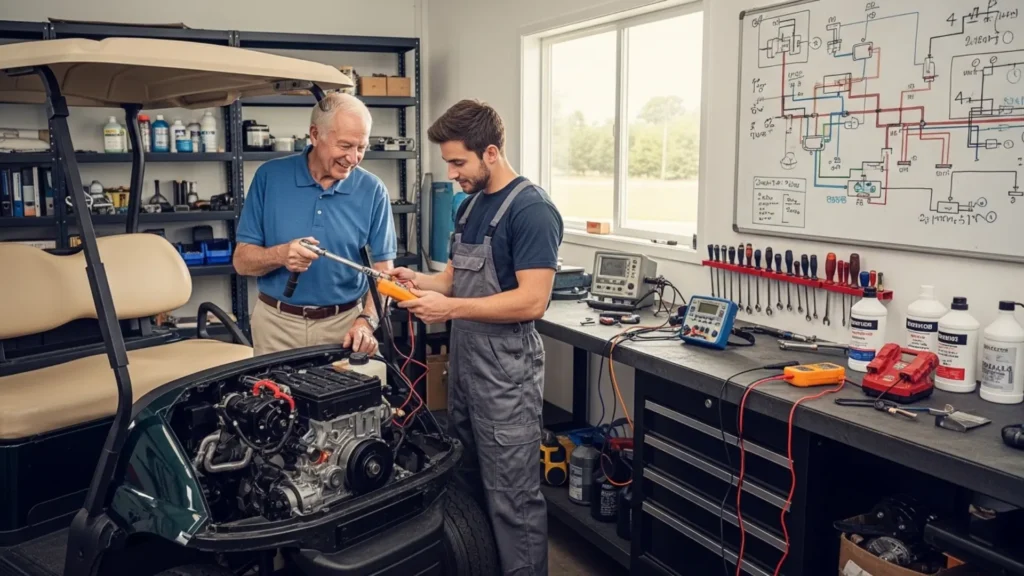
Technique 1: Equalization Charging — The Most Effective Tool Available
Equalization charging is a controlled overcharge performed at a voltage approximately 10% above the battery’s normal absorption voltage. For a 48-volt system, this means a charge at approximately 62-64 volts for a defined period, rather than the normal absorption voltage of 58-59 volts. During equalization, the elevated voltage forces more vigorous electrochemical activity in all cells simultaneously, dissolving lightly crystallised lead sulfate deposits and restoring more uniform cell-to-cell balance.
Equalization is not a one-time rescue technique — it is a periodic maintenance procedure that prevents sulfation from progressing rather than reversing it after the fact. A battery pack that is equalized every 30-60 days throughout its service life will develop significantly less sulfation than an identical pack that is never equalized. This is the single most impactful maintenance practice for lead-acid golf cart batteries, and it is routinely skipped by a majority of owners.
For batteries with existing moderate sulfation, a more aggressive equalization protocol — sometimes called a conditioning charge — uses a lower current at the elevated voltage for an extended period of 3-6 hours. This prolonged elevated-voltage charging gives hard sulfate crystals more time to dissolve. The success rate for this approach depends critically on sulfation stage: early-stage batteries typically recover 15-25% of lost capacity. Mid-stage batteries recover 5-15%. Late-stage batteries show minimal response.
How to Perform an Equalization Charge
Before proceeding, note that equalization produces hydrogen gas and must be performed in a well-ventilated area. Do not equalize in a closed garage or confined space.
- Check electrolyte levels in all cells and top up with distilled water to the correct level. Never equalize a battery with low electrolyte — the elevated charging current in partially exposed cells causes immediate damage.
- Perform a standard full charge cycle first. Equalization on a partially discharged pack distributes the stress unevenly and produces less effective results.
- If your charger has an equalization mode, engage it according to the manufacturer’s instructions. The charger will automatically apply the elevated voltage for the correct duration.
- If performing manual equalization with a programmable charger: set output to approximately 2.3-2.4 volts per cell (16.1-16.8 volts for a 6-volt battery, 21.5-22.4 for an 8-volt battery), set current to approximately C/20 (5% of rated capacity in amps), and charge for 2-4 hours while monitoring for excessive heat or electrolyte boiling.
- Monitor each battery temperature during equalization. Batteries should warm slightly — this is normal and expected. If any battery becomes very hot to the touch (above 120°F / 49°C), disconnect immediately. Excessive heat indicates an internal short circuit or severe cell damage.
- After equalization, allow the pack to cool completely. Measure each battery’s static voltage after 2 hours of rest. A healthy pack should show uniform voltages within 0.1-0.2 volts across all batteries. A significant outlier (0.5V or more below the others) after equalization indicates a battery that did not respond and likely has a more serious failure mode than sulfation.
- Check and top up electrolyte levels again after equalization. The process accelerates water loss, and refilling is required before the next use.
Technique 2: Electrolyte Refresh for Dried or Stratified Cells
Electrolyte stratification is a specific problem where the sulfuric acid concentration in a cell is not uniform — higher at the bottom and lower at the top. This occurs when a battery is consistently charged without reaching full absorption (chronic undercharging), allowing denser sulfuric acid to settle to the bottom without the vigorous gas bubbling of a full charge to mix it.
Stratified electrolyte causes the plates at the top of the cell to operate in diluted acid, reducing their capacity contribution. The cell appears to charge and test normally at rest but underperforms under load because the upper portion of the plates has less electrochemical support.
The fix is straightforward: a proper equalization charge with vigorous gassing mixes the electrolyte mechanically through the bubbling action. This is why consistent equalization prevents stratification, and why an extended conditioning equalization can partially reverse it. For severely stratified cells, gently tilting the battery slightly back and forth (with gloves and eye protection) before charging can begin the mixing process.
Electrolyte replacement — physically replacing old, degraded electrolyte with fresh sulfuric acid solution — is a more aggressive intervention occasionally promoted in reconditioning guides. This is technically feasible but carries real risks: incorrect acid concentration damages plates, improper handling of concentrated sulfuric acid causes serious burns, and the procedure does not address any of the plate-level failure modes that are limiting capacity. It is generally not recommended for DIY application and rarely produces results that justify the risk and complexity over a proper conditioning charge cycle.
| SAFETY REMINDER | All equalization work requires: well-ventilated area (hydrogen gas is explosive at concentrations above 4%), safety glasses (electrolyte splash risk from vigorous gassing), chemical-resistant gloves, and no sources of ignition within several feet of the batteries. Equalization is safe when performed correctly in the right environment and dangerous when the ventilation requirement is ignored. |
Techniques With Mixed Evidence: Honest Assessment

Pulse Desulfation Devices
Pulse desulfation devices apply rapid, high-voltage electrical pulses to a battery under charge. The theory is that the oscillating electric field causes resonance in lead sulfate crystals, breaking them up more effectively than sustained DC charging alone. Some academic papers support this mechanism in principle, and there is published research showing modest capacity improvements in lightly sulfated batteries treated with pulse conditioning.
The honest picture is more nuanced. Pulse desulfation shows measurable benefit specifically in early-stage sulfation on relatively young batteries that have not experienced other failure modes. On mid-to-late stage sulfated batteries, or batteries that have other simultaneous failure modes (grid corrosion, shedding), the effects are minimal. The devices do not work at all on mechanically damaged batteries.
The market for pulse desulfators includes a wide range of products from reputable electronics-based units ($60-$200) to questionable devices with inflated claims ($15-$40). The better-quality units from brands like Battery Tender and CTEK have earned reasonable reviews from users with early-stage sulfation issues. The inexpensive generic units are harder to evaluate because their actual output specifications rarely match their marketing claims.
Our honest recommendation: a pulse desulfator is worth trying on a battery pack that is 2-4 years old, showing mild capacity reduction, and has been kept adequately watered and properly charged apart from incomplete equalization. Do not invest in one for a 7-year-old battery pack that has been chronically undercharged — the improvement, if any, will be modest and the pack needs replacement regardless.
Epsom Salt (Magnesium Sulfate) Treatment
The Epsom salt treatment involves dissolving magnesium sulfate in distilled water and adding it to the battery’s electrolyte, typically with the goal of improving ionic conductivity and supposedly assisting in dissolving lead sulfate deposits. This is one of the most widely promoted DIY reconditioning techniques and one of the most contentious.
The theoretical argument for Epsom salt has some electrochemical logic to it: magnesium sulfate does increase electrolyte conductivity, and magnesium ions could theoretically compete with lead ions at sulfate crystal surfaces in ways that might slightly aid dissolution. These effects have been observed in laboratory settings under specific, controlled conditions.
The practical results in golf cart batteries tell a different story. Well-controlled tests of Epsom salt treatments in actual lead-acid batteries generally show minimal statistically significant improvement over a properly executed equalization charge alone. The confounding factor is that Epsom salt treatments are almost always performed alongside watering and equalization — so any improvement observed could be (and usually is) attributable to the water top-up and equalization, not the Epsom salt itself.
More importantly, there is a meaningful downside risk. Adding any substance to a battery’s electrolyte that is not part of the original formulation changes the electrolyte chemistry in ways that are not fully predictable. Magnesium sulfate at high concentrations can potentially cause issues with plate surface chemistry over time. Most battery manufacturers explicitly void warranty coverage on batteries that have had any additive placed in the electrolyte.
Our honest assessment: Epsom salt treatment has a plausible theoretical basis but insufficient controlled evidence to recommend it over proper equalization charging. For batteries still within useful service life, clean equalization is the better-evidenced intervention with less downside risk. For batteries at end of life, no chemical additive is going to change the fundamental outcome.
Electrolyte Additives and Conditioners
The battery additive market offers a range of products claiming to improve conductivity, reduce sulfation, extend cycle life, and restore lost capacity. Products like Battery Ez, Battery Chem, and various brand-name golf cart battery conditioners fill shelves at motorsport retailers and golf cart shops.
These products are universally marketed with confident efficacy claims and case-study testimonials. The evidence base for most is minimal. Independent testing of battery additives has consistently shown that any benefits observed in user testimonials are indistinguishable from the normal variation in battery performance and from the benefits of the watering and charging that accompany additive use.
There are two honest exceptions worth noting. Battery additives that are simply purified versions of the electrolyte’s natural components (some electrolyte enhancer products) have less downside risk than multi-compound chemical mixtures and may provide modest conductivity benefit. Products designed specifically for water refreshment and acid concentration correction in dried-out batteries have a clearer use case than general-purpose additives.
The category as a whole, however, does not deliver on its marketing promises for the majority of users. The $15-$40 spent on a battery additive is almost always better invested in a quality charger that has an equalization mode — the single most impactful maintenance tool for lead-acid battery longevity.
The Complete Reconditioning Protocol: What to Do, in What Order

If you have decided that your battery pack is worth attempting to recondition — it is 2-5 years old, not severely degraded, and you want to extend its useful life — here is the complete protocol in the correct sequence. This is the approach that gives the highest probability of meaningful capacity recovery without the downside risks of unproven additives.
Step 1: Full Diagnostic Assessment
- Measure each battery’s static (resting) voltage. A properly charged 6V battery should read 6.3-6.4V. An 8V battery should read 8.4-8.5V. Significant departure from these values after a full charge indicates a problem cell.
- Perform a load test on each battery individually. Use a carbon pile load tester or apply a known load and measure the voltage drop after 30 seconds. A battery that drops more than 0.5V below its resting voltage under a 75-amp load has reduced capacity. A battery that drops more than 1.5V is in a seriously degraded state.
- Measure electrolyte level in all cells. Use a hydrometer to measure specific gravity in each cell if accessible. A healthy fully-charged cell reads 1.265-1.280 specific gravity. A reading below 1.200 indicates a significantly discharged or sulfated cell.
- Inspect for physical damage: cracks, bulges, terminal corrosion, loose connections, discolouration from heat exposure. Physical damage is a disqualifying condition — do not attempt to recondition physically damaged batteries.
Step 2: The Go/No-Go Decision
Based on the diagnostic results, apply this decision framework:
| Diagnostic Finding | Decision | Reasoning |
| Static voltage within 0.3V of spec, mild load drop (0.3-0.8V), specific gravity 1.220-1.250 | RECONDITION | Early-to-mid sulfation. High probability of meaningful recovery through equalization. Worth the time investment. |
| One battery with static voltage 0.5V+ below others after full charge | TARGETED | Single-battery issue. Recondition that specific battery with extended conditioning charge. Replace if no response. |
| Load drop >1.5V on multiple batteries, specific gravity below 1.200 | BORDERLINE | Mid-stage degradation. Reconditioning may yield 10-15% recovery but the pack is near end of life. Evaluate whether recovery justifies the time. Consider replacement timeline. |
| Load drop >2V on any battery, immediate voltage collapse on load, specific gravity below 1.150 | REPLACE | Late-stage degradation or internal short. No reconditioning technique produces meaningful recovery. Replacement is the correct decision. |
| Physical damage: cracks, bulges, shorted cell (voltage near 0V) | REPLACE | Mechanical failure. No chemical or electrical treatment addresses physical plate, case, or separator damage. |
| Battery age >6 years, multiple degradation indicators present | REPLACE | At this age and condition, even successful reconditioning extends useful life by months, not years. The economics of new batteries are almost always better. |
Step 3: Pre-Conditioning Preparation
- Top up all cells with distilled water to the correct level — just below the bottom of the filler tube, not to the top.
- Clean all terminal connections. Remove corrosion with baking soda solution and a wire brush. Apply anti-corrosion spray after cleaning.
- Perform a standard full charge cycle with your normal charger before beginning the conditioning sequence. Starting the conditioning protocol on a partially discharged pack produces less effective results.
- After the full charge, allow the pack to rest for 2-4 hours so surface charge dissipates and terminal voltage settles to the true resting voltage.
Step 4: The Multi-Cycle Conditioning Sequence
This sequence works best with a programmable charger like the Lester Summit II or Delta-Q that allows manual control of charge voltage and current, or a charger with a dedicated reconditioning mode.
- Cycle 1 — Extended Absorption Charge: Apply a full charge allowing the charger to run through its complete cycle including absorption phase. After the charger terminates, immediately reconnect and run another complete cycle. This double-charge sequence drives the pack as fully charged as possible before equalization.
- Cycle 2 — Deep Discharge and Recharge: Discharge the pack to approximately 50% state of charge (measured by voltage: around 48-49V pack voltage for a 48V system). Then perform a full charge to completion including full absorption. This full cycle helps break up surface sulfation by stressing the plates through a complete electrochemical cycle.
- Cycle 3 — Equalization: Engage your charger’s equalization mode, or manually set to equalization voltage (approximately 2.35V per cell x number of cells) for 2-4 hours. Monitor temperatures throughout. Complete equalization with a standard full charge.
- Post-conditioning measurement: Allow a 4-hour rest and measure each battery’s static voltage. Run a load test and compare results to pre-conditioning measurements. Document the improvement.
- Repeat if needed: If significant improvement was achieved (5%+ capacity recovery) but the pack is still below target performance, repeat cycles 2 and 3 once more. Do not repeat more than twice — if two conditioning sequences have not produced adequate recovery, the batteries have failure modes beyond sulfation that will not respond to further treatment.
| REALISTIC EXPECTATIONS | A successful reconditioning sequence on a 3-5 year old pack with moderate sulfation typically recovers 10-25% of lost capacity. If a pack that was achieving 15 miles per charge recovers to 17-18 miles, that is a successful outcome. Do not expect to recover a degraded pack to its original specification — cells that have experienced any of the non-sulfation failure modes have permanent damage that no conditioning protocol addresses. |
Prevention Is Better Than Reconditioning: The Maintenance Habits That Make It Unnecessary
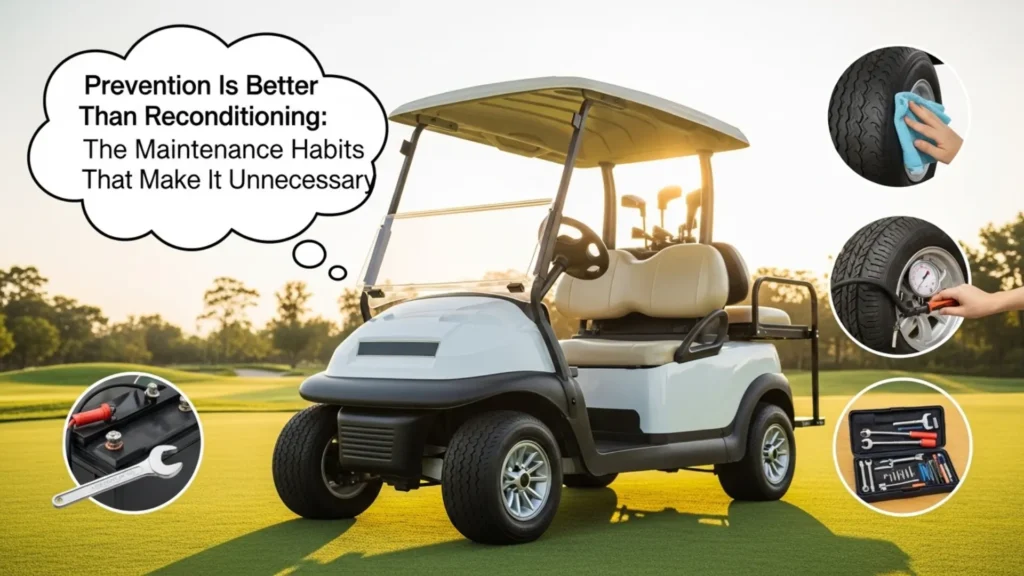
The most important insight in this entire guide is not how to recondition batteries — it is that consistent application of the right maintenance habits makes reconditioning largely unnecessary. A battery pack that is properly maintained throughout its service life degrades at a fraction of the rate of a neglected pack and maintains usable capacity 30-50% longer. Prevention is not just better than cure — it is dramatically more effective.
The Four Habits That Prevent Premature Battery Failure
Habit 1: Charge after every single use without exception. A lead-acid battery that sits in a partially discharged state begins sulfating immediately. One discharge that is not followed by a recharge within 12-24 hours does measurable damage. The discipline of plugging in after every use, every time, without exception, is the single highest-impact maintenance habit available. It costs nothing, takes five seconds, and extends battery life by years.
Habit 2: Equalize every 30-60 days. Most battery manufacturers and all experienced golf cart technicians recommend equalization every 30-60 days of regular use. A charger with an equalization mode (Lester Summit II, Delta-Q IC650) performs this automatically when engaged. For owners without equalization-capable chargers, this is the strongest argument for upgrading the charger rather than just the batteries at the next replacement.
Habit 3: Check and maintain electrolyte levels monthly. Set a calendar reminder. Before checking levels, confirm the pack is fully charged — electrolyte level is lower when the battery is discharged and you will overfill if you top up before charging. Add only distilled water, never tap water. The dissolved minerals in tap water contaminate the electrolyte and accelerate plate corrosion. Use a proper battery watering gun or syringe — overfilling by pouring from a container is a common mistake that introduces too much water and dilutes the electrolyte concentration.
Habit 4: Keep terminals clean. Acid vapour and moisture in the battery compartment cause terminal corrosion that increases resistance in the pack circuit. Higher resistance means lower effective pack voltage under load, reduced performance, and higher charging losses. A quarterly terminal cleaning with baking soda solution and anti-corrosion spray prevents the gradual performance degradation that most owners attribute to battery aging when it is actually connection degradation.
The Charger as the Most Important Maintenance Tool
A quality automatic charger with an equalization mode is more important to battery longevity than any reconditioning technique or battery additive. Here is the economic argument in plain numbers: a Lester Summit II charger costs $300-$400 and has an 8-10 year service life. A set of Trojan T-875 batteries costs $990-$1,170 and lasts 5-7 years with proper maintenance versus 3-4 years with an inadequate charger.
The difference in battery lifespan between a pack maintained with a quality charger that equalizes automatically versus a pack maintained with an inadequate OEM charger that never equalizes is typically 18-24 months of additional service life. On a $1,100 battery pack, 18 months of additional service life represents approximately $200 in amortised battery cost — more than covering the price premium of the better charger. The economics of charger investment are unambiguous.
For owners who are currently using an OEM charger that is more than 5-7 years old, or an OEM charger that does not have an equalization mode, upgrading the charger at the same time as the next battery replacement is the most impactful single investment in battery longevity available.
When to Accept That Replacement Is the Only Answer
There is no shame in concluding that a battery pack cannot be recovered. Lead-acid batteries have a finite service life, and the degradation mechanisms described in this guide are inherent to the chemistry. A battery pack that has been in service for 5-7 years in a regularly used cart has completed most of its design life regardless of how well it was maintained. Reconditioning at that point is maintenance on a product near the end of its viable service — it may buy some additional time but it is not an alternative to eventual replacement.
The specific indicators that mean replacement is the correct decision — not reconditioning — are:
- Any battery showing a load voltage collapse to below 5.5V (6V battery) or 7.0V (8V battery) under a 75-amp test load
- Any battery maintaining significantly lower voltage than the rest of the pack after a complete conditioning sequence
- Physical damage of any kind: cracked case, bulging case, corroded terminals that cannot be cleaned to bare metal, leaking electrolyte
- A shorted cell — evidenced by a battery that reads significantly below nominal voltage (below 5V for a 6V battery) at rest after a full charge
- A pack that required reconditioning less than 18 months ago — packs that need repeated reconditioning at short intervals have progressed to failure modes that reconditioning cannot address
- Battery age above 6 years with any measurable degradation — the economics of reconditioning aged batteries rarely justify the effort compared to the performance and reliability of a fresh pack
When replacement is indicated, the entire pack should be replaced simultaneously. Replacing one or two batteries in a string while leaving older batteries in place creates a matched-cells problem — the fresh batteries will cycle at different voltages than the older ones, producing uneven charge distribution that degrades both the old and new batteries faster than if replaced as a complete set.
| HONEST ADVICE | The most common outcome of attempted reconditioning on a 6-year-old battery pack that has been through moderate-quality maintenance is: the pack recovers 10-15% capacity, the improvement is noticeable for 2-4 months, and then the pack degrades to its pre-reconditioning performance level as the underlying non-recoverable failure modes continue progressing. If the goal is 6 more months from the pack, reconditioning is reasonable. If the goal is 18+ months of reliable performance, new batteries are the correct answer. |
What the Chemistry Textbooks and the Marketing Copy Both Get Wrong
The reconditioning market exists at the intersection of legitimate science and motivated reasoning, and navigating it requires understanding both. The legitimate science is real: sulfation is a reversible electrochemical process at early stages, and the techniques described in this guide for addressing it — equalization, conditioning cycles, electrolyte maintenance — have genuine scientific basis.
The motivated reasoning is also real: battery reconditioning products are sold to customers at a moment of financial stress (the prospect of a $1,000+ battery replacement), and the confirmation bias of customers who performed watering, cleaning, and equalization alongside an additive or pulse device is powerful. Most positive testimonials for reconditioning products are genuine — the batteries did improve. The attribution of that improvement to the specific product rather than the maintenance context is usually incorrect.
The pattern we observe most consistently in our customer support interactions is this: an owner who has been inconsistently maintaining their batteries discovers they are underperforming, purchases a reconditioning product, and as part of applying the product also tops up the water, cleans the terminals, and runs a full charge sequence. The batteries improve. The product gets the credit. The maintenance gets none.
The inverse is equally instructive: an owner with severely degraded batteries who applies every reconditioning technique in sequence — Epsom salt, pulse conditioning, multiple equalization cycles, electrolyte refresh — achieves essentially no improvement. They call us frustrated that nothing worked. What did not work was attempting to recover physical plate damage, grid corrosion, and late-stage sulfation through techniques designed for earlier-stage failure modes. The chemistry was not going to respond, regardless of effort.
The honest framework: reconditioning techniques are maintenance tools most effective as prevention and early intervention. They are not rescue techniques for batteries at end of life. Use them consistently throughout the pack’s service life for maximum impact, not desperation interventions in the final months of a failing pack.
| E-E-A-T NOTE | Golf Cart Gears stocks quality battery chargers with equalization modes, battery watering kits, anti-corrosion treatments, and terminal maintenance products — the tools that actually extend battery life. We also stock complete battery replacement sets from Trojan, US Battery, Crown, and lithium options from Dakota and Eco Battery for when replacement is the right answer. Our toll-free team helps you evaluate where your pack is in its service life and which path makes financial sense. |
Frequently Asked Questions
Can you recondition lithium golf cart batteries?
No. LiFePO4 lithium batteries do not experience the sulfation failure mode that reconditioning techniques address. Lithium cells degrade through a different mechanism — SEI layer growth on the anode, lithium plating under extreme conditions, and gradual capacity fade from repeated cycling. None of these mechanisms respond to equalization charging, Epsom salt, or pulse conditioning. A lithium pack that is underperforming should be assessed by the BMS diagnostic data through the app (Eco Battery) or by measuring individual cell voltages with a multimeter. If capacity has fallen below 70% of the original rating within the warranty period, the manufacturer’s warranty process is the correct path.
Is Epsom salt treatment actually effective for golf cart batteries?
Controlled testing consistently shows that Epsom salt treatments produce minimal capacity improvement beyond what a properly executed equalization charge achieves on its own. The theoretical mechanism (magnesium sulfate increasing electrolyte conductivity) exists, but the practical effects in actual batteries are small and difficult to distinguish from the benefits of the accompanying watering and charging. More concerning is the risk of voiding the battery warranty and the potential for unintended electrolyte chemistry effects. Our recommendation is to skip the Epsom salt and invest in a proper equalization charge instead.
How do I know if my golf cart battery needs reconditioning or replacement?
The load test is the definitive diagnostic. A fully charged battery that drops more than 1.5 volts below resting voltage under a 75-amp load sustained for 30 seconds is in a degraded state. If the battery is under 5 years old, shows moderate (not severe) voltage drop, and has no physical damage, reconditioning is worth attempting. If it is over 6 years old, shows severe voltage collapse, or has physical damage, replacement is the correct path. The go/no-go decision table in Section 4 provides the complete framework.
My golf cart battery voltages look fine but the cart is slow and has poor range. Why?
Static voltage is often misleading because it reflects surface charge rather than true capacity. A battery can show a perfectly normal resting voltage (6.3V for a 6V battery) but collapse under load, delivering only a fraction of its rated capacity before voltage drops below the system’s operational threshold. A load test reveals this — static voltage measurement does not. Perform individual battery load tests to identify the weak cells that are limiting pack performance.
How many times can you recondition golf cart batteries?
Equalization charging can and should be performed every 30-60 days throughout the battery’s service life — it is a maintenance procedure, not a one-time fix. The more intensive conditioning sequence described in this guide (multiple charge-discharge cycles plus equalization) can be performed two to three times on a degraded pack. Beyond three attempts without meaningful improvement, the batteries have failure modes that do not respond to electrical treatment, and replacement is the answer.
What is the best charger for reconditioning golf cart batteries?
The Lester Summit II is the most recommended charger for both ongoing battery maintenance and active reconditioning. It has a built-in equalization mode, a conditioning cycle option, selectable chemistry profiles for flooded, AGM, and lithium batteries, and a fault display that identifies battery issues during charging. The Delta-Q IC650 with the flooded lead-acid algorithm is an excellent alternative. Either charger, used consistently with its equalization mode, prevents the need for aggressive reconditioning in most battery packs.
Should I try to recondition batteries before replacing the whole pack?
If the batteries are 2-4 years old with moderate degradation and no physical damage: yes, it is worth attempting a conditioning sequence before replacement. The potential to extend useful life by 12-18 months at essentially no cost (just time) is a reasonable investment. If the batteries are 6+ years old, severely degraded, or showing physical damage: no. The reconditioning effort will produce minimal results and delay what is the correct inevitable decision. The longer you run a severely degraded pack, the more stress it puts on your charger and motor controller as those components work harder to compensate for inadequate battery voltage.
The Honest Bottom Line
Battery reconditioning is a real technique with real scientific basis for specific, well-defined failure modes at specific stages of degradation. It is not a magic recovery method for batteries at end of life, and the products marketed as battery restorers and conditioners are, with a few exceptions, offering less than they claim.
The techniques that actually work are not mysterious or expensive: equalization charging, proper electrolyte maintenance, and consistent full-charge discipline. These are the same practices that prevent premature battery failure in the first place. They cost essentially nothing to implement beyond a quality charger and a bottle of distilled water.
The framework for using this guide: diagnose before intervening (load test every battery), be honest about what stage of degradation you are dealing with (early sulfation responds, mechanical failure does not), apply the conditioning sequence in the right order for maximum effect, and accept replacement when the diagnostic evidence points there. A battery pack that receives consistent equalization and watering throughout its service life rarely needs the intervention this guide describes — which is exactly the point.
Spend the $300-$400 on a Lester Summit II before you spend it on reconditioning products. The charger with equalization mode is the single best investment in battery longevity available at any price point, and it pays for itself in extended battery life on the very first pack it maintains.