
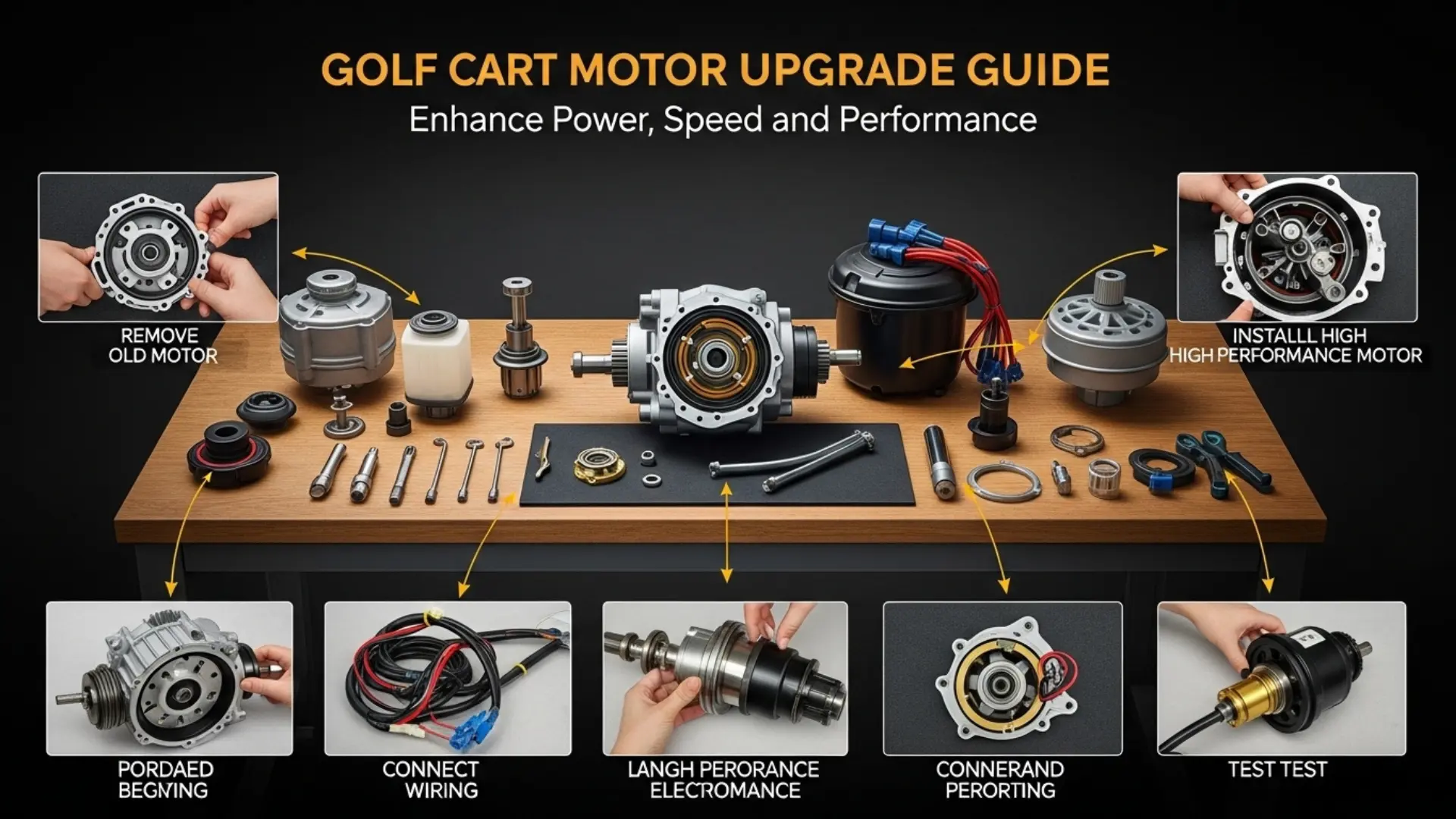
The Upgrade Most Golf Cart Owners Do Wrong
Ask a golf cart owner who wants more speed what they need and the most common answer is a faster motor. They have already priced motors online, found something that says high-torque or high-speed in the listing title, and are ready to buy. The problem is that in golf cart performance, the motor is almost never the limiting factor — the controller is.
Your OEM golf cart controller is programmed at the factory with deliberately conservative current limits. This protects the motor from overheating in worst-case fleet use, protects the battery pack from high discharge rates that would reduce cycle life, and protects the manufacturer from warranty claims on vehicles used harder than intended. The result is a cart that has significantly more performance capability in its existing motor than the controller is allowing it to deliver.
A controller upgrade on a stock motor typically adds 3-5 mph to top speed and noticeably improves acceleration and hill-climbing ability without touching the motor at all. The controller upgrade costs $200-$450. Replacing the motor without upgrading the controller costs more and delivers considerably less benefit.
That said, motor upgrades are genuinely valuable in specific scenarios — when the existing motor has worn brushes, when you want the maintenance-free benefit of switching to AC, or when you want the absolute highest performance ceiling that the 48V platform can deliver. This guide covers both the controller upgrade path and the motor upgrade path with the technical depth needed to make an informed decision, including a direct comparison of the three leading aftermarket controller brands.
Table of Contents
| QUICK ANSWERWhat is the best way to get more performance from a golf cart?Step 1 — Controller upgrade first: Alltrax, Navitas, or Curtis controller swaps on a stock motor add 3-6 mph and meaningfully improve torque. Best ROI of any single upgrade. Cost: $200-$450.Step 2 — High-torque motor if needed: For maximum hill performance, a high-torque DC motor paired with an upgraded controller delivers the best results from the DC platform. Cost: $250-$500 for motor.Step 3 — AC motor conversion for ultimate performance: Navitas and Ride4Fun AC conversion kits replace the DC motor and controller with a brushless AC system. Top speed 20-24 mph, zero brush maintenance. Cost: $650-$1,200 complete kit.48V only: All meaningful performance upgrades require a 48V system. If your cart is still 36V, voltage conversion (covered in Blog 10) is the prerequisite before any motor or controller upgrade. |
DC vs AC Golf Cart Motors: The Physics That Actually Matter
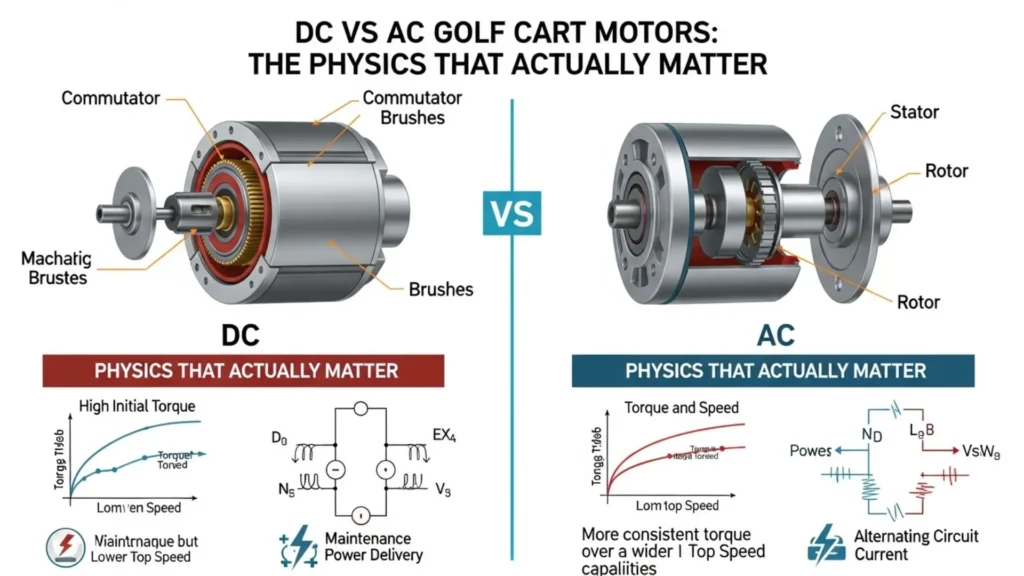
The debate between DC and AC motors in golf carts is not primarily about which one is faster or stronger in absolute terms — modern DC and AC systems can both deliver impressive performance. The real differences are in maintenance requirements, efficiency profile, throttle response, and how each type handles regenerative braking. Understanding these differences helps you choose the right upgrade path for your specific priorities.
DC Series-Wound Motors: How They Work
The DC series-wound motor is the traditional golf cart motor, used in virtually every electric golf cart built before approximately 2008. The series-wound designation means the field windings — the electromagnets that create the magnetic field the armature rotates within — are wired in series with the armature, meaning the same current that drives the armature also magnetises the field.
This series configuration produces a characteristic performance curve that is actually well-suited to golf cart use: at low speed and high load (starting from a stop, climbing a hill), the motor produces maximum torque because the high current creates maximum field strength. As speed increases and load decreases, torque tapers naturally. This built-in torque-speed tradeoff is why DC series motors feel responsive and strong from a standing start.
The limitation is the carbon brush system. The armature in a DC series motor rotates inside the field, and current is transferred to the rotating armature through carbon brushes that press against the commutator — a segmented copper ring on the armature shaft. These brushes wear down with use. A typical set of golf cart motor brushes lasts 3-6 years in regular residential use, after which brush replacement is required to maintain full motor performance. Brushes that are worn to less than 1/4 inch in length produce reduced torque, increased arcing, and commutator damage if not replaced.
The practical upshot: DC series motors are proven, durable, and repairable. Brush replacement is a legitimate DIY task on most platforms. The motor winding design is well-understood by aftermarket suppliers, and high-torque replacement motors with thicker windings (Series torque motors) and high-speed replacement motors with different winding ratios (Series speed motors) are available for every major golf cart platform.
AC Induction Motors: The Modern Architecture
AC induction motors have no brushes, no commutator, and no physical contact between stationary and rotating parts beyond the bearings. Current is induced in the rotor through electromagnetic induction — the rotating magnetic field from the stator causes current to flow in the rotor’s conductors without any physical contact. The result is a motor with essentially zero wear on electrical components. In normal golf cart use, an AC motor can last the entire remaining service life of the cart without any motor servicing required.
The performance profile of AC motors differs from DC series motors in important ways. AC motors deliver more consistent torque across the entire speed range — they do not taper off as strongly at higher speeds as a DC series motor does. This translates to a cart that maintains strong acceleration and pull throughout its speed range rather than feeling strong off the line and progressively less responsive at higher speeds.
AC motors also enable regenerative braking — the ability to convert the kinetic energy of the cart back into electrical energy during deceleration. When the driver lifts off the accelerator, an AC motor can be switched into generator mode, slowing the cart through magnetic braking while simultaneously returning charge to the battery pack. The EZGO RXV uses this principle and is notable among stock carts for its noticeably stronger engine-braking feel and marginally better range compared to DC-motor TXT models.
The tradeoff is complexity and cost. An AC motor requires an AC motor controller — a significantly more sophisticated power conversion device than a DC controller. The controller must generate the three-phase AC waveform that drives the motor, and it must do this precisely to control speed and torque. This is why AC conversion kits cost $650-$1,200 compared to $200-$450 for a DC controller upgrade. The AC controller is a more capable but more expensive device.
DC vs AC: Which Is Right for You?
| Factor | DC Series Motor | AC Induction Motor |
| Motor maintenance | Brush replacement every 3-6 years. DIY-feasible, $15-45 in parts. | None — no brushes, no commutator. Motor is maintenance-free for life. |
| Torque at low speed | Excellent. Series winding produces maximum torque at standstill. | Very good. Consistent but slightly different feel vs DC series. |
| Torque at high speed | Tapers off as speed increases — characteristic of series winding. | More consistent. Maintains torque across wider RPM band. |
| Top speed potential | 18-22 mph with upgraded controller and motor. | 20-24 mph with AC conversion kit. |
| Regenerative braking | Not available on DC series motors. | Standard feature — extends range 8-12% in typical use. |
| Upgrade entry cost | $200-$450 (controller only). $450-$900 (controller + motor). | $650-$1,200 (complete AC kit with controller). |
| Heat management | Brush arcing generates heat. Higher temps reduce performance and brush life. | Lower heat generation. Better sustained performance in hot conditions. |
| Simplest upgrade path | Controller swap only — stays in existing motor pocket. | Full motor + controller replacement — higher complexity installation. |
| Best for | Budget upgrades, casual performance improvement, older carts worth preserving. | Maximum long-term performance, maintenance elimination, premium builds. |
Motor Controllers: The Real Performance Variable
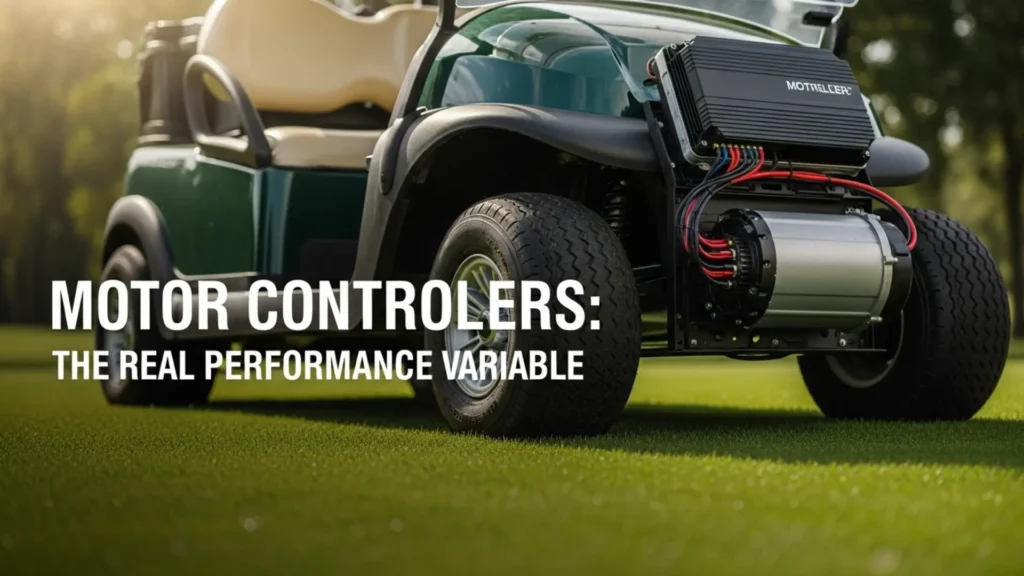
The motor controller is the electronic brain between your battery pack and your motor. It takes the driver’s throttle input and translates it into precisely modulated power delivery to the motor — controlling current, voltage, and timing to produce the desired speed and torque response. The OEM controller in most stock golf carts is programmed conservatively, with current limits and speed cutoffs well below the motor’s actual capability.
Understanding what the controller actually does — and what you can change — is the foundation of intelligent golf cart performance upgrades. Almost every meaningful performance improvement comes from changing what the controller allows the motor to do, not from swapping the motor for a different one.
What OEM Controllers Limit and Why
The OEM Alltrax 350 controller in a standard EZGO TXT limits motor current to approximately 250-300 amps. The same motor can safely handle 400+ amps intermittently without damage. The current limit is set low to reduce battery pack stress, reduce motor heat generation over an extended operating cycle, and protect the drivetrain from shock loads that high-torque acceleration would create. These are legitimate engineering choices for a product used in fleet rental environments where the operator does not own the equipment and may not maintain it carefully.
For an owner-operated cart that is maintained properly, charged after every use, and not subjected to commercial-fleet duty cycles, those conservative limits are unnecessarily restrictive. Raising the current limit from 250A to 350A on a stock motor is the single change that produces the most significant improvement in acceleration and hill-climbing performance — typically without any additional motor risk in normal residential use.
Top speed is controlled by a different parameter — the speed cutoff or the maximum field weakening setting. The OEM controller begins limiting power above a programmed speed threshold to prevent the cart from exceeding its design speed. Raising this threshold allows the motor to continue accelerating to a higher top speed. On most 48V DC platforms, a controller upgrade moves top speed from the stock 14-15 mph to 18-20 mph without any other modifications.
Alltrax vs Navitas vs Curtis: The Controller Comparison That Actually Tells You Something
Three controller brands dominate the golf cart performance aftermarket: Alltrax, Navitas, and Curtis. Each has a different history, different product philosophy, and different sweet spot in the market. Here is the honest breakdown.
Alltrax: The Performance Standard
Alltrax was the first major aftermarket controller brand specifically targeting the golf cart performance market, and it remains the benchmark against which other options are evaluated. The AXE series (for EZGO TXT and similar DC platforms) and the SR series (for Club Car DS and Precedent) are the flagship products.
Alltrax controllers are programmable via the Alltrax DeviceNet tool — a free software application that communicates with the controller through a serial port. Users can adjust current limits, speed limits, acceleration rate, braking rate, and a range of other parameters. This programmability is what separates Alltrax from a simple plug-in upgrade — it allows the controller to be tuned specifically to the cart’s motor, battery, and intended use.
The AXE 4834 (48V, 300A) and AXE 4845 (48V, 450A) are the two most popular Alltrax models for residential upgrades. The 4834 provides a meaningful upgrade over the OEM controller and suits most residential use cases. The 4845 is for owners who want the maximum DC platform performance — it raises the current ceiling high enough to stress some motor windings at sustained high-load operation, so it pairs best with a high-torque motor replacement.
Navitas: The AC Conversion Leader
Navitas made its name in golf carts by offering the first widely available, drop-in AC motor and controller conversion kits for the EZGO TXT platform. The Navitas 48V AC Kit (motor + controller) replaces the original DC motor and Curtis DC controller with a brushless AC induction motor and a purpose-built AC controller that communicates with the AC motor’s encoder for precise speed and torque control.
The performance improvement from a Navitas AC kit on an EZGO TXT is dramatic by stock standards: top speed moves from 14-15 mph to 20-22 mph, acceleration is noticeably crisper throughout the speed range, and the motor is permanently maintenance-free. The regenerative braking feature adds a modest range benefit (8-12% in typical use) and provides a satisfying engine-braking feel that stock DC carts lack.
Navitas has expanded its platform coverage significantly. DC controller upgrades from Navitas are also available for Club Car DS, EZGO TXT, and Yamaha Drive platforms — these are less celebrated than the AC kits but represent a competitive alternative to Alltrax in the pure DC upgrade market, typically at similar pricing.
The Navitas AC kit installation is more involved than a DC controller swap — the motor must be physically replaced in addition to the controller, which requires removing the motor from its mount and disconnecting the coupling. Most competent DIYers can complete the installation in 3-5 hours with the right tools and a clear installation manual.
Curtis Instruments: The Commercial-Grade Option
Curtis Instruments has been manufacturing motor controllers for industrial and commercial electric vehicles since before golf carts were a major market. The Curtis 1234 series AC controller and Curtis 1209 / 1510 DC controllers are used as OEM equipment in commercial golf carts and material handling vehicles worldwide.
Curtis controllers are not as prominently marketed in the residential golf cart upgrade space as Alltrax or Navitas, but they are well-regarded by fleet operators and commercial resellers. The Curtis 1234 AC controller (used in the Navitas AC kit and also available independently) is a well-proven commercial-grade unit with programmability via the Curtis CAN programmer tool.
The Curtis DC controllers — particularly the 1209B and 1510 series — are premium alternatives to Alltrax in the DC upgrade space. They are programmable, durable, and well-supported by Curtis’s commercial service network. The primary reason they are less common in residential upgrade applications is distribution — Alltrax has stronger golf cart dealer relationships in the aftermarket segment, while Curtis sells primarily through commercial and industrial channels.
Controller Comparison Table
| Model | Type | Voltage | Max Current | Price | Best For |
| Alltrax AXE 4834 | DC | 48V | 300A | $220–$280 | EZGO TXT, most DC 48V carts. Best entry-level performance upgrade. Programmable. |
| Alltrax AXE 4845 | DC | 48V | 450A | $280–$360 | High-performance DC builds. Pairs with high-torque motor. Not needed for stock motor. |
| Alltrax SR 48300 | DC (Regen) | 48V | 300A | $260–$320 | Club Car DS. Regenerative braking on DC motor. Excellent all-around upgrade. |
| Navitas 48V AC Kit | AC (motor+ctrl) | 48V | 400A equiv. | $700–$950 | EZGO TXT and Club Car DS. Full AC conversion. Max performance + zero motor maintenance. |
| Navitas DC 48300 | DC | 48V | 300A | $230–$290 | Competitive Alltrax alternative. Good programmability. Slightly different tuning interface. |
| Curtis 1234-4321 | AC | 24-80V | 350A | $380–$480 | Commercial-grade AC. Used in OEM EZGO RXV and Navitas AC kits. Best long-term durability. |
| Curtis 1510A-5151 | DC | 48V | 500A | $290–$380 | High-current DC applications. Commercial and heavy-duty carts. Strong programmability. |
Motor Upgrade Options: When You Actually Need a New Motor
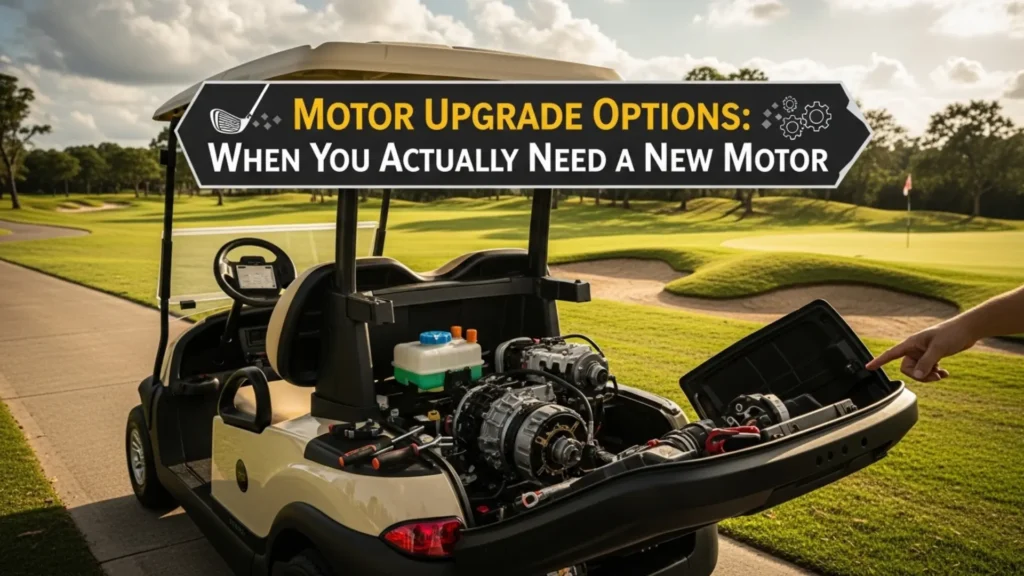
As established at the outset of this guide, the controller limits performance more than the motor in most stock carts. But there are legitimate scenarios where a motor upgrade is the right call — and when it is, choosing the right motor for your specific goal makes a meaningful difference to the outcome.
High-Torque DC Motors: For Hills and Hauling
A high-torque motor is wound with more turns of heavier gauge wire in the field and armature windings. This produces more magnetic flux per amp of current, which translates directly to more torque at low speed — the kind of pull you feel accelerating from a stop or climbing a steep grade. The tradeoff is slightly lower top speed compared to a high-speed motor, because the high-torque winding geometry also increases back-EMF at higher RPMs.
The most popular high-torque motors for EZGO TXT platforms are wound for 300-350 ft-lbs of torque at peak output — approximately 25-30% more than the stock motor. For a cart used primarily in hilly terrain, carrying multiple passengers or heavy cargo regularly, or towing a trailer, the high-torque motor paired with an Alltrax AXE 4845 controller produces noticeably better sustained performance than a controller upgrade alone.
Brands and suppliers worth knowing in the high-torque DC motor market include Advanced EV, D&D Motor Systems, and Plum Quick Motors. All three produce motors specifically matched to EZGO, Club Car, and Yamaha platform bolt patterns and shaft dimensions — a critical detail since motors with incorrect shaft sizing or mounting patterns require adapter hardware that adds cost and complexity.
High-Speed DC Motors: For Top Speed Focus
A high-speed motor uses fewer turns of finer wire in its windings — the opposite configuration from a high-torque motor. This reduces back-EMF at higher RPMs, allowing the motor to spin faster before the controller’s speed limit becomes the bottleneck. High-speed motors produce peak power at higher RPM and deliver lower torque at low speed compared to high-torque motors.
The practical result: a high-speed motor paired with an upgraded controller produces higher top speed (typically 22-26 mph on a 48V system with appropriate programming) but slightly less responsive acceleration from a standing start compared to a high-torque motor. For flat-terrain use at higher sustained speeds — a community where cart paths run for distances and a faster cruise speed is the goal — the high-speed motor is the right choice.
For mixed-terrain use with hills and varied loads, the high-torque motor is almost always the better choice. The sensation of strong, confident acceleration and hill-climbing that a high-torque motor provides tends to be more satisfying in daily use than marginal additional top speed on terrain where you cannot safely use it anyway.
Platform-Specific Motor Fitments
| Cart Platform | Stock Motor | High-Torque Option | High-Speed Option | Notes |
| EZGO TXT (48V DC) | GE / Alltrax 350A / ~5hp | D&D / Advanced EV Torque Wind | Plum Quick Speed Wind | Most well-supported platform for DC upgrades. High-torque and high-speed options widely available. Navitas AC kit also available. |
| EZGO RXV (48V AC) | AC Induction Curtis 1234 | N/A (AC motor) | Controller tune only | RXV motor is already AC — high-torque/speed aftermarket not applicable. Controller programming is the primary upgrade path. |
| Club Car DS (48V DC) | GE / DCS ~5hp | D&D ES-690 or ADVANCED EV | Advanced EV Speed Wound | DS shares similar motor pocket with TXT. Most EZGO-spec motors fit with minor modification or adapters. Alltrax SR series is the controller upgrade standard. |
| Club Car Precedent (48V) | GE / DCS ~5hp | Advanced EV High Torque | Limited options | Precedent’s OBC complicates controller upgrades — OBC bypass is required for most aftermarket controllers. Fewer options than TXT/DS platforms. |
| Yamaha Drive2 (48V) | AC Induction (factory) | N/A (AC motor) | Controller tune only | Yamaha Drive2 electric uses AC motor from factory. Strong performance out of box. Primary upgrade path is controller programming, not motor replacement. |
Beyond Motor and Controller: The Other Factors in Golf Cart Speed
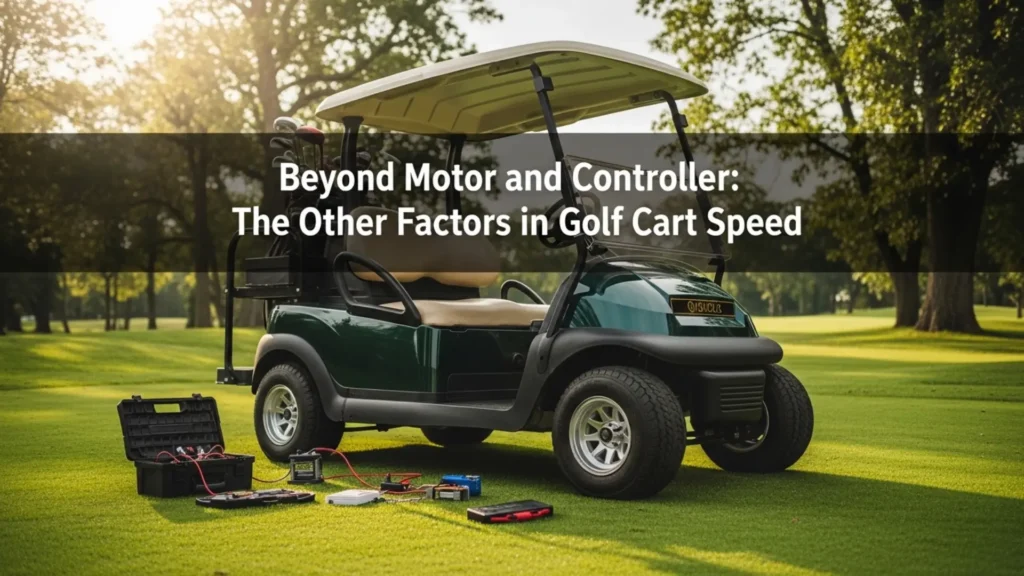
A controller and motor upgrade is the foundation of golf cart performance improvement, but the total speed and handling package depends on several other variables that many owners overlook when planning an upgrade.
Tire Size and Speed
Golf cart tire diameter has a direct, mathematical effect on top speed. A larger diameter tire covers more ground per revolution, effectively increasing the gear ratio between the motor and the ground. The relationship is linear: an 18-inch tire (diameter) replaced with a 22-inch tire produces a theoretical 22% increase in top speed at the same motor RPM.
In practice, the speed gain from larger tires is real but slightly less than the theoretical maximum, because larger tires also increase rolling resistance and rotational inertia, which slightly reduces acceleration. The net result on a controller-upgraded cart: moving from 18-inch OEM tires to 22-inch all-terrain tires adds 2-4 mph to top speed with a modest reduction in hill-climbing snap. For owners wanting maximum top speed on flatter terrain, larger tires are an inexpensive and effective complement to the controller upgrade.
Important caveat: larger tires on a standard-height cart will contact the fender or body on full steering lock in many platforms. Always verify clearance before purchasing upsized tires. A 3-inch or 4-inch lift kit is often the prerequisite for running 22-inch or larger tires — which is covered in detail in our Lifted Golf Cart Buyer’s Guide.
Gear Ratio and Rear Axle
Most golf cart rear axles use a fixed gear ratio that was designed for the stock motor’s RPM and the OEM tire size. When you upgrade both motor speed and tire size, the factory gear ratio may no longer be optimal — the motor may be spinning at an RPM that is either below its peak efficiency band or past it.
Rear axle gear ratio changes are an advanced modification that most residential cart owners do not need to consider. But for owners building a high-performance cart with a high-speed AC motor and 23-inch tires targeting 24-26 mph, a gear ratio change — moving from the stock 12.44:1 ratio to something like 10.35:1 — properly matches the drivetrain components to each other and produces a cart that feels refined rather than just fast.
Battery Pack Health and Its Effect on Upgrade Performance
This is the variable that produces the most disappointment after a performance upgrade, and it is the one most installers forget to mention: a controller upgrade on a battery pack with two or three weak cells will not deliver the expected performance improvement. The controller can only deliver current that the battery pack can supply. A pack with severely sulfated cells will still voltage-sag under the high current demand of an upgraded controller, limiting the performance gain.
Before investing in a controller or motor upgrade, test the battery pack under load — either with a carbon pile load tester or by measuring individual battery voltages immediately after a full-throttle acceleration run. If any battery drops more than 0.5V below the others under the same load, that battery is limiting the entire pack’s current delivery capability. A battery replacement or upgrade is the right first step, and the controller upgrade delivers its full potential on a healthy pack.
| TECH TIP | The single most common post-upgrade disappointment is a controller swap that does not deliver expected speed on a cart with aging batteries. When helping customers plan upgrades, we always recommend a battery load test before committing to any performance work. A $1,100 battery replacement before a $280 controller upgrade is the correct investment sequence — the controller pays its full performance dividend on a healthy pack. |
Installation Overview: What Each Upgrade Actually Involves
DC Controller Swap: The Most Accessible Upgrade
A DC controller replacement on an EZGO TXT or Club Car DS is legitimately within the capability of a mechanically confident DIYer. The process:
- Disconnect the battery pack (negative cable first).
- Photograph all wiring connections to the existing controller from multiple angles.
- Label each wire with masking tape if the photographed connections are not completely clear.
- Remove the mounting bolts holding the controller (usually 4-6 bolts to the frame or motor mount).
- Transfer all wiring connections from the old controller to the new one in the same configuration. The main battery terminals (B+ and B-) and motor terminals (M+ and M-) are the critical ones.
- Install the new controller in the same mounting position.
- Reconnect the battery pack and perform a slow, controlled test drive before programming.
- Connect laptop with Alltrax DeviceNet or Navitas programming software to set current limit, speed limit, and acceleration profile per the manufacturer’s recommendations for your specific motor.
Total time: 2-3 hours for someone doing it for the first time. A technician who has done it before completes the swap in 45-60 minutes.
Navitas AC Kit Installation: More Involved but Manageable
An AC motor conversion adds motor replacement to the controller swap. The sequence is similar to the DC controller swap up to the point of motor removal:
- Complete the safety disconnection and wiring documentation as above.
- Remove the motor coupling — the rubber coupler between the motor shaft and transaxle input. This usually requires a coupling puller tool ($20-$30).
- Remove the motor mounting bolts (typically four) and extract the motor from its pocket.
- Install the new AC motor using the provided mounting hardware — Navitas kits include platform-specific mounting adapters for EZGO TXT and Club Car DS.
- Install the new coupling between the AC motor shaft and transaxle input.
- Mount and wire the AC controller following the Navitas wiring diagram — AC controllers have additional connections for the motor’s encoder and temperature sensor compared to DC controllers.
- Reconnect the battery and perform an initial slow-speed test before full programming.
- Program the controller using the Navitas programming app (smartphone-based via Bluetooth on newer kits).
Total time: 4-6 hours for a first-time installation. A shop familiar with the Navitas kit completes it in 2-3 hours.
| IMPORTANT NOTE | Club Car Precedent owners: any aftermarket controller upgrade requires an OBC bypass module. The Precedent’s On-Board Computer communicates with the controller and will prevent the cart from operating if it does not receive the expected handshake from an OBC-compatible controller. Alltrax and Navitas kits for Club Car Precedent include this module — ensure it is part of your kit before purchase. |
Real-World Performance Results: What to Actually Expect
These results are based on documented outcomes from standard residential 48V carts — EZGO TXT, Club Car DS, and Yamaha Drive — with stock tires and standard-height suspension. Results will vary with battery condition, passenger load, terrain, and tire size.
| Upgrade Package | Approx. Top Speed | 0-15mph Feel | Hill Performance | Notes |
| Stock (EZGO TXT 48V, fresh batteries) | 14–15 mph | Moderate | Adequate | Baseline comparison. Performance varies with battery age — older packs can reduce this to 11-12 mph. |
| Alltrax AXE 4834 controller only | 17–19 mph | Noticeably sharper | Improved | Most cost-effective single upgrade. $220-280. Significant improvement in throttle response and top speed. |
| Alltrax AXE 4845 + high-torque motor | 19–21 mph | Strong | Excellent | Best DC platform combination for hilly terrain and heavy loads. $500-900 total. |
| Navitas 48V AC Kit (motor + controller) | 20–22 mph | Very sharp, regen braking | Excellent | Best overall performance upgrade. Zero motor maintenance. Regen braking adds range. $700-950. |
| AC Kit + 22-inch tires | 22–24 mph | Strong | Good | Requires lift kit for tire clearance. Full performance build. Approximately $1,200-1,600 total investment. |
| DC controller upgrade + high-speed motor + 22″ tires | 22–26 mph | Moderate (speed-wound) | Moderate | Maximum DC speed build. Best suited for flat terrain. Not recommended where hills are common — high-torque setup handles hills better. |
What We Have Learned Supporting Hundreds of Motor Upgrades
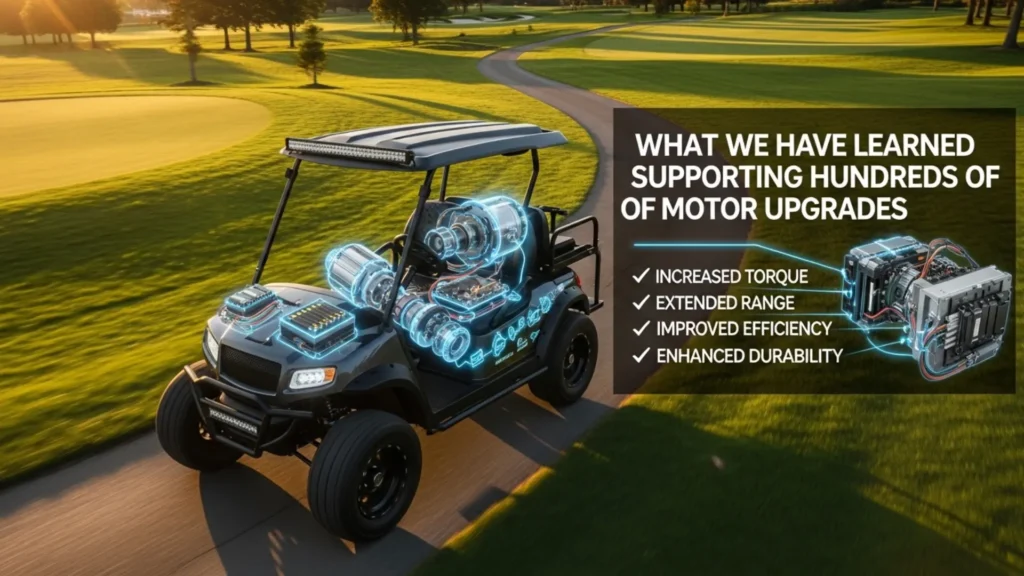
After supporting hundreds of motor and controller upgrade decisions on our support line, three patterns emerge consistently that most online guides never surface.
The first is the battery health prerequisite that we mentioned earlier, but it deserves emphasis: we receive several calls per month from customers who installed a new controller and are disappointed that their cart is only slightly faster than before. In virtually every case, the battery pack has weak cells that are limiting current delivery under the higher demand of the upgraded controller. The controller is doing its job — the pack cannot supply what the controller is asking for. Upgrade the batteries first, or at minimum test the pack under load before spending money on the controller.
The second is about programming. An Alltrax or Navitas controller installed with factory default settings is not delivering its full potential. The factory defaults are intentionally conservative. Programming the controller — raising the current limit appropriately for your motor, setting the acceleration curve for your preferred driving feel, adjusting the speed cutoff to your target — is what turns a good upgrade into an excellent one. This requires the manufacturer’s software tool and approximately 30 minutes of careful adjustment. Skipping the programming step is leaving significant performance on the table.
The third is about the AC kit versus DC controller upgrade decision. Many owners ask us which one they should buy, framing it as a performance question. The honest answer is: if money is the primary constraint and your DC motor is in good condition, the Alltrax controller at $250 delivers 70% of the performance improvement of the Navitas AC kit at $750. If you plan to keep the cart for many more years and want the best possible long-term investment — no motor maintenance, regen braking, consistently strong performance — the Navitas AC kit is worth the premium. If you are unsure, start with the controller upgrade. You can always add the AC kit later if the controller alone leaves you wanting more.
| E-E-A-T NOTE | Golf Cart Gears stocks Alltrax, Navitas, and Curtis controllers alongside high-torque and high-speed motor options for all major platforms. Our technical team has first-hand experience installing these systems across EZGO TXT, Club Car DS and Precedent, and Yamaha Drive platforms. We provide pre-purchase compatibility verification and post-installation programming support on all controller and motor orders. |
Frequently Asked Questions
Will a motor upgrade void my golf cart warranty?
Any modification to a golf cart’s drive system that goes beyond OEM-specification components can void the manufacturer’s powertrain warranty on that specific system. If your cart is still within its factory warranty period, replacing the motor or controller with aftermarket components may affect warranty coverage for related drivetrain components. Check your specific warranty terms before modifying a cart that is still covered. For carts past the warranty period, this is not a relevant concern.
What is the fastest a stock 48V golf cart can go with just a controller upgrade?
On a standard EZGO TXT or Club Car DS with a healthy 48V battery pack and stock motor, an Alltrax AXE 4834 controller upgrade reliably achieves 17-19 mph on flat terrain. With the AXE 4845 and appropriate programming, 19-21 mph is achievable without touching the motor. These figures assume stock OEM tires in standard 18-inch sizing — larger tires add 2-4 mph to these numbers.
Can I upgrade my 36V golf cart’s controller for more performance?
Performance upgrades on 36V systems are very limited. The 36V aftermarket controller ecosystem is thin, and the lower voltage cap means less available power regardless of current limit settings. If you have a 36V cart and want meaningful performance improvement, the correct path is a full 36V-to-48V voltage conversion first (covered in our 36V vs 48V guide), then apply the controller and motor upgrades described in this article. Attempting to extract significant performance from a 36V platform is an exercise in diminishing returns.
Is the Navitas AC kit difficult to install?
The Navitas AC kit for EZGO TXT and Club Car DS is a 4-6 hour installation for a first-time DIYer with mechanical confidence and basic hand tools. The key requirements are: a coupling puller for motor removal, a clear flat workspace, and careful attention to the wiring diagram. The Navitas installation manual is well-written. The programming via Bluetooth smartphone app after installation is straightforward. Most owners who are comfortable servicing their own car would manage this installation without difficulty.
Do I need a new charger after a motor/controller upgrade?
No — motor and controller upgrades do not require a charger change as long as the battery voltage system remains the same. The charger charges the battery pack, not the motor or controller. The only scenario where a charger change is needed alongside a motor upgrade is if the upgrade is part of a broader voltage conversion (36V to 48V), in which case a 48V charger is required regardless of the motor and controller changes.
What is the difference between high-torque and high-speed golf cart motors?
High-torque motors use more windings of heavier wire, which produces more magnetic force per amp — maximum pulling power at low speed, ideal for hills and heavy loads. High-speed motors use fewer windings of thinner wire, which allows the motor to spin faster before back-EMF limits RPM — ideal for flat-terrain speed. For most residential owners in mixed terrain, high-torque is the better choice. For resort or community environments where flat paths at higher speeds are the primary use case, high-speed motors deliver more satisfying results.
How long does a DC motor brush replacement take and is it DIY-feasible?
On most golf cart DC motors, brush replacement takes 30-60 minutes and is within the capability of any mechanically confident DIYer. The process involves removing the motor from the cart (30-45 minutes on most platforms), removing the brush end cap, extracting the worn brushes, installing new brushes of the correct specification, and reassembling. Brush replacement kits cost $15-$45 depending on platform. A shop charges $80-$150 for the same work including the parts.
The Bottom Line: Start With the Controller, Upgrade From There
Golf cart motor performance upgrades are genuinely effective, and the payoff for a well-planned upgrade — crisper acceleration, meaningful top speed gains, better hill performance — transforms the daily experience of driving the cart. The key is sequencing the upgrades correctly and not spending money out of order.
Start with the battery pack. A healthy, fully charged 48V pack with no weak cells is the foundation everything else depends on. Then consider the controller upgrade — it is the highest ROI single modification available for any DC golf cart. Then evaluate whether a motor upgrade (high-torque for hills, high-speed for flat terrain) or a full AC conversion (for maximum performance and zero maintenance) fits your budget and goals.
Program whatever controller you install. Default factory settings are conservative by design. Thirty minutes with the programming software extracts the full performance that the controller and motor combination is capable of.
And if you are on a 36V cart: voltage conversion first. There is no meaningful performance upgrade path at 36V that justifies skipping the conversion. Do it once, do it completely, and then every upgrade in this guide becomes available to you.