
The Domino Effect of Lifting a Golf Cart — What the Lift Kit Listing Does Not Tell You
Lifted golf carts are genuinely appealing. The aggressive stance, the clearance to run larger tires, the ability to traverse rougher terrain that a stock cart could not handle — these are real, tangible benefits that explain why lifted carts have become one of the fastest-growing segments of the golf cart market. The aftermarket is rich with options, the aesthetics are undeniable, and dealers actively promote factory-lifted configurations at every price point.
What most listings, dealer presentations, and YouTube build videos conspicuously omit is what we call the domino effect of lifting a cart. Lifting a golf cart by 3 or 4 inches does not simply raise the cart’s body off the ground. It changes the suspension geometry, which changes the steering geometry, which changes how the tires wear. Larger tires to fill the new wheel arches add rotational inertia and reduce motor efficiency, which reduces range. The higher center of gravity changes the rollover threshold, which changes safe cornering speed. And if you are buying an aftermarket kit for a cart that was not engineered for it at the factory, the quality of that engineering determines whether the result is a well-handling vehicle or a cart that wanders, vibrates, and wears out its ball joints in two seasons.
This guide exists because nobody else in the golf cart content space is being honest about the full picture. We are going to walk through every single change that a lift introduces — the mechanical, the electrical, the safety, the cost — so that you can make a genuinely informed decision about whether to lift your cart, what lift height to choose, whether factory or aftermarket is better for your situation, and what the total project cost actually looks like. Since bigger tires reduce efficiency, it’s important to understand your golf cart battery and range before making the upgrade.
| QUICK ANSWER: Should I lift my golf cart, and what does it actually cost?A 3-inch lift kit alone: $250-$500 aftermarket. Allows tires up to 22-23 inches. Minimal domino effect at this height. Best for casual use and mild terrain improvement.A 4-inch lift with complete package: $450-$800 for lift kit + new tires + wheels. More aggressive stance, better clearance. Starts triggering the steering and range changes described in this guide.Factory-lifted from manufacturer: $2,000-$4,000 premium over base cart. Suspension geometry is engineered correctly from the ground up. No compromise on handling or tire wear. The right choice for buyers who want a lifted cart as their primary vehicle.Total real-world aftermarket build cost: A complete 4-inch lift with quality tires, wheels, spindles, and accessories typically runs $1,200-$2,200 installed — significantly more than the lift kit price alone. |
What Lifting Actually Does to a Golf Cart’s Mechanics
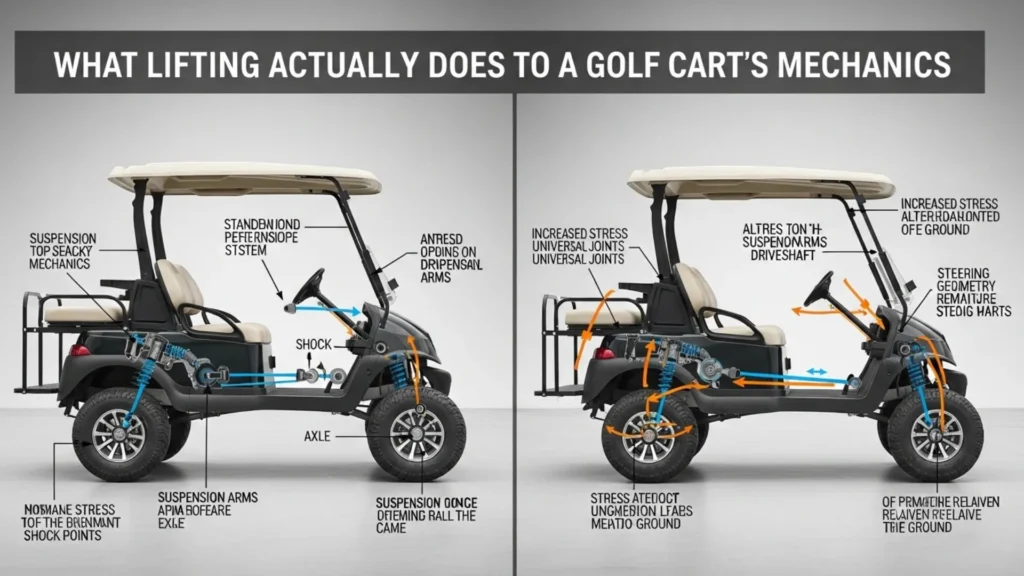
A golf cart suspension lift raises the vehicle body relative to the axles and wheels, creating additional clearance between the lowest point of the chassis and the ground. This is achieved through one of several mechanisms — A-arm replacement, spring extensions, drop spindles, or block lifts — each of which affects the suspension geometry differently.
Understanding these mechanisms matters because they have different effects on handling, geometry, and long-term component life. Buying a lift kit based purely on price or lift height without understanding which mechanism it uses is one of the most common mistakes in the lifted cart market.
Lift Mechanism Types and Their Engineering Tradeoffs
| Lift Type | How It Works | Typical Height | Engineering Tradeoffs |
| A-Arm / Long-Travel Suspension Kit | Replaces OEM A-arms with longer geometry components, raising the chassis relative to wheel centerline | 3″ – 6″ | Best geometry — designed to maintain correct camber and caster angles throughout lift height. Most expensive option ($400-$900 for quality kits). Factory lifts use this approach. Minimal compromise on handling when done correctly. |
| Drop Spindle Lift | Replaces front spindles with units that drop the wheel hub lower relative to the A-arm pivot point, raising the chassis | 3″ – 4″ | Good geometry at moderate heights. Drop spindles maintain more correct camber angle than block lifts. More expensive than blocks ($180-$350), but less than full A-arm kits. Good middle option. |
| Lift Block / Spring Spacer Kit | Adds spacer blocks between the spring perch and A-arm or between the spring and frame, pushing the chassis upward | 2″ – 4″ | Lowest cost option ($80-$200). Changes suspension geometry without correcting for the change — introduces positive camber, accelerated tire wear, and altered steering angles. Acceptable for mild 2-inch lifts; a real compromise at 4 inches. |
| Rear Block Lift Only | Raises the rear of the cart only, typically paired with front spindle or A-arm lift for level stance | 3″ – 4″ | Rear block lifts are simpler than front work. Rear alignment is less geometry-sensitive than front. Most lift kits include both front mechanism and rear blocks as a matched set. |
| Full Suspension Replacement Kit | Complete replacement of front A-arms, spindles, springs, rear blocks, and sometimes rear spindles — full suspension overhaul | 4″ – 6″ | Most expensive ($600-$1,200+ for quality kits). Best engineering at higher lift heights. Reserved for serious builds targeting 22-inch+ tires and genuine off-road capability. The standard for custom builders. |
| THE GEOMETRY PROBLEM | Every golf cart’s front suspension was engineered with specific camber, caster, and toe angles optimised for the stock ride height. When you raise the chassis without correcting these angles — which block lifts do not — the tires run at an incorrect angle to the road surface. Positive camber (top of tire tilted outward) causes the tires to wear on the outer edge, reduces cornering grip, and puts lateral stress on wheel bearings and ball joints. At 3-4 inches of block lift, you will often see noticeable outer tire wear within a season of regular use. |
The Domino Effect: Every Change That Follows a Lift
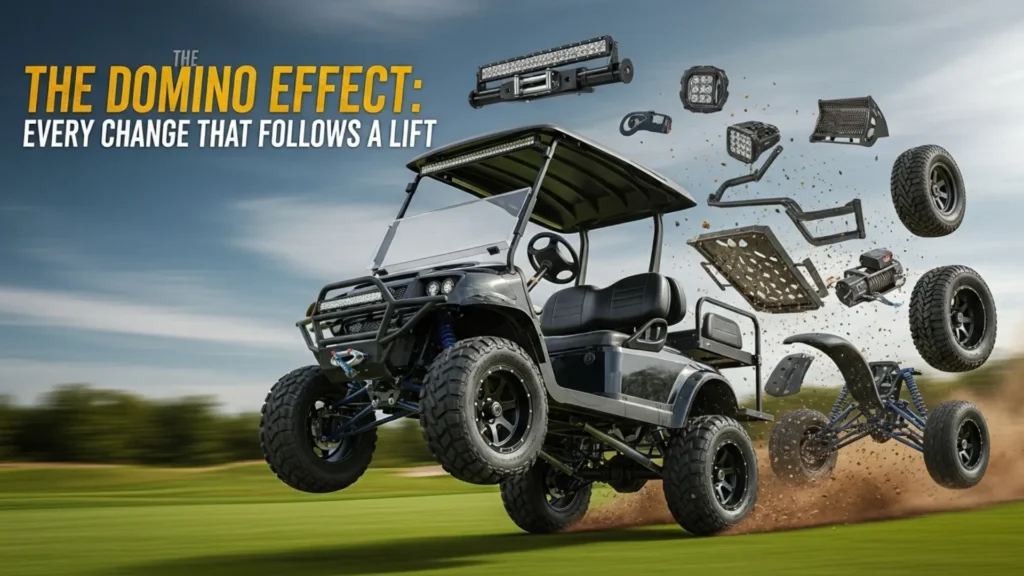
Here is the complete chain of consequences that flows from a lift decision. Understanding this chain before you start is what separates a well-planned build from a series of expensive surprises.
1. The Lift Changes Ground Clearance — Good
This is the benefit you are paying for, and it is genuine. A 4-inch lift adds approximately 3-4 inches of clearance between the chassis and the ground (slightly less than the lift height due to how suspension geometry works). This is enough to clear most obstacles, rocks, and terrain features that a stock cart cannot navigate. For owners who use their cart on a rough farm, wooded property, or heavily landscaped terrain, this clearance improvement is the primary practical value of the lift.
2. More Clearance Means You Can Run Larger Tires
A stock golf cart typically runs 18×8.5-8 tires (18 inches diameter, 8.5 inches wide, fits an 8-inch rim). With a 3-inch lift, you can typically fit 22×10-10 or 22×11-10 tires. With a 4-inch lift, 23-inch and even 25-inch tires become possible on wider wheel offsets. This larger tire is where much of the visual transformation comes from — the taller, wider tires filling larger wheel arches are the aesthetic signature of a lifted cart.
But this is also where the domino falls. Larger tires have higher rotational inertia than smaller tires. The motor must work harder to accelerate the larger rotating mass. The rolling radius increases, which changes the effective gear ratio between the motor and the ground. Top speed goes up (covered in the motor guide) but battery efficiency goes down — more energy is consumed to move the same cart the same distance.
3. Larger Tires Reduce Battery Range
This is the trade-off most lift kit listings never mention. A cart running 22-inch tires instead of 18-inch tires consumes more battery energy per mile due to the higher rolling resistance and rotational inertia of the larger rubber. The magnitude depends on the tire weight, tread depth, and surface being driven on.
Quantifying the range reduction: in our experience, moving from standard 18-inch tires to 22-inch all-terrain tires on the same cart typically reduces range per charge by 10-18% on flooded lead-acid batteries. On a cart that previously achieved 22 miles per charge, expect 18-20 miles with the same battery pack after the larger tires are fitted. If you are using the lifted cart primarily for off-road or rough-terrain use where efficiency is already being reduced by the surface, the incremental range impact of larger tires is less pronounced.
The range reduction amplifies the case for lithium batteries in a lifted cart. LiFePO4 packs maintain voltage better under the higher current draw of larger tires, provide more usable capacity per pound of battery, and hold their range more consistently over the discharge cycle. If you are building a serious lifted cart and planning to use it heavily, lithium batteries combined with a controller upgrade represent the best electrical foundation.
4. The Larger Tires May Not Fit Without Fender Modifications
Even with a lift kit installed, the new tires may contact the fender liner or body panel on full steering lock. This is a platform-specific issue — some carts have more wheel arch clearance than others — but it is common enough to be a planning consideration rather than an afterthought.
Fender flares and extended wheel arch kits are available for EZGO TXT, Club Car DS and Precedent, and Yamaha Drive platforms. These bolt-on or clip-on pieces extend the wheel arch coverage to accommodate wider, taller tires without requiring body modification. A quality fender flare set costs $80-$200 for the pair and takes 30-45 minutes to install.
Before installing any tire larger than the lift kit listing specifies as safe, do a steering lock-to-lock check with the tires on the cart. Turn the wheel to full lock in both directions and check clearance at the fender, A-arm, and body panel. A tire that clears by half an inch on a smooth surface may contact on rough terrain when the suspension compresses. Build in adequate margin.
5. The Higher Center of Gravity Changes Rollover Risk
This was covered in our Golf Cart Safety Guide, but it deserves direct mention in the context of lift decisions. A 4-inch suspension lift raises the center of gravity by approximately 2-3 inches above stock. Combined with wider tires — which provide more lateral grip but also enable higher cornering speeds before the cart’s traction limit — the result is a cart that can be driven aggressively before rollover but will roll over more suddenly when that threshold is exceeded.
Factory-lifted carts from Club Car and EZGO address this with recalibrated suspension geometry and springs that partially compensate for the changed center of gravity. Aftermarket lift kits vary enormously in whether they include any such recalibration. A cheap block lift at 4 inches is geometrically identical to the factory suspension with 4 inches of arbitrary height added — there is no engineering compensation for the changed dynamics.
The practical guidance: a ROPS (Rollover Protection Structure) is more important on a lifted cart than on a stock cart. A seatbelt is more important. And the ‘I know this terrain’ confidence that leads to fast cornering on familiar ground should be recalibrated to account for the higher center of gravity. The cart handles fine — it just has a lower rollover threshold than the stock version, and that threshold needs to be respected.
6. The New Steering Geometry May Affect Handling
Front suspension lifts change the caster, camber, and kingpin inclination angles of the front suspension. Caster (the front-to-back tilt of the steering axis) is particularly important — it produces the self-centering force that returns the steering wheel to straight ahead after a turn. Block lifts typically reduce caster significantly, producing a cart that feels vague and does not track straight without constant steering input.
Drop spindle lifts and quality A-arm kits address this by maintaining or correcting the caster angle at the new ride height. This is the engineering difference between a lift kit that feels like a finished vehicle and one that feels loose and wandering. When evaluating aftermarket lift kits, always ask the seller specifically whether the kit maintains correct caster geometry at the specified lift height. If they cannot answer that question, the kit probably does not.
Factory Lifted vs Aftermarket: The Honest Comparison
The choice between buying a factory-lifted cart and building your own lifted version from a standard cart is one of the most debated decisions in the golf cart enthusiast community. Here is the honest breakdown with no promotional spin.
| Factor | Factory-Lifted (e.g. Club Car Onward Lifted) | Aftermarket Lift on Standard Cart |
| Suspension engineering | Engineered from ground up at target lift height. Correct geometry, recalibrated springs, matched components. | Depends entirely on kit quality. Premium kits approach factory quality. Budget kits introduce geometry compromises. |
| Manufacturer warranty | Full warranty coverage — lift is original equipment, not a modification. | Aftermarket lift voids manufacturer suspension and steering warranty on modified components. |
| Total cost | $2,000-$4,000 premium over base cart. Higher upfront but no additional build cost. | $1,200-$2,200 for complete build (kit + tires + wheels + accessories). Lower or similar to factory premium depending on spec. |
| Customisation | Limited to factory options — specific tire, wheel, and colour combinations offered. | Complete freedom — any tire size, wheel design, lift height, and accessory combination. |
| Resale value | Factory lifted carts command premium resale. Buyers trust manufacturer build quality. | Custom builds vary. Quality builds retain value well; amateur installations often do not. |
| Handling quality | Predictable, well-behaved. Designed to handle correctly at lift height. | Depends on kit quality and installer expertise. Range from excellent to poor. |
| Best for | Primary vehicle, family use, buyers who want reliability without build risk, those valuing warranty. | Enthusiasts who want specific build, upgrading existing cart, buyers prioritising budget flexibility, custom aesthetic goals. |
The honest verdict: if you are buying new and a lifted cart is your primary intended configuration, factory-lifted is almost always the right choice at the premium involved. The engineering is correct, the warranty is intact, and the resale value supports the investment. The aftermarket build path makes most sense when: you already own a standard cart that you want to transform, you have specific customisation goals the factory options cannot meet, or you want maximum control over component quality and configuration.
Choosing a Lift Kit: What to Look For and What to Avoid
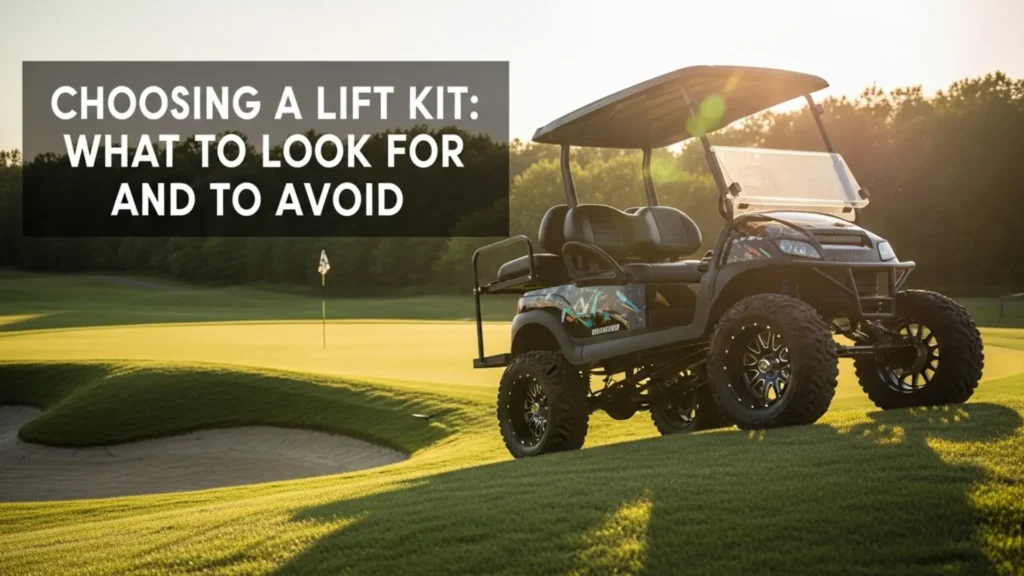
The aftermarket lift kit market ranges from purpose-engineered suspension systems to imported block kits that are essentially welded steel spacers with no geometric consideration whatsoever. The price range spans $80 to over $1,000 for the kit alone, and the quality correlation with price is real — though not perfectly linear.
What a Quality Lift Kit Must Include
- Engineered A-arm geometry or drop spindles (not just blocks) for front lift heights of 3 inches or more
- Explicit caster correction built into the front suspension design
- Matched rear lift components (blocks or rear spring extensions) that level the cart at the specified lift height
- New or upgraded ball joints rated for the increased load and altered angle of operation at lift height
- Complete hardware including grade-8 fasteners — not mild-steel hardware that will corrode and shear at the worst time
- Platform-specific engineering — not a universal kit claiming to fit twelve different cart models
- Clear installation documentation with torque specifications for every fastener
- A phone number or support channel staffed by people who actually know golf cart suspension
Red Flags When Evaluating Lift Kits
- The listing says the kit fits a wide range of cart brands without specifying how (a 3-inch block kit can physically bolt onto many carts without any platform-specific engineering)
- No mention of geometry correction, caster correction, or suspension angle recalibration in the product description
- Vague or absent installation instructions — a quality kit has detailed, torque-spec’d instructions
- Very low price for the claimed lift height — a genuine 4-inch A-arm kit with quality hardware cannot be manufactured and sold for $120 at any margin
- No information about ball joint quality or replacement interval
- Reviews mentioning steering wander, uneven tire wear, or handling changes that are not present in the seller’s description
Recommended Lift Kit Brands by Platform
| Platform | Recommended Brands | Best Lift Heights | Notes |
| EZGO TXT (2001+) | GTW, Madjax, Performance Plus | 3″ or 4″ | GTW stalks spindle lift for EZGO is the most widely used and well-regarded aftermarket option. Performance Plus A-arm kit for 5″ builds. |
| Club Car DS (all years) | GTW, Madjax, Jakes | 3″ or 4″ | Jake’s 3+3 double-offset spindle lift is the performance standard for Club Car DS. Available in 3-inch and extended configurations. |
| Club Car Precedent (2004+) | GTW, Madjax | 3″ or 4″ | Precedent has different front geometry than DS. DS kits do NOT fit Precedent. Always verify platform specifically. |
| Yamaha Drive / Drive2 | GTW, Madjax, Performance Plus | 3″ or 4″ | Yamaha A-arm geometry differs from Club Car and EZGO. Yamaha-specific kits only — never attempt to cross-fit. |
| All platforms — 5″+ builds | Performance Plus, True Trac | 5″ – 6″ | 5-inch and above requires complete A-arm replacement and typically upgraded rear axle support as well. Budget $600-$1,000+ for the lift kit alone at this height. |
Tires and Wheels for Lifted Carts: The Complete Selection Guide
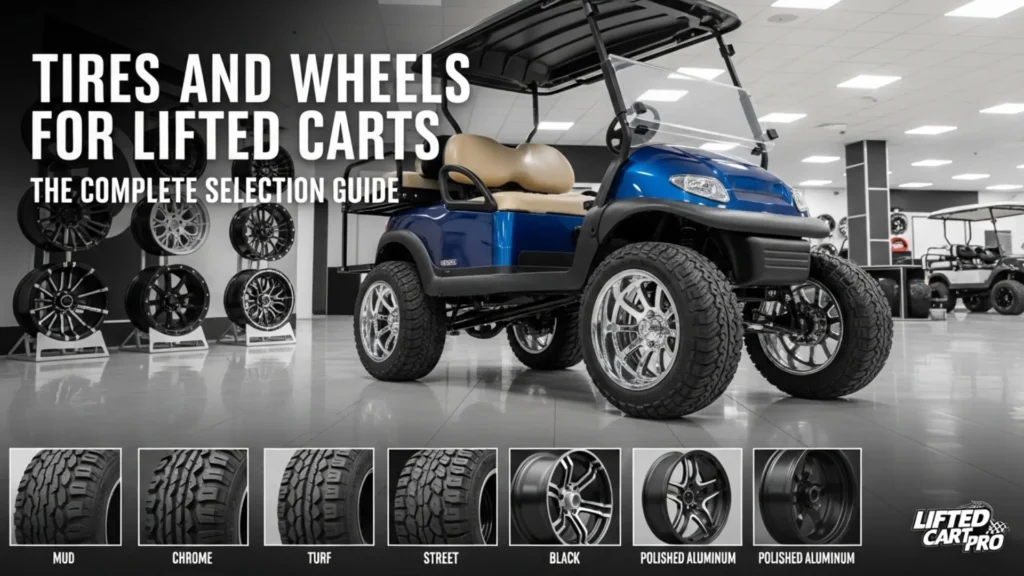
Tire selection for a lifted cart is more consequential than for a stock cart, because the larger tire size amplifies the effect of any tread pattern, rubber compound, or sizing decision. The wrong tire on a lifted cart creates handling, range, and clearance issues that feed back into every other aspect of the build.
Tire Sizing Explained
Golf cart tire sizing uses a three-number format: overall diameter × width × rim diameter. An 18×8.5-8 tire is 18 inches in diameter, 8.5 inches wide, fits an 8-inch rim. A 22×10-10 tire is 22 inches in diameter, 10 inches wide, fits a 10-inch rim. The rim diameter almost always changes when you lift a cart, because the larger tires typically require 10-inch or 12-inch rims rather than the stock 8-inch units.
Diameter is the most important dimension for a lifted cart. It determines ground clearance, the height change from stock, and the effective gear ratio change as discussed earlier. Width affects lateral stability and tire contact patch — wider tires grip better on loose terrain but add more rotational inertia and may require fender flares on narrower-bodied platforms.
| Tire Size | Min. Lift Required | Rim Size | Terrain Type | Notes |
| 18×8.5-8 (stock) | None | 8″ | Pavement / turf | OEM size on most carts. Widest availability, lowest cost. No lift required. |
| 20×10-10 | 2″ – 3″ | 10″ | Pavement / light turf | Good step up from stock. More aggressive look with modest lift. Minimal range impact. |
| 22×10-10 | 3″ – 4″ | 10″ | Mixed / all-terrain | Most popular lifted cart tire size. Good balance of aesthetics, clearance, and manageable range impact. Most lift kits designed for this size. |
| 23×10-14 | 4″ | 14″ | All-terrain / off-road | Serious off-road capability. Heavier than 10-inch rim versions — more range impact. Most aggressive stock-lift-compatible size. |
| 25×10-12 | 5″ – 6″ | 12″ | Off-road / trail | Significant build only. Requires 5-6″ lift, fender flares, and often spindle/A-arm upgrades to prevent rubbing. Range impact is substantial. |
Tread Pattern: Turf, All-Terrain, or Mud
Golf cart tires come in three broad tread categories, each with different performance characteristics that matter significantly more on a lifted off-road-oriented build than on a stock street cart.
Turf tires have low, widely spaced tread blocks designed to minimise divot impact on grass and produce low rolling resistance on pavement. They are the right choice for carts used exclusively or primarily on manicured turf — golf courses, well-maintained community paths, and smooth terrain. On anything rougher, turf tires offer limited traction and can be slippery in wet conditions.
All-terrain tires balance on-road ride quality with off-road traction. The more aggressive tread pattern provides meaningful grip on loose soil, gravel, and wet grass while remaining driveable on pavement without excessive noise or wear. For most lifted cart builds that will see mixed use — pavement paths plus rougher terrain — an all-terrain tire is the correct choice. The Kenda Bear Claw, GBC Kanati, and STI HD series are well-regarded all-terrain options at reasonable prices.
Mud-terrain tires with deep, aggressive knobby tread patterns are authentic off-road equipment. They provide excellent traction in soft mud and loose terrain but are noisy on pavement, wear faster on hard surfaces, and add the most rotational inertia of any tire category — producing the greatest range impact. Unless the cart will genuinely see regular mud and soft terrain use, mud-terrain tires are often overkill that compromises everyday usability for aesthetics.
Wheels and Wheel Offset
Wheel offset — the distance between the wheel mounting face and the wheel’s centreline — determines how far the tire sits outboard of the suspension. Zero offset puts the tire centred on the hub. Positive offset pulls the tire inward toward the cart. Negative offset pushes the tire outward.
For lifted carts running wider tires, some negative offset is often desirable to push the tires further outboard, improving stability and providing a wider track width that partially compensates for the higher center of gravity. However, excessive negative offset increases the scrub radius — the distance between the steering axis and the tire contact patch — which produces steering kick and uneven tire wear.
The practical recommendation: stick with wheels that are specifically engineered for golf cart lift applications on your specific platform. Generic aftermarket wheels with arbitrary offset dimensions are a common source of steering problems on lifted carts. GTW, Madjax, and Fairway Alloys all manufacture platform-specific wheel and tire packages with validated offset dimensions. Buying a matched package from a specialist supplier is significantly more reliable than mixing individual wheels and tires from different sources.
| TECH TIP | Before committing to a tire and wheel combination, verify that the assembly fits your specific platform’s hub bore and bolt pattern. Golf carts typically use a 4×4 bolt pattern (four bolts on a 4-inch circle), but hub bore diameters vary between platforms and between OEM and aftermarket wheels. A wheel with the correct bolt pattern but the wrong hub bore will either not mount at all or will run with excessive runout that causes vibration. |
The Real Total Cost: A Complete Lifted Cart Build Breakdown
One of the most misleading aspects of the lifted cart aftermarket is that most cost discussions stop at the lift kit price. Here is what a complete, properly specified lifted cart build actually costs when you account for every component involved.
| Component | Budget Build | Mid-Range Build | Premium Build | Notes |
| Lift kit (3-4″ A-arm or drop spindle) | $180 – $280 | $350 – $500 | $500 – $900 | Budget = block lift. Mid = drop spindle. Premium = full A-arm replacement kit. |
| Tires (set of 4) | $200 – $300 | $280 – $420 | $380 – $600 | 22″ tires. Budget = basic turf/AT mix. Mid = Kenda Bear Claw. Premium = GBC Kanati/STI HD. |
| Wheels / rims (set of 4) | $160 – $240 | $240 – $400 | $400 – $700 | 10″ or 12″ wheels. Budget = steel. Mid = cast alloy. Premium = billet/machined alloy. |
| Fender flares | $60 – $100 | $100 – $160 | $160 – $260 | May not be required at 22″. Needed for 23″+ or wide-offset wheels. |
| Installation (shop labour) | $0 (DIY) | $150 – $280 | $250 – $400 | 3-4 hour job at a shop. DIY is feasible for a mechanically capable owner with basic tools. |
| Alignment check (post-lift) | $0 (often skipped) | $60 – $100 | $60 – $100 | Toe alignment is the minimum post-lift check. Highly recommended even on quality kits. Often skipped on budget builds — then owners wonder why tires wear unevenly. |
| ROPS (safety upgrade) | $0 (skipped) | $0 (skipped) | $180 – $350 | Strongly recommended on any lifted cart used in terrain with slopes. Higher center of gravity increases rollover risk vs stock. |
| TOTAL INSTALLED COST | $600 – $920 | $1,180 – $1,860 | $1,930 – $3,310 | Excludes base cart. Budget build includes real geometry compromises. |
The key insight from this table: a budget build is significantly cheaper in absolute dollar terms, but it delivers a cart with geometry compromises that produce accelerated tire wear, vague steering, and a less satisfying driving experience. The mid-range build with drop spindles, quality all-terrain tires, and an alignment check is where the cost-to-quality curve is most favourable. The premium build with full A-arm replacement is the right choice for serious builds and owners who want factory-equivalent engineering from an aftermarket kit.
From the Shop: Patterns We See With Lifted Cart Builds
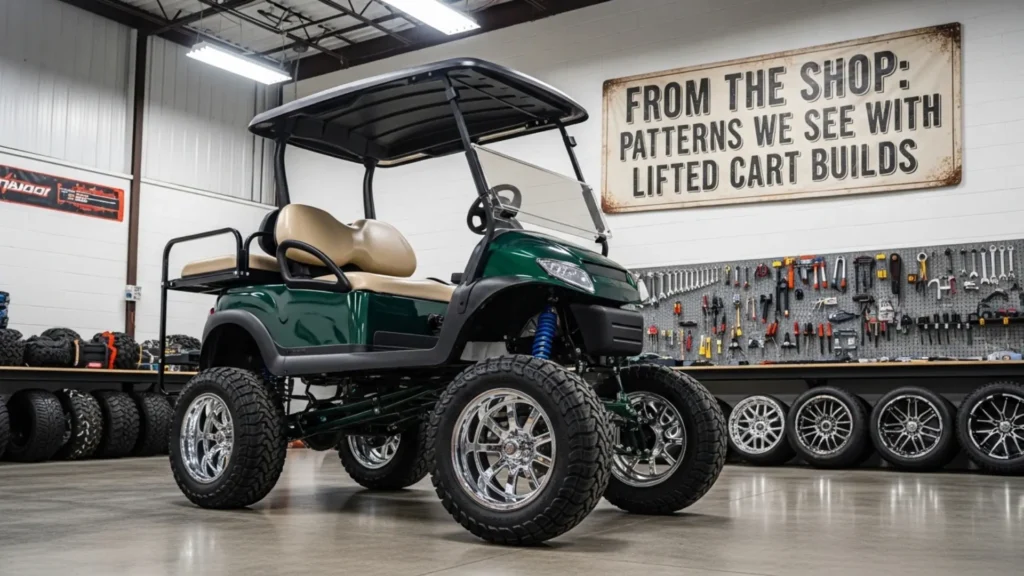
The most consistent feedback we hear from customers who lifted their carts and then called us about problems falls into three categories, and all three are preventable with the right planning upfront.
First is uneven tire wear that appears after a season of use. The owner lifted with a block kit, installed 22-inch tires, and noticed the outer edge of the front tires wearing noticeably faster than the inner edge. This is positive camber from uncorrected suspension geometry — exactly what quality drop spindle or A-arm kits prevent. The fix is either replacing the tires and upgrading to a geometry-correcting lift kit or accepting the accelerated wear as an ongoing cost of the budget build. Neither is a good outcome when a better kit at the start would have prevented it.
Second is the steering wander complaint. The cart feels like it does not track straight — the driver has to actively steer to maintain a straight line on flat pavement. This is the caster reduction effect of block lifts, reducing the self-centering force. Quality lift kits restore caster through their spindle or A-arm geometry. Block kits do not. Upgrading the lift kit after the build is more expensive than getting it right the first time.
Third is range disappointment. An owner lifts the cart, installs 22-inch mud-terrain tires, and notices the cart now gets noticeably less range per charge than before the build. They assumed the lift would not affect the electrical system. It does not affect the electrical system directly, but the heavier tires and increased rolling resistance draw more current per mile, which discharges the battery faster. The honest disclosure at the point of sale would have managed expectations. Always factor range impact into the build plan, especially if range is important to your use case.
| E-E-A-T NOTE | Golf Cart Gears stocks lift kits, tires, and wheels for EZGO TXT, Club Car DS and Precedent, and Yamaha Drive platforms. All lift kits are platform-specific — we do not sell universal kits that claim to fit everything. Our team provides build consultation on lifted cart projects and will confirm geometry, tire clearance, and component compatibility for your specific platform before any order ships. |
Frequently Asked Questions
Will lifting my golf cart void the manufacturer’s warranty?
Installing an aftermarket lift kit will void the manufacturer’s warranty coverage on the suspension components and any related steering and drivetrain components that are modified or stressed by the lift. The rest of the cart — battery, motor, controller, body — is generally not affected. Factory-lifted carts (purchased lifted from the manufacturer) retain full warranty coverage because the lift is part of the original specification.
How much does a 4-inch lift reduce my golf cart’s range?
The lift itself does not reduce range — the larger tires that the lift enables do. Moving from stock 18-inch tires to 22-inch all-terrain tires typically reduces range per charge by 10-18% on a lead-acid pack, or 8-14% on a lithium pack. The magnitude varies with tire weight, tread pattern, and surface type. A lighter all-terrain tire like the Kenda Bear Claw has less range impact than a heavy mud-terrain tire of the same size.
What is the best lift height for a golf cart that will be used in a planned community?
For community use with occasional off-road or rough-terrain excursions, a 3-inch lift with 22×10-10 all-terrain tires is the most practical configuration. It provides meaningful clearance improvement and a distinctive appearance without the handling compromises that become more pronounced at 4-6 inches. It also stays within the tire size range that most quality drop spindle kits handle well without requiring fender modifications on most platforms.
Can I lift a Club Car Precedent with an EZGO TXT lift kit?
No. Club Car and EZGO have different front suspension geometry, different spindle dimensions, and different A-arm mounting configurations. A lift kit engineered for an EZGO TXT will not correctly fit a Club Car Precedent, even if some hardware appears similar. Always buy platform-specific lift kits. Using the wrong kit produces incorrect geometry even if it physically mounts — do not do it.
Do I need new ball joints after installing a lift kit?
Quality lift kits include new ball joints as part of the kit, because lifting changes the operating angle of the existing ball joints beyond their designed range. Budget block kits do not include ball joints and rely on the existing joints at an altered angle. After installing a quality lift kit, ball joints should be inspected at 12-month intervals — the increased angles and loads accelerate wear compared to stock geometry. Replace at any sign of play or looseness in the joint.
What tires are best for a lifted golf cart used in the Florida sand and scrub terrain?
For Florida sandy/scrubby terrain, an all-terrain tire with a moderately aggressive tread pattern is the best choice — something like the Kenda Bear Claw or GBC Kanati in 22×10-10 or 22×11-10 sizing. These provide excellent traction on loose sandy soil while remaining manageable on the pavement paths that connect to community roads. Full mud-terrain tires are overkill for Florida terrain and add unnecessary weight and rolling resistance.
How do I know what lift height is compatible with my golf cart?
The primary constraints are tire clearance at full steering lock (depends on fender and A-arm geometry), suspension travel (how much droop and compression the suspension can handle before components contact), and battery range tolerance (how much range reduction is acceptable). For most club car and EZGO platforms, 3-4 inches with 22-inch tires is the practical limit without requiring fender modifications or accepting significant handling compromises. 5-6 inch builds require full A-arm replacement and are best left to shops familiar with that level of work.
The Lifted Cart Decision: Go In With Clear Eyes
A lifted golf cart is a genuinely satisfying build when it is done correctly. The stance, the capability, the ability to traverse terrain that a stock cart cannot handle — all of these deliver real value that goes beyond aesthetics. The enthusiast community around custom golf cart builds is genuinely rewarding, and a well-done lifted cart holds its value better than a comparable stock cart.
The key is understanding, before you spend the first dollar, that lifting a cart sets a chain reaction in motion. The lift requires larger tires. The larger tires affect range. The new suspension geometry requires correction to maintain proper handling. The higher center of gravity requires adjusted driving habits and ideally a ROPS. None of this is reason not to lift — it is reason to plan the lift properly, choose the right components, and budget for the complete build rather than just the lift kit.
Buy a quality kit from a brand that engineers specifically for your platform. Get the suspension aligned after installation. Run the tire size the kit is actually designed for. Install a ROPS if you will be on any sloped terrain. And budget the full build cost from the start — the total invested in a properly done mid-range lifted build is $1,200-$1,800, and the result is a cart that handles well, looks great, and lasts without the ongoing maintenance headaches that a cheap block lift with uncorrected geometry inevitably produces.