
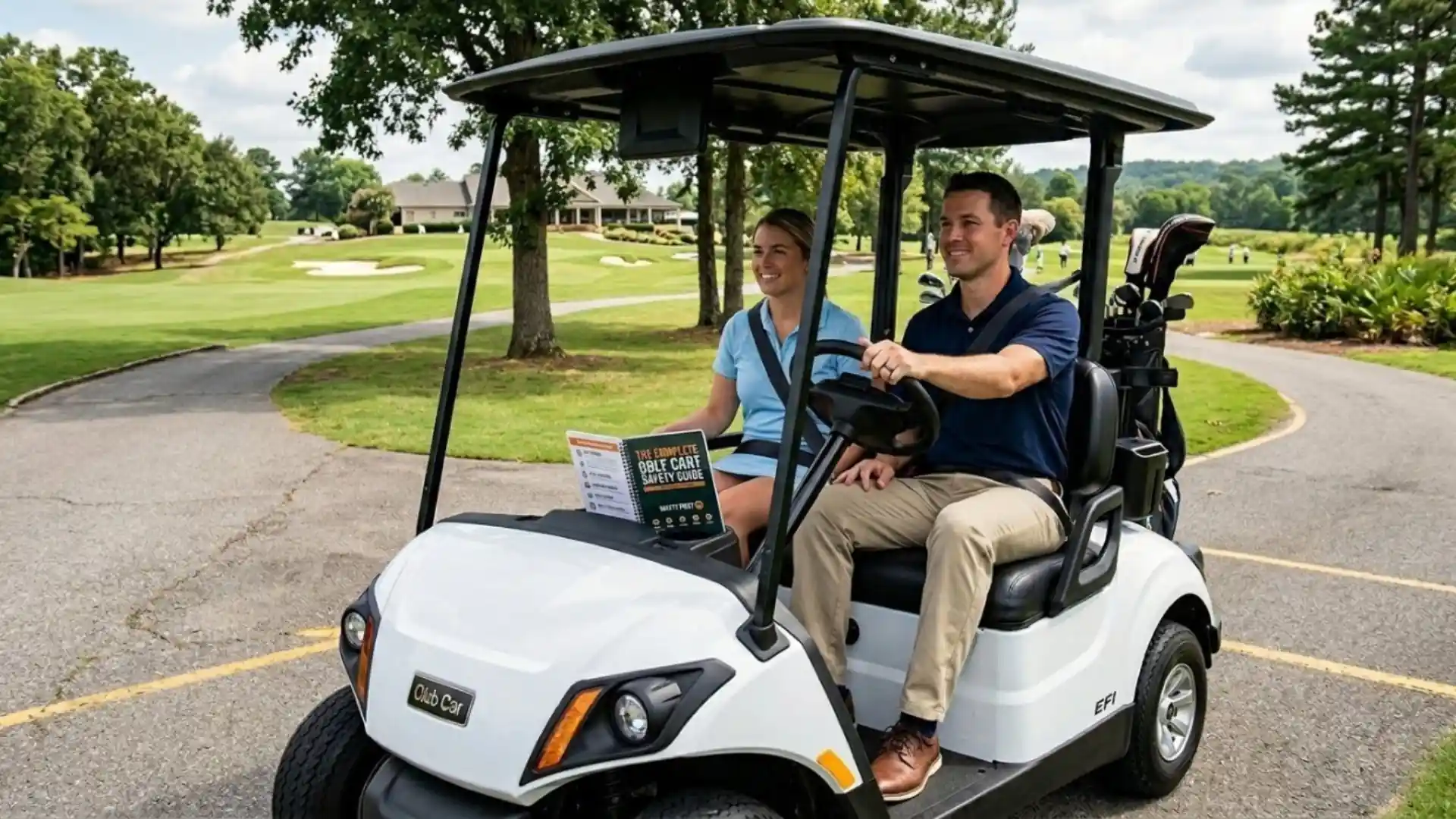
Golf Carts Are Not Toys And the Injury Numbers Prove It
There is a persistent assumption in American culture that golf carts are inherently safe because they are slow. They have no seatbelts in most configurations, no roof structure rated for rollover, no crumple zones, and sometimes no real brakes to speak of — but they only go 15 miles per hour, so how dangerous could they be?
According to the U.S. Consumer Product Safety Commission, approximately 15,000 golf cart-related injuries are treated in emergency departments across the country every year. The leading causes are not high-speed collisions. They are rollovers on slopes and turns, passengers falling from moving carts, children falling from improperly supervised rides, and foot injuries from dangling limbs contacting the ground or cart frame.
None of those injury mechanisms require speed. They require physics, complacency, and a vehicle that most owners treat like a piece of outdoor furniture rather than a motorised vehicle that follows all the same laws of momentum, center of gravity, and kinetic energy as any other vehicle — just at a smaller scale.
This guide exists because we believe every golf cart owner deserves a clear, honest explanation of the actual risk profile of these vehicles, the specific hazards that generate the most injuries, and the practical safety measures — most of them inexpensive — that meaningfully reduce risk without making cart ownership feel like an exercise in paranoia.
We cover the physics of golf cart rollovers, passenger protection best practices, the legal requirements for street-legal operation, the safety equipment every cart should carry regardless of where it is driven, and a practical guide to child passenger safety that most golf course and community guides never actually provide.
| QUICK ANSWERWhat are the most important golf cart safety measures?1. Slow down on turns and slopes: Rollover is the leading cause of serious golf cart injuries. Most rollovers happen at 10-15 mph on turns or side slopes, not during straight-line travel.2. Keep all limbs inside the cart: Foot injuries from dragging or contact with cart frame are among the most frequent cart injuries. Establish this as a non-negotiable rule for all passengers, especially children.3. Add seatbelts and a ROPS: A Rollover Protection Structure (ROPS) and lap belts are the two most impactful safety upgrades for any golf cart. Both are available for all major platforms at GolfCartGears.com.4. Follow LSV requirements for road use: Driving a standard golf cart on public roads without LSV certification and equipment is illegal in most states and creates serious personal liability exposure in the event of an accident. |
The Physics of Golf Cart Rollovers: Why It Happens Without Warning
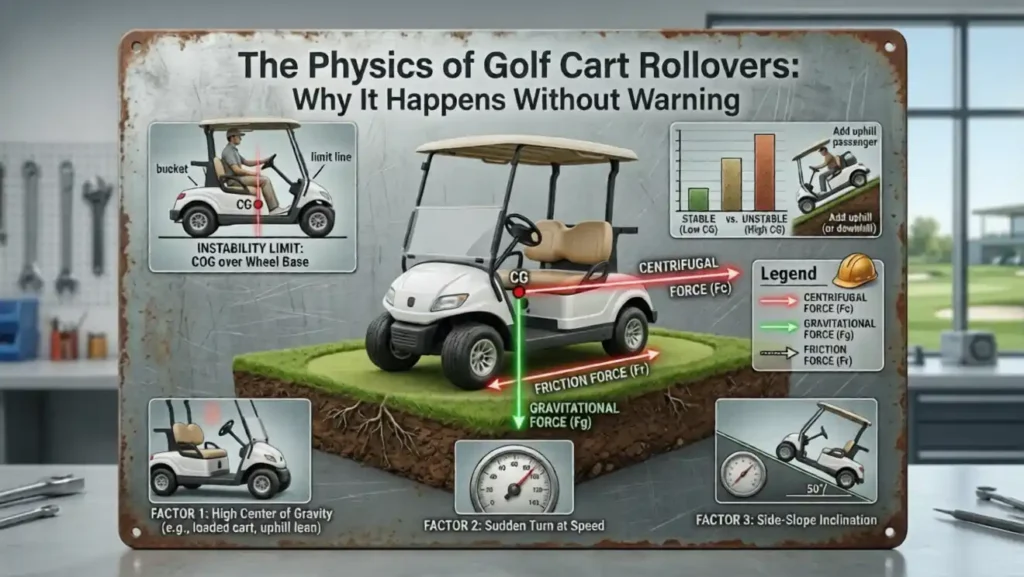
Understanding why golf carts tip over requires a brief introduction to two physics concepts: center of gravity and lateral weight transfer. You do not need an engineering degree for this — you just need to understand why the cart behaves differently from what your instincts expect.
A standard two-passenger golf cart has a center of gravity that sits relatively high compared to its wheelbase width. The battery pack sits low in the chassis, which helps — but the seat height, the roof canopy, and any passengers sitting upright all add mass above the cart’s roll axis. When the cart turns, that elevated mass wants to continue moving in the original direction. This creates a lateral force pushing the cart’s weight to the outside of the turn.
At low speeds, the tire grip overcomes this lateral force easily. As speed increases — even modestly, from 8 mph to 14 mph in a medium-radius turn — the lateral force grows with the square of velocity. Double the speed and the rollover risk quadruples, not doubles. This is why cart users are frequently caught off-guard: the cart felt perfectly stable at their normal driving speed, and then one tighter turn, one wet patch, or one unfamiliar slope tip changed that instantly.
Lifted carts are significantly more susceptible to rollover than standard-height carts. A 4-inch suspension lift raises the center of gravity, increases the lever arm for lateral forces, and often installs larger tires that change the dynamic handling characteristics. A lifted cart that feels stable during mild use on flat ground can reach rollover threshold at surprisingly low speeds on a side slope or during an aggressive turn. Factory-lifted carts from Club Car and EZGO are engineered with recalibrated suspension geometry that partially compensates for this — aftermarket lift kits vary enormously in how well they address the handling tradeoff.
The Slope Problem: Side Slopes Are More Dangerous Than Steep Hills
Most golf cart owners think about hills as going up or down. The far greater rollover risk comes from traversing a slope — driving across it rather than directly up or down it. When a cart sits at an angle to a slope, gravity pulls the entire vehicle mass toward the downhill side. Combined with any turning or acceleration, this creates exactly the lateral force distribution that leads to rollover.
The U.S. Golf Cart Industry has informal guidelines suggesting that golf carts should not be driven on slopes steeper than 20-25 degrees without specific equipment. On a side slope specifically, the recommended limit is lower — some manufacturers caution against sustained traversal of side slopes exceeding 15 degrees. For context, 15 degrees is roughly the slope of a gentle hillside that you would not think twice about walking across. It feels almost flat. On a cart, particularly a loaded or lifted cart, it is the kind of slope where rollovers happen.
The practical rule: when in doubt about a slope, drive up or down it rather than across it. If you must traverse, slow to a crawl, keep passengers still and centered, and be ready to correct if the cart feels like it is loading the downhill tires. Do not attempt slope traversal with passengers leaning outside the cart body, and never traverse a side slope with a heavily loaded cargo bed.
Wet and Slippery Surfaces: When Tires Cannot Grip
Golf cart tires are a significant safety variable that most owners never think about until they have a near-miss on wet grass. Standard OEM golf cart tires have relatively shallow tread patterns optimised for smooth pavement and well-maintained turf. On wet grass — particularly the early-morning dew-covered fairways and community paths that most carts operate on regularly — tire grip drops substantially from the dry-surface baseline.
Worn tires make this dramatically worse. A set of golf cart tires that have lost their tread depth to 1/16 of an inch or less can provide barely 30% of the lateral grip of a fresh set in wet conditions. Checking tire tread depth is one of the most neglected maintenance tasks on golf carts and one of the most practically impactful safety measures available.
For carts operating on off-road terrain, gravel paths, or rough ground, all-terrain golf cart tires provide significantly improved grip in varied conditions. The tread pattern and rubber compound are specifically designed for the variable surfaces these carts operate on. GolfCartGears.com stocks all-terrain tire options for all Club Car, EZGO, and Yamaha platforms in standard and lifted cart sizing.
| PHYSICS FACT | A 900-pound golf cart carrying two adult passengers traveling at 12 mph carries approximately 7,200 foot-pounds of kinetic energy. Stopping that system from a sudden obstacle requires either distance (braking) or an impact that absorbs all of that energy into whatever is hit. At 12 mph, a cart with marginal brakes on wet grass needs approximately 18-25 feet to stop. Know your stopping distance before you drive in populated areas. |
Passenger Safety: The Rules That Actually Prevent Injuries
The majority of golf cart passenger injuries fall into a handful of completely preventable categories. Here is what the injury data tells us, and what to do about it.
The Foot and Leg Injury Problem
Foot injuries are the most common golf cart injury type treated in emergency departments, and almost all of them are preventable with one rule: every passenger keeps all four limbs inside the cart body while the cart is moving, always.
The mechanism is straightforward and surprisingly easy to trigger. A passenger — most commonly a child, but frequently an adult too — lets their foot dangle outside the cart body during travel. The foot contacts the ground at 10 mph. The result ranges from road rash to a broken ankle to a fracture that requires surgery, depending on the contact point and whether the cart wheel or frame is involved.
Children are particularly vulnerable because their natural seated posture puts their legs at a height where they naturally swing, and because they have less impulse control to keep themselves positioned safely. Establish the limbs-inside rule explicitly before every trip with child passengers, and enforce it consistently. One clear rule stated once before departure prevents the majority of these injuries.
Ejection: The Serious Injury Scenario
Ejection from a golf cart — most commonly during rollover but also during sudden braking or sharp turns — is the injury mechanism most associated with serious outcomes including head injuries, spinal injuries, and fatalities. Standard golf carts have no seatbelts, no door structure, and no enclosure that prevents a passenger from being thrown from the vehicle.
The two most effective physical countermeasures are seatbelts and a Rollover Protection Structure (ROPS). Seatbelts prevent ejection during sudden directional changes and minor rollovers. A ROPS provides a structural cage that, in the event of a rollover, maintains a survivable space around the occupants. Together, these two additions transform the safety profile of a standard golf cart from “no ejection protection whatsoever” to a level of protection roughly comparable to a UTV with safety equipment.
Seatbelt retrofit kits are available for all major Club Car, EZGO, and Yamaha platforms. Installation requires no special tools and takes approximately 45 minutes. The cost is $60-$160 depending on platform and the number of seats. That cost per seat is one of the smallest safety investments-per-impact-severity-prevented available for any vehicle type.
Passenger Count and Weight Distribution
Golf carts are rated for a specific maximum passenger load, and exceeding that load creates compounding safety risks. A two-passenger cart with four adults is carrying approximately double its rated passenger weight, which raises the center of gravity, reduces braking effectiveness, strains the battery pack under load, and increases stopping distance. It also means half the passengers have no secure seating position and are likely sitting in ways that reduce their stability during turns.
The practical rule: do not carry more passengers than the cart has seats. A two-passenger cart carries two passengers. If your family of four regularly rides together, invest in a rear seat kit that converts the cargo area to a proper rear-facing passenger bench with secure seating positions. GolfCartGears.com carries rear seat and flip seat kits for all major platforms — a $180-$380 investment that creates a proper seating position for additional passengers rather than an improvised perch that falls short of every safety standard.
| SAFETY TIP | Never allow a child to ride in the cargo bed of a golf cart, even for a short distance. A cargo bed has no secure seating, no restraints, and no structural protection. In the event of sudden braking or a turn, a child in the cargo bed becomes a projectile. The cargo bed is for cargo, not passengers. |
Rollover Protection Structures (ROPS): The Safety Upgrade Most Owners Skip
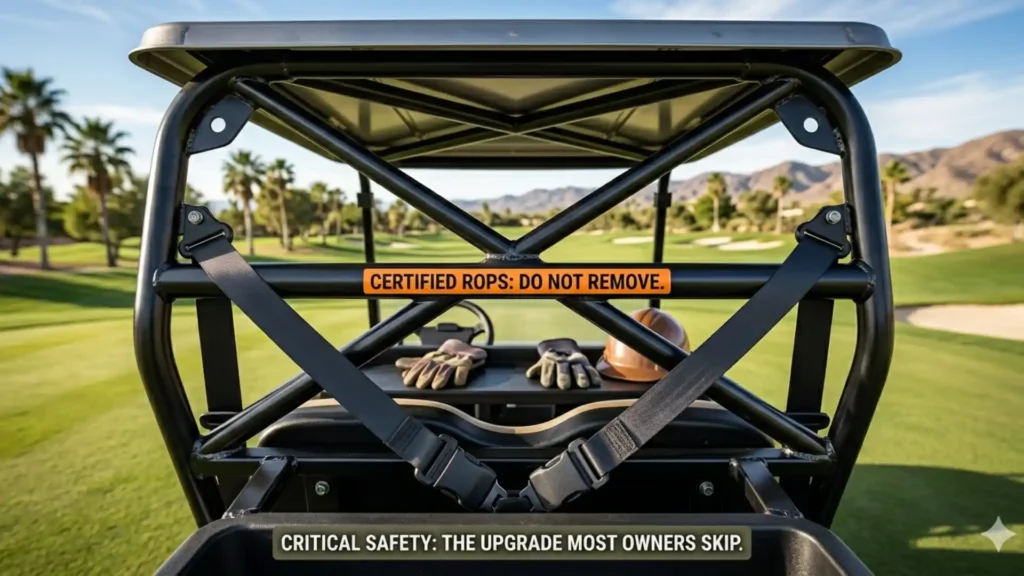
A Rollover Protection Structure — commonly called a ROPS or roll bar — is a reinforced steel or aluminium overhead frame designed to maintain survivable headroom if the cart tips over. It is the golf cart equivalent of a roll cage, and it is the single most impactful structural safety upgrade available for standard golf carts.
Most standard golf cart tops (the canopy or enclosure) are not ROPS-rated. They are weather protection devices, not structural safety devices. An OEM Club Car or EZGO canopy will not meaningfully protect occupants in a rollover — it will compress or shatter. A proper ROPS maintains a structural arch that can absorb rollover forces and prevent the cart roof from crushing occupants.
ROPS kits are available for most major platforms from aftermarket manufacturers. A bolt-on ROPS kit for a Club Car DS, EZGO TXT, or Yamaha Drive2 typically costs $180-$350 and installs in two to three hours with basic hand tools. The ROPS mounts to the cart frame and supports a reinforced overhead arch that replaces or reinforces the existing top support structure.
For lifted carts and carts used in any off-road or side-slope context, a ROPS should be considered standard equipment rather than an upgrade. The incremental rollover risk from a lifted configuration is significant enough that operating without some form of rollover protection is a decision that is difficult to justify on safety grounds alone.
| Safety Equipment | Cost Range | Install Time | Impact Level | Best For |
| Lap Seatbelt Kit | $60 – $160 | 45 min | HIGH | All carts. Prevents ejection during sudden manoeuvres and minor rollovers. |
| ROPS (Roll Bar Kit) | $180 – $350 | 2–3 hrs | VERY HIGH | Lifted carts, off-road use, slope terrain. Prevents roof crush in rollover. |
| LED Light Kit | $80 – $180 | 1–2 hrs | HIGH | All carts used at dusk, dawn, or evening. Dramatically improves visibility to pedestrians and other vehicles. |
| Horn | $15 – $40 | 15 min | MEDIUM | All carts in pedestrian environments. Alerts walkers and cyclists at path intersections. |
| Side Mirrors | $25 – $60/pair | 20 min | MEDIUM | Community roads and paths with vehicle traffic. Required for LSV certification. |
| Slow-Moving Vehicle (SMV) Emblem | $8 – $25 | 5 min | HIGH (road use) | Any cart on public roads or highways. Legally required in most states. Makes cart visible to approaching traffic. |
| All-Terrain Tires | $120 – $300/set | 1–2 hrs | HIGH (off-road) | Carts on wet grass, gravel, or varied terrain. Dramatically improves lateral grip and rollover threshold. |
| Windshield (shatter-resistant) | $80 – $200 | 30–45 min | MEDIUM | Required for LSV certification. Also protects occupants from debris, insects, and low-branch strikes at speed. |
Street-Legal Golf Carts: The LSV Requirements You Must Know Before Driving on Public Roads
The term “street-legal golf cart” gets used loosely in the market, but it has a specific legal meaning that matters enormously for both your personal safety and your legal liability. A Low Speed Vehicle (LSV), as defined by the National Highway Traffic Safety Administration, is a four-wheeled motor vehicle with a maximum speed of 20-25 mph that meets Federal Motor Vehicle Safety Standards. LSVs are permitted on public roads with posted speed limits of 35 mph or lower in all 50 states.
A standard golf cart — even one with headlights, a windshield, and a horn added — is not automatically an LSV. True LSV certification requires a manufacturer-assigned Vehicle Identification Number (VIN) and compliance documentation against specific federal safety standards. The practical implication: if you add safety accessories to a standard cart and drive it on a public road without a VIN, you are driving an unregistered, uninsured motor vehicle on a public road. In the event of an accident, your personal liability exposure is significant.
For owners in golf cart communities where local ordinance specifically authorises non-LSV golf cart operation on community roads, this distinction matters less for daily use. For anyone considering driving on public roads that connect to or from their community, it matters enormously.
Federal LSV Equipment Requirements (What Every Street-Legal Cart Must Have)
| Required Equipment | FMVSS Std | Cost to Add | Available at GCG? | Notes |
| Headlamps (low + high beam) | 108 | $80–$180 | Yes — LED kits | LED strongly recommended. Must comply with FMVSS 108 photometric output. Incandescent originals fall short on many carts. |
| Tail Lamps | 108 | Included in kit | Yes | Must be visible from 500 feet to the rear. Most complete LED kits include compliant tail lamps. |
| Stop Lamps (brake lights) | 108 | Included in kit | Yes | Must activate independently with brake pedal application. |
| Turn Signal Lamps (front + rear) | 108 | $40–$100 | Yes — TS kits | Self-cancelling preferred. Amber front, red or amber rear. Flash rate 60-120 cycles/min. |
| Reflex Reflectors | 108 | $10–$30 | Yes | Red rear, amber front. Often included in complete lighting kits. Retroreflective material only. |
| Horn | 141 | $15–$40 | Yes | Must produce audible signal at 200 feet. Standard electric horn kits meet this easily. |
| Windshield (shatter-resistant) | 205 | $80–$200 | Yes — all brands | Must be safety glass or FMVSS-compliant polycarbonate. Standard folding windshields comply in most jurisdictions. |
| Rearview Mirror | 111 | $20–$60 | Yes | Interior rearview required. Exterior side mirrors required in most states. Check your state’s specific LSV mirror requirements. |
| Seat Belts | 209/210 | $60–$160 | Yes — all brands | Lap belts minimum for LSV. Shoulder belts required on some state DMV registrations. Always verify state requirement. |
| Parking Brake | 135 | $0–$80 | Parts available | Most modern carts have a parking brake. Older carts may need a retrofit mechanism. |
| Vehicle Identification Number (VIN) | 565 | State DMV | Factory LSV only | Hardest requirement to retrofit. Factory LSV carts have VINs assigned. Converting a standard cart requires state-level inspection and VIN assignment — process varies by state. |
| LSV REALITY CHECK | Adding all the physical equipment in the table above to a standard golf cart does NOT automatically make it an LSV. True LSV status requires a manufacturer-assigned VIN and federal safety standard compliance documentation. For community road use under local ordinance (the most common scenario), having the equipment is what local enforcement checks. For public road use and insurance purposes, VIN assignment is the legal requirement. Know which context you are operating in. |
The Slow-Moving Vehicle (SMV) Emblem: One of the Most Overlooked Safety Items
The Slow-Moving Vehicle (SMV) emblem is a fluorescent orange triangular sign that mounts on the rear of any vehicle that travels at 25 mph or less on public roads. It was originally developed for agricultural equipment — tractors and farm machinery — but legally applies to golf carts operating on public roads in most states.
The purpose of the SMV emblem is straightforward: it warns approaching traffic, especially at higher speeds, that the vehicle ahead is travelling significantly slower than normal road traffic. A car approaching at 45 mph closes on a 12 mph golf cart at 33 mph relative speed. Without a warning sign, the driver has little time to react. The SMV emblem, visible at several hundred feet, gives approaching drivers the cue they need.
In most states that permit golf cart operation on public roads, the SMV emblem is legally required. Driving without one on a qualifying road exposes you to a traffic violation, but more importantly, it removes the one piece of passive safety equipment specifically designed to prevent rear-end collisions with slow-moving vehicles.
An SMV emblem costs $8-$25 and mounts in five minutes. It is one of the lowest cost-per-safety-benefit items in the entire golf cart accessories catalogue. If your cart ever travels on a public road of any kind, this item should already be mounted.
Night Driving Safety: Visibility Works Both Ways
Golf carts used at dusk, dawn, or after dark operate in a visibility context that dramatically changes the risk profile. The hazards shift from rollover and ejection to being struck by other vehicles that do not see the cart in time to stop or swerve.
Standard OEM golf cart headlights are often inadequate by modern standards — the incandescent bulbs or basic halogen units on older Club Car DS and EZGO TXT models provide enough light to see where you are going but are not bright enough to make your cart visible at meaningful distances to oncoming vehicles or pedestrians.
LED lighting upgrades are one of the highest-value practical improvements for golf cart safety. A quality LED headlight kit provides 3-5 times more light output than comparable incandescent units, and LED tail lights with a higher-output brake light function dramatically improve rear visibility to following traffic. The combination of improved forward illumination and better rear visibility reduces both the risk of the cart striking something and the risk of something striking the cart from behind.
For carts used in any community with active pedestrian traffic during evening hours — a retirement community where residents walk after dinner, a resort property with evening entertainment — LED side marker lights and lit rear reflectors add additional visibility that is particularly valuable for pedestrians approaching from angles where the main lights do not point.
Child Passenger Safety: The Honest Guide Most Communities Do Not Provide
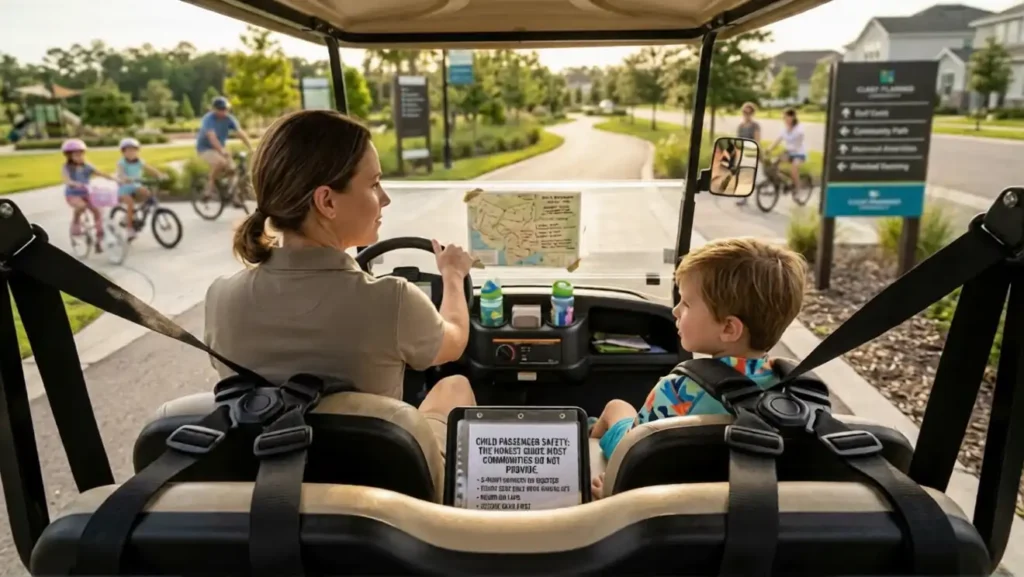
Children are involved in a disproportionate share of golf cart injuries for three compounding reasons: they are smaller, which means falls and rollovers create proportionally greater injury severity; they have less impulse control, which means they are more likely to dangle limbs outside the cart or lean in destabilising ways; and they are often supervised by adults who are familiar enough with the cart to have relaxed their safety vigilance.
The most common child injury scenario in golf carts is not dramatic. It is a child sitting on an adult’s lap in the driver’s seat whose foot makes contact with the ground when the adult presses the brake or accelerator. Or a child in the rear seat whose arm is resting outside the cart when the cart passes a post or gate. Or a child who falls asleep during a longer ride and slumps toward the edge of an open-sided cart without anyone noticing until the cart turns.
Age and Size Appropriate Passenger Guidelines
- Children under 3 years old should not ride in standard open-sided golf carts. There is no safe seating position for an infant or toddler in a vehicle with no enclosure, no child restraint system, and sides open to the environment.
- Children 3-6 years old should be seated in the centre of the bench, between adults, with all limbs inside the cart body. Never allow this age group to sit on the outside edge of a bench seat.
- Children 7-12 years old can occupy any proper seat position but should have the limbs-inside rule explicitly reviewed before each trip. Their natural seated posture tends toward swinging legs, and this is the age group most commonly involved in foot contact injuries.
- Children 13-15 years old: review the previous section on legal driving ages. Supervised passenger travel is generally safe at this age with the same rules applied as adults.
The Two Rules That Prevent Most Child Injuries
Rule one: all limbs inside the cart body, all the time, any time the cart is moving. State it clearly before the first ride of the day, restate it any time a foot or arm drifts outside, and enforce it consistently. Children respond to consistent rules; they test inconsistent ones.
Rule two: do not allow children to ride in positions that are not proper seats. The front footwell is not a seat. The rear cargo area is not a seat. The armrests are not seats. If there is not a proper bench seat available for the child, the child does not ride on this trip. Period.
Electrical and Battery Safety: What Most Cart Owners Overlook
Golf cart batteries are a safety consideration that goes beyond performance. A flooded lead-acid battery pack on a 48-volt system carries several hundred amp-hours of stored energy, contains sulfuric acid, and produces hydrogen gas during charging. These characteristics create real hazard scenarios that proper maintenance and handling practices directly prevent.
Charging Safety
Always charge golf cart batteries in a well-ventilated space. The hydrogen gas produced during charging is colourless, odourless, and explosive at concentrations above 4% in air. In a closed, unventilated garage, an actively charging golf cart battery pack can reach this concentration in as little as 30-45 minutes if the space is small. This is not a theoretical risk — golf cart battery charging fires and explosions do occur, and they are almost exclusively the result of charging in confined spaces with inadequate ventilation.
Never charge batteries on which you notice cracks, bulges, or leaking electrolyte. A physically damaged battery cell can develop internal short circuits during charging that generate heat rapidly. If you see physical damage to any battery in the pack, disconnect the pack from the charger, disconnect the damaged battery from the string, and arrange replacement before the next charge cycle.
Do not leave batteries charging unattended overnight if your charger does not have an automatic shutoff function. Chargers without automatic shutoff can overcharge batteries that have been left connected too long, generating heat, warping plates, and in flooded batteries, eventually boiling off electrolyte until plates are exposed to air — a condition that can generate sufficient heat to cause a fire.
Battery Handling Safety
Always wear safety glasses when working near or with flooded lead-acid batteries. Electrolyte splatter during connection, disconnection, or watering tasks is uncommon but does occur, and sulfuric acid at any concentration is immediately damaging to eyes.
Never place metal tools across two battery terminals simultaneously. Even briefly bridging battery terminals with a metal object — a spanner, a screwdriver, a wedding ring — creates an immediate short circuit that can generate temperatures sufficient to weld metal or cause a battery case explosion. Remove rings and metal bracelets before any battery work.
If electrolyte contacts skin, flush immediately and thoroughly with clean water for a minimum of 10 minutes. Battery acid burns are deceptive — the initial burning sensation may be mild, but the acid continues to react with tissue if not thoroughly neutralised. Seek medical attention if the affected area is larger than a few square centimetres.
| FIRE SAFETY | Keep a dry chemical fire extinguisher rated for Class B fires accessible in any space where you regularly charge your golf cart. Water should never be used on a battery-related electrical fire — it conducts electricity and can cause electrocution. A dry chemical extinguisher is the correct response. A 2.5-lb unit is sufficient for a home garage and costs $15-$30. |
What to Do If Your Golf Cart Starts to Tip or Roll
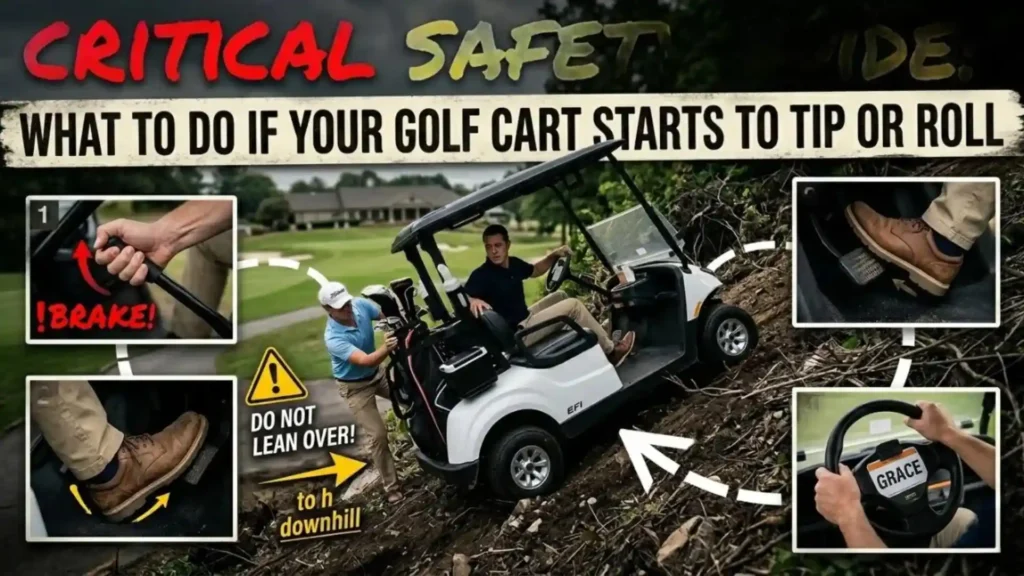
If you ever feel your golf cart beginning to tip — that distinct sensation of the inside tires going light and the cart loading toward the outside — the instinctive response most people have is exactly wrong. People grab the overhead bar and brace against the direction of the tip. This shifts body weight to the outside of the turn, which accelerates the rollover rather than preventing it.
The correct response has two parts. First, release the accelerator immediately — do not brake hard, which can cause sudden deceleration that makes the lateral weight transfer worse. Second, if the cart is still tipping despite releasing the accelerator, tuck yourself toward the centre of the cart and protect your head. Do not attempt to jump out of a tipping golf cart — the majority of serious rollover injuries occur when occupants attempt to exit during the roll and the cart lands on them.
If you are wearing seatbelts (which is why they matter), remain belted. If not, tuck your head, protect your neck, and remain as far from the sides and roof line as possible. The most dangerous part of a golf cart rollover for unbelted occupants is the crush zone between the cart roof and the ground — staying away from the perimeter and staying low minimises exposure to that zone.
After any rollover: do not attempt to right the cart yourself without proper equipment. A rolled golf cart can have fuel leaks (gas models), battery damage, or structural damage that makes it unsafe to move. Check all passengers for injury first. Call for help. Do not reconnect a damaged battery pack until a qualified technician has inspected it for cracks, leaks, or internal damage.
Frequently Asked Questions
Q: Do golf carts need seatbelts?
Standard golf carts are not legally required to have seatbelts in most states for private property or golf course use. For LSV-classified carts operating on public roads, seatbelts are federally required as part of LSV certification (FMVSS 209/210). Regardless of legal requirements, adding seatbelts is one of the highest-impact safety upgrades available and is strongly recommended for all carts carrying children, operating on slopes, or used at any speed above a slow walking pace.
Q: What is the most common cause of golf cart accidents?
Rollover on turns and slopes is the leading cause of serious golf cart injuries. Passenger ejection — either during rollover or from sudden braking — is the mechanism most associated with severe outcomes. Foot and limb injuries from passengers allowing limbs to contact the ground or cart frame are the most frequently treated category in emergency departments by volume.
Q: How fast can a golf cart go before it becomes dangerous?
There is no safe maximum speed for a golf cart in the same way there is for a passenger car, because the risk is context-dependent. At 8 mph on flat, dry pavement in a straight line, virtually no golf cart is at meaningful rollover risk. At 12 mph in a tight turn on wet grass with a heavy passenger load, a standard golf cart can be at or near rollover threshold. Speed combined with turning radius, surface conditions, and passenger loading is what creates risk — not speed alone.
Q: Do I need insurance for a golf cart?
For private property use only, insurance is not legally mandated in most states but is strongly recommended. Your homeowner’s policy likely does not cover golf cart incidents that occur off your immediate private property. Dedicated golf cart liability insurance runs $75-$150 per year and provides coverage for community path, golf course, and private road incidents. For LSV-classified carts on public roads, insurance is required in most states and mirrors standard auto insurance minimum requirements.
Q: Are lifted golf carts more dangerous?
Lifted carts have a higher center of gravity and a correspondingly lower lateral stability threshold than standard-height carts, particularly on side slopes and during tight turns. This does not make them inherently dangerous, but it does require adjusted driving habits — slower turns, more caution on side slopes, and greater awareness of loading conditions. Factory-lifted carts from Club Car and EZGO include suspension geometry adjustments that partially compensate for the lift. Aftermarket lifts vary significantly in how well they address the handling tradeoff.
Q: What should I do if a child falls from a golf cart?
Stop immediately. Do not continue driving — even one additional rotation of the wheel can cause additional injury if the child is near the cart. Assess the child for consciousness, breathing, and obvious injuries before moving them. If there is any indication of head, neck, or spinal injury, do not move the child — call emergency services and keep them still until help arrives. Any fall from a moving vehicle, however slow, warrants medical evaluation if the child lost consciousness for any period or is complaining of neck or head pain.
Q: What is an SMV emblem and do I need one?
A Slow-Moving Vehicle (SMV) emblem is a fluorescent orange triangular reflective sign that mounts on the rear of vehicles travelling 25 mph or less on public roads. It warns approaching traffic of the vehicle’s slower speed. Most states require SMV emblems on golf carts operating on public roads, and the sign costs $8-$25 — one of the most cost-effective safety items available. If your cart ever travels on a public road of any type, mount one.
The Bottom Line: Most Golf Cart Injuries Are Preventable
Golf carts are not inherently dangerous vehicles. They are slow, simple machines that generate serious injuries almost exclusively through predictable, preventable mechanisms — excessive speed in turns, passengers with limbs outside the cart body, insufficient equipment for the driving environment, and children in improper seating positions.
The safety equipment list is not long, and it is not expensive. Seatbelts. A ROPS if you have a lifted cart or operate on slopes. LED lighting for any dusk or evening use. An SMV emblem for any road use. Side mirrors for community road operation. All-terrain tires if you drive on anything other than smooth pavement or well-maintained turf.
Beyond equipment, the habits matter more than the hardware. Slow down for turns — always, every time, even the turns you drive every day. Keep all limbs inside the cart body — yours and every passenger’s. Charge in ventilated spaces. Replace worn tires before they become a liability rather than after they already have been.
None of this is complicated. It is just the kind of discipline that is easy to maintain when you think clearly about what a golf cart actually is: a motor vehicle that follows all the same physics as any other vehicle, just at a gentler scale.