
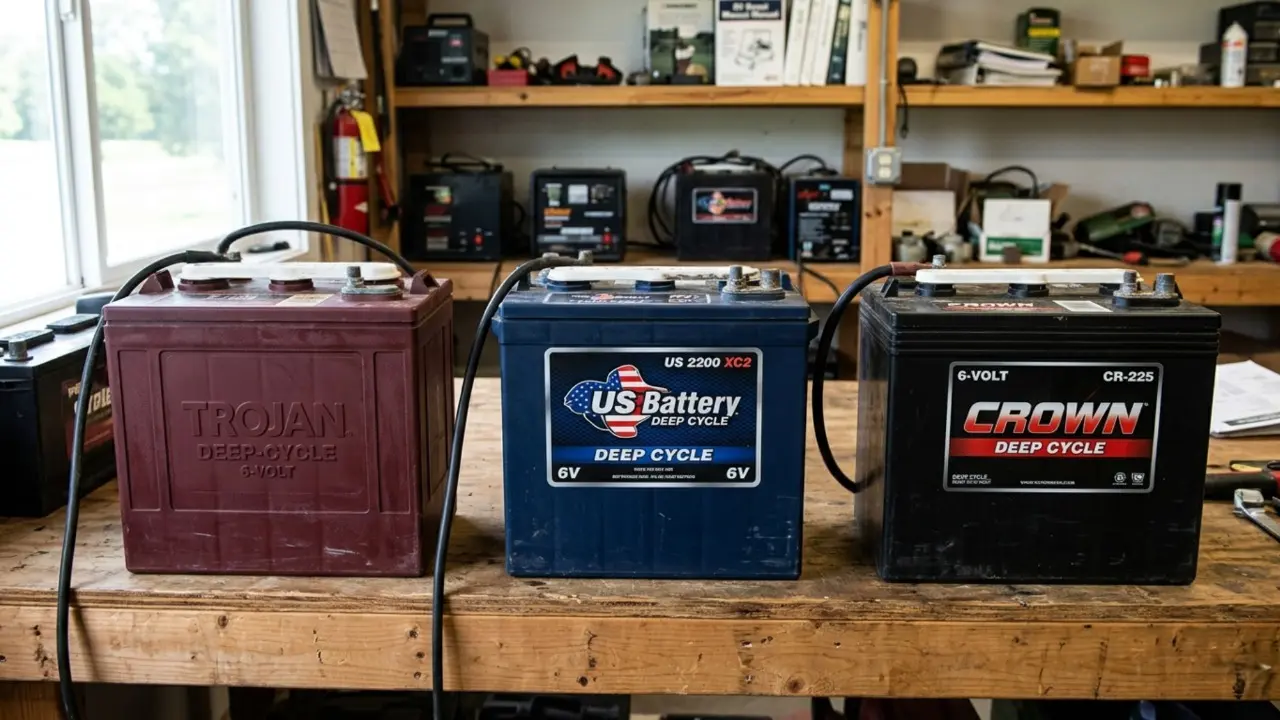
Why This Comparison Matters More Than You Think
Walk into almost any golf cart dealership or independent shop in North America and ask which battery you should buy. The answer will be Trojan, almost every time. Not because Trojan has been evaluated against the alternatives and found to be superior in your specific situation — but because Trojan has dominated the golf cart battery market for so long that recommending anything else requires the technician to defend their choice.
What actually happens in a market like this is that genuinely competitive products from US Battery and Crown get significantly less shelf space and significantly less sales effort, even though in head-to-head specification comparisons they are not merely comparable to Trojan — they frequently exceed it on rated capacity, and they cost meaningfully less.
The question is not whether Trojan makes a good golf cart battery. They absolutely do — the T-105 and T-875 are genuine engineering achievements with a proven track record over decades. The question is whether Trojan makes the only good golf cart battery, or whether other brands at lower price points deliver comparable or better real-world results for specific buyer situations.
This guide answers that question with the kind of transparency that most battery retailers avoid. We cover actual rated specifications, manufacturing differences, plate technology, warranty terms, real-world lifespan patterns, and a plain-English verdict on which brand is right for which type of buyer. We also include Interstate and Duracell where relevant, because they appear in more cart shops than their specifications probably justify.
By the end, you will have the information needed to make a confident battery decision without needing to simply trust whoever is behind the counter at your local shop.
Table of Contents
| QUICK ANSWERTrojan vs US Battery vs Crown — which should you buy?Trojan: The performance benchmark and the safest choice if you want a proven product with an unmatched support network. Best for owners who value brand confidence and consistent performance. T-105 (6V) and T-875 (8V) are the standards.US Battery: Higher rated capacity than Trojan at a lower price. The best value option for budget-conscious buyers who want genuine quality, not compromise. US2200XC2 (6V) and US8VGC (8V) are the headline products.Crown: The most durable plate construction in this comparison — built for heavy cycling and commercial fleet applications. Underappreciated in residential use. CR-235 (6V) and CR-215 (8V) deliver consistent deep-cycle performance across a long service life. |
The Brands: Who Actually Makes These Batteries?
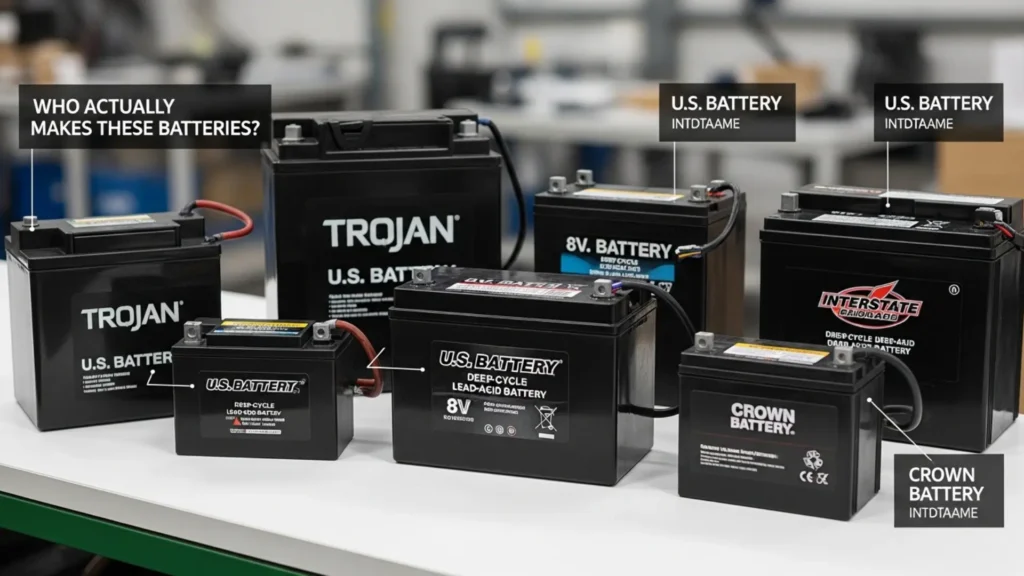
Before comparing specifications, it helps to understand who these companies are and how they operate. The battery you buy carries a brand name, but the actual product is defined by decades of manufacturing decisions about plate alloys, separator materials, case design, and quality control standards.
Trojan Battery Company
Trojan Battery Company was founded in 1925 in California and is one of the oldest and most respected names in deep-cycle battery manufacturing. The company has been producing golf cart batteries since the early days of electric golf carts and has invested consistently in advancing lead-acid deep-cycle technology over that time. Trojan manufactures batteries under the Trojan name only — they are not a private-label operation producing batteries for multiple brands.
Trojan’s two flagship innovations are Maxguard separators and T2 Technology. Maxguard is a proprietary envelope-style separator design that physically encapsulates each positive plate, reducing plate shedding and short-circuit risk from plate material that falls to the bottom of the cell over time. T2 Technology refers to Trojan’s paste formulation and plate curing process that they claim produces a more consistent, denser active material than standard manufacturing processes. Both are genuine engineering differences, not marketing language — and they contribute to the consistency of performance and lifespan that Trojan’s reputation is built on.
The downside of Trojan is price. As the premium brand with the highest market share, Trojan’s pricing reflects demand — a single T-875 8-volt battery typically runs $165-$195, and a full six-battery 48-volt pack runs $990-$1,170 at retail. This is the highest price point in the mainstream flooded lead-acid category.
US Battery Manufacturing
US Battery Manufacturing is a California-based company with a history in deep-cycle battery production going back to the 1980s. The company operates its own manufacturing facilities in the United States and produces batteries under the US Battery name as well as for several private-label customers — though the US Battery branded product carries different specifications from most of the private-label production.
US Battery’s proprietary technology is Diamond Plate Technology (DPT), a plate formulation and surface treatment process that the company claims produces higher initial capacity and better capacity retention over the battery’s cycle life compared to standard lead-calcium and lead-antimony plate alloys. Whether DPT fully delivers on every claim is debated, but the rated capacity figures — US2200XC2 at 232Ah versus Trojan T-105 at 225Ah for comparable 6V batteries — are independently verifiable numbers that reflect genuine engineering differences.
US Battery’s price point is meaningfully lower than Trojan — typically 15-25% less for equivalent battery sizes, bringing a full 48-volt pack replacement to $800-$950 at retail versus Trojan’s $990-$1,170. For buyers replacing a full pack on a budget, this $150-$220 difference in pack cost is significant.
Crown Battery
Crown Battery is an Ohio-based manufacturer founded in 1926 — nearly the same vintage as Trojan — with a long history in industrial and commercial deep-cycle applications. Crown is widely used in golf cart fleet applications, material handling equipment, and marine markets. The brand is less visible in residential golf cart retail than Trojan or US Battery, primarily because Crown’s distribution focuses more heavily on commercial dealers and industrial distributors.
Crown’s distinguishing manufacturing characteristic is heavy plate construction. Crown batteries consistently use thicker positive plates than equivalent Trojan or US Battery products in the same battery size category. Thicker plates store more active material, which provides greater capacity and — more importantly — greater cycle life, because each plate can absorb more charge-discharge cycles before the active material degrades to failure.
Crown’s pricing sits between Trojan and US Battery at most distributors — roughly $145-$175 per 8-volt battery, or $870-$1,050 for a full 48-volt pack. The relative obscurity of the brand in residential retail means that pricing varies more than Trojan’s more standardised market pricing.
Interstate and Duracell (Honourable Mention)
Interstate Batteries is a massive distribution company, not a battery manufacturer. Interstate sources its deep-cycle golf cart batteries primarily from East Penn Manufacturing (Deka) and to a lesser extent Trojan, then sells them under the Interstate brand. The quality varies across their product line because it reflects multiple manufacturing sources. Interstate’s main advantage is the widest retail distribution network in the US — an Interstate dealer is often closer than any other battery supplier. Their golf cart battery pricing is generally comparable to US Battery.
Duracell Golf Cart batteries are manufactured by East Penn Manufacturing under a licensing agreement. East Penn makes legitimate, well-engineered batteries, and the Duracell-branded golf cart products are generally comparable to mid-tier US Battery products in specifications. They are not premium products, but they are not the cheap private-label products that the Duracell household battery association might suggest. If your local option is Interstate or Duracell and a full Trojan order requires a week’s lead time, either brand is a credible choice for standard residential use.
| MARKET REALITY | Roughly 65-70% of all golf cart batteries sold through independent golf cart dealers in North America are Trojan-branded products. This market share is a function of brand recognition and established dealer relationships, not an objective measure of product superiority. It means that most technicians have the most experience with Trojan, which influences recommendations in a self-reinforcing cycle that has little to do with actual comparative testing. |
Head-to-Head Specifications: The Numbers That Actually Matter
Battery specifications are the most objective basis for comparison, but they require careful interpretation. Rated capacity in amp-hours (Ah) is the most commonly cited number, but it is measured at a specific discharge rate that varies between manufacturers, making direct comparisons misleading if you do not check the measurement conditions. We use the standard 20-hour rate (C20) here for comparability.
6-Volt Deep Cycle Batteries (Used in 36V and 8-Battery 48V Systems)
| Model | Brand | Voltage | Capacity (C20) | Weight (lbs) | Reserve Capacity | Plate Technology | Retail Price (each) |
| T-105-RE | Trojan | 6V | 225 Ah | 67 lbs | 447 min | T2 Technology, Maxguard Sep. | $155 – $185 |
| US2200XC2 | US Battery | 6V | 232 Ah | 69 lbs | 468 min | Diamond Plate Technology (DPT) | $130 – $165 |
| CR-235 | Crown | 6V | 235 Ah | 70 lbs | 480 min | Heavy plate construction | $140 – $175 |
| GC2-XHD | Interstate | 6V | 220 Ah | 66 lbs | 430 min | Standard East Penn manufacture | $120 – $155 |
| GC6 / SLI6V | Duracell | 6V | 218 Ah | 65 lbs | 420 min | East Penn OEM manufacture | $115 – $145 |
| SPEC NOTE | The Crown CR-235 has the highest rated C20 capacity in this comparison at 235Ah versus Trojan’s 225Ah — a 4.4% advantage. In a full 8-battery 36V pack, that translates to approximately 2-3 additional miles of range on a full charge under moderate driving conditions. The US Battery US2200XC2 at 232Ah is nearly equivalent to Crown and still exceeds Trojan. Both cost less per unit than Trojan. |
8-Volt Deep Cycle Batteries (Most Common for 48V / 6x8V Systems)
| Model | Brand | Voltage | Capacity (C20) | Weight (lbs) | Reserve Capacity | Plate Technology | Retail Price (each) |
| T-875 | Trojan | 8V | 170 Ah | 63 lbs | 315 min | T2 Technology, Maxguard Sep. | $165 – $195 |
| US8VGC | US Battery | 8V | 170 Ah | 63 lbs | 315 min | Diamond Plate Technology (DPT) | $140 – $170 |
| CR-215 | Crown | 8V | 180 Ah | 66 lbs | 330 min | Heavy plate construction | $145 – $180 |
| GC8 | Interstate | 8V | 165 Ah | 61 lbs | 305 min | Standard East Penn manufacture | $120 – $155 |
| GC8 / SLI8V | Duracell | 8V | 162 Ah | 60 lbs | 298 min | East Penn OEM manufacture | $115 – $145 |
The 8-volt comparison tells a slightly different story from the 6-volt. The Trojan T-875 and US Battery US8VGC are rated at an identical 170Ah — the DPT formulation closes the gap entirely at this size. Crown’s CR-215 leads the field at 180Ah — a 6% advantage over both Trojan and US Battery that translates directly to longer range per charge and greater usable capacity throughout the pack’s service life. At a price that sits between US Battery and Trojan, Crown’s CR-215 represents arguably the best objective value in the 8-volt segment.
Plate Technology: The Engineering Differences That Determine Real-World Life
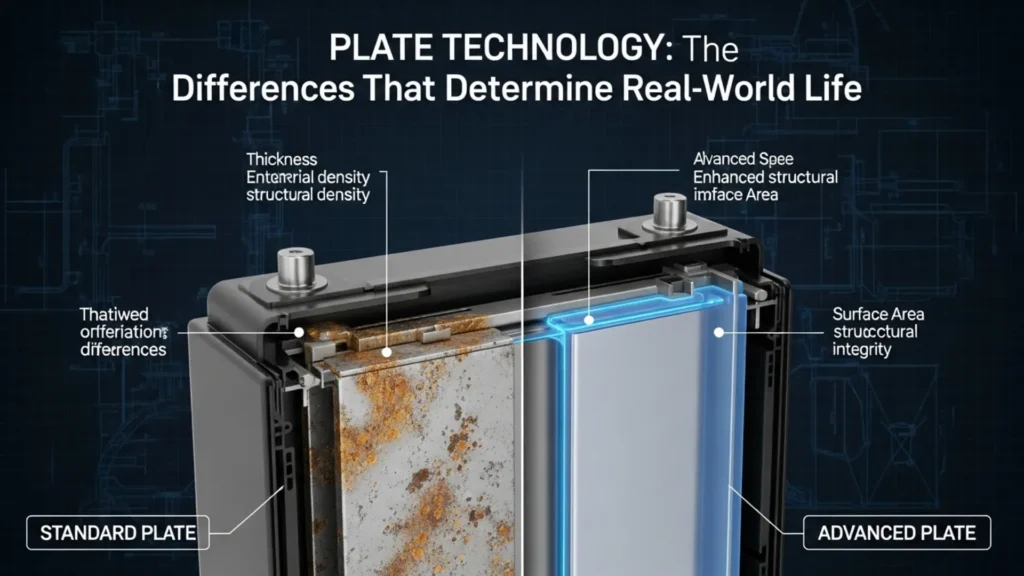
Rated capacity tells you the starting line. Plate engineering tells you how many times the battery can run the same race before it degrades to an unusable level. For golf cart owners replacing packs every four to six years, the number of discharge cycles a battery reliably delivers before significant capacity loss is arguably more important than the starting capacity number.
Trojan T2 Technology and Maxguard Separators
Trojan’s T2 Technology centres on the paste formulation applied to the lead plates — the mixture of lead oxide, sulphuric acid, water, and expanders that forms the active material. Trojan claims T2 produces a denser, more mechanically stable active material that sheds less over repeated cycling than standard formulations. Plate shedding — the gradual fall of active material from the plate surface to the bottom of the cell — is one of the primary end-of-life mechanisms in deep-cycle batteries, and reducing it directly extends service life.
The Maxguard separator takes a different approach. Standard battery separators are flat sheets of porous plastic material between the positive and negative plates. Maxguard uses an envelope-style design that wraps around the positive plate, creating a physical containment system for the active material that falls from the plate surface. The shed material stays within the envelope rather than accumulating as sediment at the cell bottom, delaying the short-circuit failure that occurs when sediment buildup bridges the plate gap.
Together, these two technologies produce batteries with notably consistent cycle life across different usage patterns — which is why Trojan is particularly valued in commercial fleet applications where charging discipline and maintenance quality vary between operators. The T2/Maxguard combination provides a degree of forgiveness for imperfect maintenance that pure plate thickness cannot match.
US Battery Diamond Plate Technology (DPT)
US Battery’s Diamond Plate Technology focuses on the surface morphology of the positive plate — the microscopic texture and structure of the active material at the plate surface. US Battery claims DPT creates a higher surface area at the plate-electrolyte interface, which increases the rate of electrochemical reaction and contributes to the higher rated capacity figures their batteries achieve compared to similarly sized Trojan batteries in the 6-volt segment.
The trade-off in some DPT implementations is that a higher surface area material can be more susceptible to grid corrosion over very long service life compared to a denser, lower-surface-area plate. In practice, US Battery’s 6-volt batteries in golf cart applications regularly achieve four to six years of service life under normal residential use conditions — essentially the same range as Trojan. The capacity advantage is real; the longevity question comes down to specific usage patterns and maintenance quality, as it does for every lead-acid battery.
Crown Heavy Plate Construction
Crown takes the most straightforward engineering approach of the three: make the plates thicker. Positive plate thickness is the single most reliable predictor of cycle life in deep-cycle flooded lead-acid batteries. More plate material means more active material available, which means more charge-discharge cycles before the plate degrades to a level where capacity loss becomes significant. There is less subtlety here than Trojan’s Maxguard or US Battery’s DPT — thicker plates just cycle more times.
Crown’s published cycle life figures for the CR-235 and CR-215 at 50% depth of discharge are among the highest in the mainstream flooded golf cart battery category — typically 600-800 cycles versus the 500-650 typically quoted for Trojan and US Battery equivalents. In a cart cycled once per day, 800 cycles translates to approximately 2.2 years of daily use before significant capacity loss, compared to 1.4 years at 500 cycles. For fleet applications or heavy daily users, this extended cycle life has meaningful economic implications.
Real-World Lifespan and Total Cost of Ownership
Published cycle life figures are laboratory measurements at controlled temperatures and specific discharge depths. Real-world lifespan varies considerably based on charging frequency, equalization consistency, water level maintenance, operating temperature, and depth of discharge in typical use. Here is an honest estimate of what each brand typically delivers in actual residential and light commercial golf cart use:
| Brand / Model | Rated Capacity | Typical Lifespan (Maintained) | Typical Lifespan (Average Care) | Pack Cost (6x8V / 48V) | Cost Per Year | Best For |
| Trojan T-875 | 170 Ah | 5 – 7 years | 4 – 5 years | $990–$1,170 | $165–$245/yr | Owners who want proven brand reliability, strong support network, and are comfortable paying a premium. |
| US Battery US8VGC | 170 Ah | 4 – 6 years | 3 – 5 years | $840–$1,020 | $155–$255/yr | Budget-conscious buyers who want genuine quality at a lower price. Best value in standard residential use. |
| Crown CR-215 | 180 Ah | 5 – 8 years | 4 – 6 years | $870–$1,080 | $120–$195/yr | Heavy users, commercial fleets, carts in hot climates. Highest capacity and longest cycle life in the comparison. |
| Interstate GC8 | 165 Ah | 3 – 5 years | 3 – 4 years | $720–$930 | $165–$285/yr | Best option when local availability matters more than specs. Not a first choice on pure merit. |
| Duracell GC8 | 162 Ah | 3 – 5 years | 2 – 4 years | $690–$870 | $165–$300/yr | Budget starting point. Specifications lag the top three brands. Not recommended when US Battery pricing is available. |
The cost-per-year calculation in the table above tells a story that surprises most buyers. Trojan’s premium upfront cost is partially offset by its above-average maintained lifespan — a well-maintained Trojan pack at 6-7 years brings annual cost down to $165-$195 per year. Crown’s higher capacity and longer cycle life at a moderate price point produces the lowest annual cost of the group when carts are maintained properly — $120-$195 per year at best maintenance. US Battery falls in the middle and is genuinely competitive with Trojan on an annualised basis despite the lower purchase price.
The most striking finding from this analysis is that Interstate and Duracell — the brands with the widest retail availability — have the highest annual cost in the comparison despite the lowest purchase prices. Their shorter typical lifespan in real-world use erases the purchase price advantage faster than buyers expect.
Warranty Comparison: What Each Brand Actually Covers
| Brand | Full Warranty | Pro-Rated Period | Total Coverage | Key Warranty Terms |
| Trojan T-105 / T-875 | 18 months | 30 months | 48 months | Full replacement within 18 months if defect confirmed. Pro-rated credit toward replacement from month 19-48. Requires proper maintenance documentation for claims. |
| US Battery US2200XC2 / US8VGC | 18 months | 30 months | 48 months | Identical warranty structure to Trojan. Full replacement in first 18 months, pro-rated through 48 months. Maintenance records not formally required but help validate claims. |
| Crown CR-235 / CR-215 | 12 months | 24 months | 36 months | Shorter warranty period than Trojan or US Battery. Crown’s warranty covers manufacturing defects only — capacity degradation is not warranted after 12 months. Battery load test required for claims. |
| Interstate | 12 months | 18 months | 30 months | Weakest warranty in the comparison. Only 12 months full coverage. Pro-rated period shorter than competitors. Claims handled through local Interstate dealer network. |
| Duracell | 12 months | 18 months | 30 months | Same warranty structure as Interstate. Claims through Walmart/Sam’s Club or designated Duracell service centres. Limited claim support infrastructure for golf cart-specific issues. |
Crown’s shorter warranty period relative to its actual plate durability is a known brand weakness in the residential market. Crown batteries are engineered to outlast their warranty in most use cases — a 36-month warranty on a battery that routinely achieves 5-8 years of service life reflects conservative liability management, not product quality. That said, a shorter warranty does matter if you have a premature failure — getting a replacement at month 15 is easier with Trojan or US Battery’s 18-month full replacement window than Crown’s 12-month equivalent.
Maintenance Requirements: How Each Brand Performs Under Imperfect Care
One of the most practically important distinctions between these brands is how they perform when maintenance is imperfect — which is most of the time for most residential cart owners. Laboratory cycle life figures assume perfect charging discipline, regular equalization, and consistent water level maintenance. Real-world ownership rarely matches those conditions.
Trojan: Most Forgiving Under Imperfect Maintenance
The Maxguard separator envelope is Trojan’s single most important advantage in maintenance-imperfect environments. When a battery is not equalized on schedule and plate shedding begins, Maxguard contains the debris that would otherwise accumulate at the cell bottom and eventually bridge the plate gap, causing an internal short circuit. This physical containment mechanism extends the functional life of a Trojan battery that has been imperfectly maintained relative to what competing batteries deliver in the same conditions.
This is why Trojan dominates golf club fleet applications. When a fleet of 200 carts is maintained by a rotating staff of groundskeepers, maintenance quality varies enormously. Trojan’s forgiveness under variable maintenance conditions consistently outperforms batteries that perform equally well under perfect conditions but degrade faster under the real-world imperfect conditions of fleet use.
US Battery: Competitive Under Normal Care, More Sensitive to Neglect
US Battery’s DPT formulation delivers excellent capacity and competitive lifespan under standard maintenance conditions. The area where US Battery tends to trail Trojan in real-world comparisons is specifically in neglect scenarios — batteries that have gone extended periods without equalization, or that have been allowed to run deep into discharge without prompt recharging.
For residential owners who charge consistently after every use and equalize on a 60-day schedule, the difference between US Battery and Trojan in lifespan is minimal. For owners whose schedule is more casual, Trojan’s maintenance forgiveness advantage becomes more pronounced. This is honest context worth considering, particularly if you know yourself well enough to acknowledge that your maintenance schedule will not be perfect.
Crown: Best Longevity Under Sustained Heavy Cycling
Crown’s heavy plate construction is least sensitive to the abuse of deep, frequent cycling and the gradual plate thinning that occurs over hundreds of cycles. Where Crown differentiates from both Trojan and US Battery is specifically in high-cycle-count scenarios — commercial fleets running multiple charge cycles per day, carts used in hilly terrain that heavily discharges the pack on every outing, and hot-climate applications where elevated temperature accelerates plate degradation.
For a residential cart owner doing one moderate discharge cycle per day in a temperate climate, Crown’s heavy plate advantage over Trojan may add only 6-12 months of additional service life — meaningful but not dramatic. For a resort fleet cart doing two or three full cycles per day in a Florida summer, the heavy plate advantage compounds into 18-24 months of additional service life, which changes the economics of the purchase significantly.
| TECH TIP | The single maintenance practice that most equalises the performance gap between these three brands is consistent equalization every 60 days. A set of US Battery or Crown batteries that are equalized regularly will outperform a set of Trojan batteries that are never equalized. Buy a charger that has an equalization mode (Lester Summit II, Delta-Q IC650) and use it. The quality of the charger and the consistency of equalization matter more than the brand on the battery in most residential scenarios. |
The Honest Buyer’s Guide: Which Brand for Which Buyer
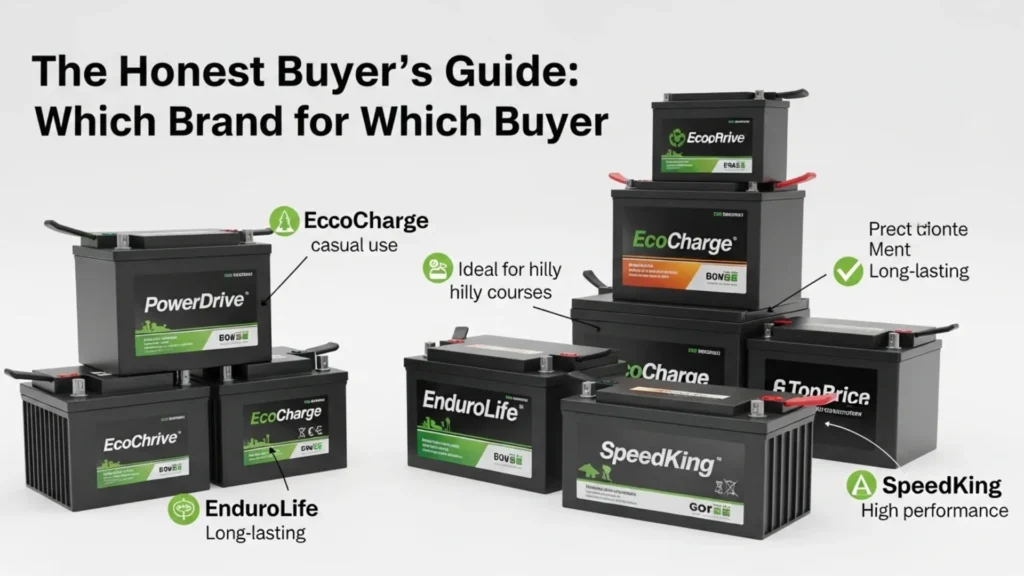
Buy Trojan If…
- You want the brand with the longest proven track record and the most technician familiarity
- Your cart is in a fleet or shared-use environment where maintenance quality is variable
- You prefer the peace of mind of buying the market leader and dealing with the most established warranty support network
- Your driving environment includes significant slope, high temperatures, or other conditions that stress the battery pack above average
- Budget is not a significant constraint and you want to make the safest brand choice available
The honest Trojan case is simple: it is the most reliable product in the market, has the most technicians who know how to service and support it, and carries the most forgiveness under imperfect maintenance conditions. You pay a premium for those properties. For fleet operators and for owners who place high value on brand confidence, that premium is justified. For residential owners with good maintenance habits who would benefit from comparing specifications honestly, the case for Trojan on pure merit is somewhat weaker than its market position suggests.
Buy US Battery If…
- You are replacing a 48-volt pack on a budget and want the best value option that does not compromise quality
- Your maintenance habits are good — you equalize on schedule and check water levels monthly
- Your cart is primarily used in moderate temperatures (below 95 degrees Fahrenheit average ambient)
- You want higher rated capacity at lower cost than Trojan in the 6-volt segment
- You are comfortable with a brand that is less visible in retail but backed by a US manufacturing operation with its own facilities
US Battery is the most logical choice for a budget-aware residential owner with reasonable maintenance habits. The specification comparison does not support the price premium that Trojan commands over US Battery in most residential use cases. The US2200XC2 has more rated capacity than the Trojan T-105 at a lower price per unit — and in the 8-volt segment, the US8VGC matches the Trojan T-875 specification exactly at a 15-20% lower price. That is a compelling case that the market tends to undervalue relative to Trojan’s brand equity.
Buy Crown If…
- Your cart is used heavily — two or more full discharge cycles per week consistently
- You are in a hot-climate environment (Florida, Texas, Arizona, Nevada) where summer temperatures regularly exceed 95 degrees
- You are equipping a small commercial fleet where total cost of ownership over four or more years matters more than upfront unit cost
- You want the highest rated capacity in the 8-volt segment (CR-215 at 180Ah leads the comparison)
- You are comfortable sourcing from a brand with less retail visibility but a legitimate 90-year manufacturing history
Crown is the most underappreciated battery in this comparison. In heavy-use and hot-climate scenarios, Crown’s heavy plate construction delivers genuinely better cycle life than either Trojan or US Battery at a price point that sits between them. The 36-month warranty is the legitimate weakness, but for a buyer who understands that a Crown battery is engineered to outlive its warranty in normal use, the shorter coverage period is an acceptable tradeoff for the improved long-term economics.
What We Have Learned Supporting Thousands of Battery Purchases
After years of helping golf cart owners purchase, maintain, and replace battery packs, the patterns that emerge consistently tell us a few things that the marketing materials for any of these brands will not say directly.
The first is that pack replacement timing is overwhelmingly driven by maintenance habits, not brand quality. The majority of premature battery pack replacements we see — packs failing at three years or less — are from carts whose owners never equalized, routinely drove the pack past 50% discharge without recharging, or let water levels drop below plate level. A Trojan T-875 failing at three years in those conditions is not a Trojan quality failure — it is a maintenance failure that would have produced the same result with US Battery or Crown. Brand choice matters at the margin; maintenance habits matter fundamentally.
The second is that the Trojan premium is most justified at the commercial and fleet end of the market and least justified for the average residential owner who charges consistently and does moderate use. If you are a retired couple using your cart for morning errands and afternoon trips to the clubhouse three times a week, a US Battery US8VGC set at $840-$1,020 a pack will serve you as well as a Trojan T-875 set at $990-$1,170 for any purpose you will realistically put that cart to.
The third is that charger quality directly multiplies or divides the value of any battery you purchase. A $1,200 Trojan pack on a marginal OEM charger that has never seen an equalization cycle will fail significantly sooner than an $850 US Battery pack on a quality Lester Summit II with regular equalization. If you are replacing batteries on a budget, consider whether the incremental cost of a charger upgrade would add more longevity to the new pack than upgrading the battery brand.
| E-E-A-T NOTE | Golf Cart Gears stocks Trojan, US Battery, Crown, and lithium options from Dakota and Eco Battery. We do not have a financial incentive to recommend one flooded lead-acid brand over another — our margins are similar across brands. The comparison in this article reflects genuine technical analysis and real-world patterns from supporting thousands of battery purchases. |
Frequently Asked Questions
Are Trojan batteries really worth the extra cost over US Battery?
For most residential owners with consistent maintenance habits, the honest answer is: not significantly. The T-875 and US8VGC have identical rated capacity at 170Ah, and both deliver four to six years of service under standard maintenance. Trojan’s advantage shows most clearly in fleet environments, variable maintenance conditions, and extreme operating environments. For a well-maintained residential cart used moderately, the US Battery pack delivers equivalent performance at a meaningfully lower price.
Why does Crown battery have the highest capacity but is less popular than Trojan?
Crown’s relative obscurity in residential golf cart retail is primarily a distribution and brand awareness issue, not a product quality issue. Crown focuses heavily on commercial and industrial distribution channels rather than golf cart dealer networks. Technicians who have not used Crown regularly are more likely to recommend the brand they know — Trojan — even when Crown’s specifications may be objectively stronger for a specific application. Crown’s shorter warranty period also makes it a harder sell in retail environments where customers compare warranty terms.
How long should Trojan T-875 batteries last?
Under proper maintenance — monthly water level checks, equalization every 60 days, consistent charging after every use, and temperature-moderated storage — Trojan T-875 batteries typically last five to seven years in residential golf cart use. Under average maintenance (inconsistent equalization, occasional deep discharge, infrequent water checks), the realistic expectation is four to five years. Under poor maintenance, three years or less is common.
Can I mix Trojan batteries with US Battery or Crown in the same pack?
No. Never mix brands, ages, or specifications in a series-wired battery pack. Even batteries with identical specifications from different manufacturers have manufacturing tolerances that create slight differences in internal resistance and charge acceptance. Mixing batteries produces uneven charge distribution across the pack, which over time causes stronger batteries to repeatedly over-charge weaker ones — dramatically shortening the lifespan of the entire pack.
Is the US Battery US2200XC2 actually better than the Trojan T-105?
On rated capacity at the C20 rate, yes — the US2200XC2 at 232Ah has a 3% advantage over the Trojan T-105 at 225Ah. In normal residential use, this advantage is real but modest: approximately 1-2 additional miles per charge under moderate driving conditions. The more meaningful advantage is the 15-25% lower price per unit. On a straight specification-per-dollar comparison, the US2200XC2 offers more value than the T-105 for the majority of residential buyers.
Do these brands need different chargers?
No — Trojan, US Battery, and Crown all use standard flooded lead-acid chemistry with compatible charging profiles. The same quality automatic charger with a proper 48V absorption voltage (approximately 58.2-58.4V for a 48V pack) and an equalization mode works correctly with all three brands. What changes between brands is the water consumption rate — Crown’s higher capacity plates in the CR-235 and CR-215 consume slightly more water per charge cycle than equivalent Trojan or US Battery cells, requiring marginally more frequent water level checks.
Where can I buy Crown batteries for my golf cart?
Crown has less retail distribution than Trojan or US Battery in the golf cart channel. GolfCartGears.com stocks Crown batteries for all major platform configurations and ships direct. Industrial battery distributors, marine supply companies, and some commercial fleet suppliers also carry Crown. If your local golf cart dealer does not stock Crown, online purchasing with direct-to-door delivery is the most practical sourcing option.
The Verdict: Three Good Products, Different Situations
This comparison does not produce a single winner because the best battery depends on who you are, how you use your cart, and what you value in a purchase. That is not a diplomatic hedge — it is the honest conclusion of a genuine specification and real-world performance analysis.
Trojan is the best choice when maintenance consistency is questionable, when the cart is used in a fleet or shared environment, or when the peace of mind of buying the market leader with the most established support network is worth the price premium. Its Maxguard separator technology is a genuine engineering advantage in imperfect maintenance conditions.
US Battery is the best choice for residential owners with consistent maintenance habits who want genuine quality at a price that is meaningfully lower than Trojan. The US2200XC2 in the 6-volt segment is arguably the best specification-per-dollar battery in this comparison, and the US8VGC matches the Trojan T-875 exactly on rated capacity for less money.
Crown is the best choice for heavy users, commercial applications, and hot-climate owners who cycle their packs frequently and want the longest cycle life available in the mainstream flooded lead-acid category. The CR-215’s 180Ah rated capacity leads the 8-volt field, and Crown’s heavy plate construction delivers cycle life that justifies its price point in high-use scenarios.
Whatever you choose: charge after every use, equalize every 60 days, check water levels monthly, and invest in a quality charger with an equalization mode. Those four habits, applied consistently, will extract more life from any of these three batteries than brand selection alone ever will.