
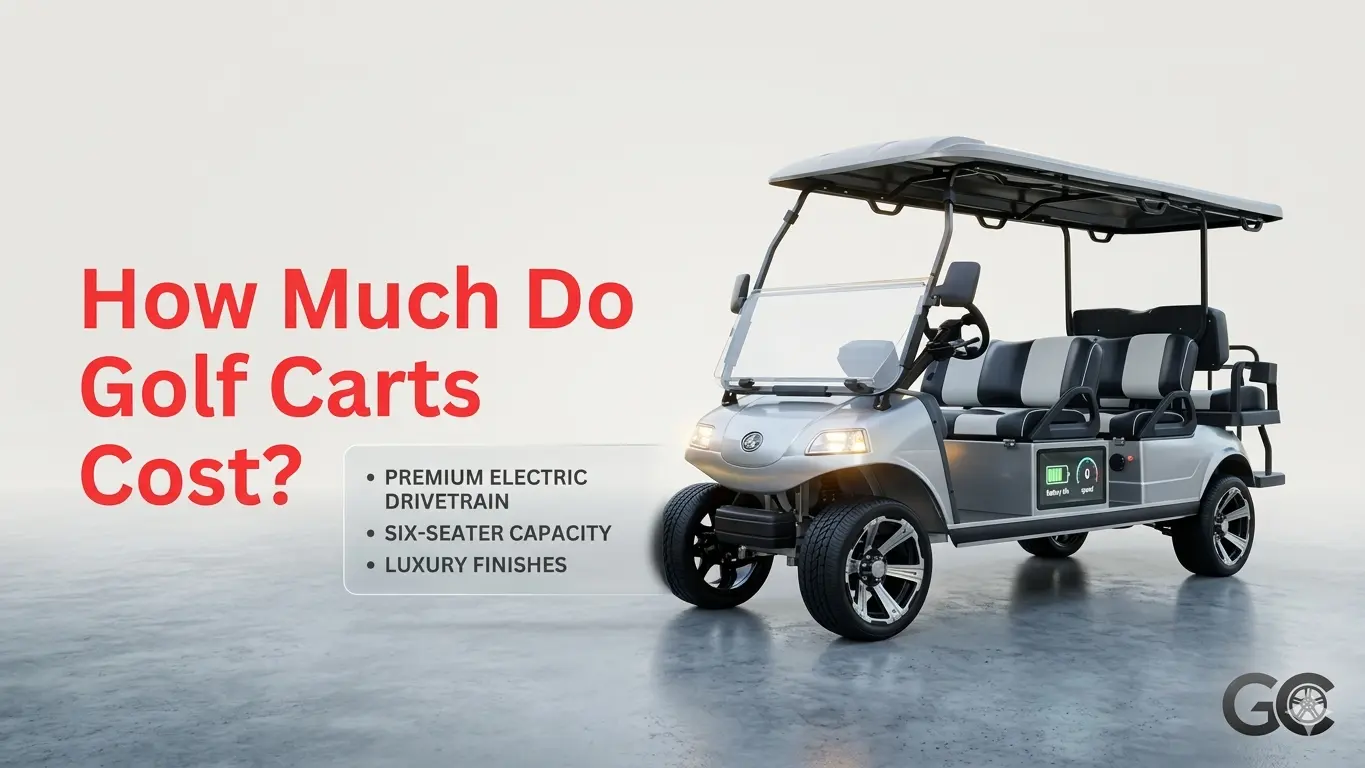
The Price You See Is Not the Price You Pay
Search “how much does a golf cart cost” and you will find a hundred articles that confidently tell you golf carts run $7,000 to $15,000 and leave it at that. What those articles do not tell you is that the sticker price of a golf cart is often the smallest part of the actual financial picture — especially if you are buying electric.
The battery pack alone on a new electric golf cart needs replacing every four to six years if it is lead-acid, at a cost of $1,000 to $1,600. The charger ages out. Tires wear. Cables corrode. And if you want your cart to actually do what you imagined when you bought it — haul a family across a large property, cruise a gated community comfortably, carry groceries from the clubhouse — you are looking at $200 to $800 in accessories on top of the purchase price.
This guide does what most buyer’s guides refuse to do: it breaks down the complete cost of golf cart ownership — purchase price by category, brand-by-brand pricing, new versus used economics, hidden recurring costs, and the total 5-year and 10-year cost of ownership numbers you should actually be working from.
Table of Contents
Whether you are buying your first cart, upgrading from an older model, or trying to understand whether a used cart at a dealer is actually a good deal — this is the pricing guide you needed before you walked into that showroom.
| QUICK ANSWERHow much does a golf cart cost in 2026? New base-model electric (36V/48V): $8,000 – $12,000. Standard 2-passenger, manufacturer warranty, OEM charger included.New premium / 4-passenger / LSV: $12,000 – $22,000+. Lifted, street-legal, larger body, enhanced suspension.Used (3-6 years old): $3,500 – $8,500. Price depends heavily on battery condition — the single most important factor in used cart value.True 5-Year Cost of Ownership: $12,000 – $22,000 depending on battery type, usage, accessories, and maintenance. Sticker price is the beginning, not the end. |
The Golf Cart Market in 2026: What You Are Actually Buying
The term “golf cart” now describes four genuinely different product categories that share a name but little else in terms of price, capability, or regulatory status. Understanding which category you are shopping in is the first step to making sense of the price range.
Standard golf carts — the two-passenger units you see on every golf course — are designed for speeds of 12-15 mph and are intended for golf course and private property use. These are the most commonly sold category and the price anchor most people are working from.
Low Speed Vehicles (LSVs), also called Neighborhood Electric Vehicles (NEVs), are street-legal golf carts certified to Federal Motor Vehicle Safety Standards. They are legal on roads posted at 35 mph or lower, require seat belts, headlights, turn signals, mirrors, and a Vehicle Identification Number (VIN). LSVs command a significant price premium over standard golf carts — and for good reason, because they are genuinely more useful if you live in a golf cart community or planned neighbourhood where cart-to-road access is normal.
Lifted and custom carts occupy a wide price spectrum. A factory-lifted model from Club Car or EZGO adds $2,000-$4,000 over the base price. A professionally lifted and customised cart from an independent builder can easily reach $20,000-$35,000. These are not golf carts in the traditional sense — they are custom utility vehicles that happen to share a chassis with golf carts.
Used golf carts are their own category with their own valuation logic — heavily influenced by battery age and condition in a way that new car buyers are not accustomed to thinking about. We cover used cart valuation in detail below, because it is where many buyers either find exceptional value or get quietly burned.
New Golf Cart Prices by Brand: 2026 MSRP Guide
The three dominant brands in the golf cart market — Club Car, EZGO, and Yamaha — each sell through authorised dealers and each has a distinct product line with different price positioning. Here is a realistic overview of 2026 pricing across models and configurations.
Club Car — Premium Brand, Premium Price
Club Car is widely regarded as the premium end of the mainstream golf cart market, and its pricing reflects that. The brand’s build quality, particularly the welded aluminium frame (Carryall and Precedent/Onward models) that does not rust, is a genuine differentiator that justifies part of the price premium over competitors.
| Club Car Model | Config | Power | MSRP Range | Notes |
| Onward 2 Passenger | 2-Pass | Electric / Gas | $10,299 – $11,800 | Entry point for new Club Car |
| Onward 4 Passenger | 4-Pass | Electric / Gas | $12,500 – $14,200 | Most popular family config |
| Onward Lifted 4 Pass | 4-Pass Lifted | Electric / Gas | $14,500 – $17,500 | Factory lift + larger tyres |
| Precedent i2 (Golf) | 2-Pass | Electric / Gas | $8,500 – $9,800 | Golf-specific, fleet popular |
| Villager 4 (LSV) | 4-Pass LSV | Electric | $16,500 – $19,500 | Street-legal, VIN, full lights |
| Carryall 500 / 700 (Utility) | Utility | Electric / Gas | $13,000 – $18,000 | Commercial / resort utility |
EZGO — Best Value in the Mainstream Market
EZGO (a Textron brand, like Club Car) offers some of the best feature-per-dollar value in the new golf cart market. The RXV platform is particularly well-regarded for its AC motor and regenerative braking system, which meaningfully extends battery range compared to older DC motor setups. EZGO has narrowed the quality gap with Club Car significantly over the past five years.
| EZGO Model | Config | Power | MSRP Range | Notes |
| TXT 2 Passenger | 2-Pass | Electric / Gas | $7,500 – $9,200 | Entry-level, fleet workhorse |
| RXV ELiTE 2 Passenger | 2-Pass | Electric (AC) | $9,800 – $11,500 | AC motor + regen braking |
| Freedom RXV 4 Passenger | 4-Pass | Electric / Gas | $11,200 – $13,500 | Popular community cart |
| Liberty ELiTE (LSV) | 4-Pass LSV | Electric | $15,500 – $18,500 | Street-legal, DOT compliant |
| Express S4 / L6 | 4-6 Pass | Electric / Gas | $12,000 – $16,000 | Rear-facing rear seats |
Yamaha — The Reliability Play
Yamaha’s golf cart division consistently scores at or near the top of owner satisfaction surveys for long-term reliability and low maintenance frequency. The Drive2 platform is particularly respected for its drive-system longevity. Yamaha tends to price between EZGO and Club Car for comparable configurations, making it an attractive middle ground for buyers who prioritise long-term dependability over prestige brand positioning.
| Yamaha Model | Config | Power | MSRP Range | Notes |
| Drive2 PowerTech (Gas) | 2-Pass | Gas | $8,200 – $9,500 | Yamaha’s flagship gas engine |
| Drive2 QuieTech EFI | 2-Pass | Gas (EFI) | $8,800 – $10,200 | Quieter gas engine, better efficiency |
| Drive2 PTV Electric | 2-Pass | Electric (48V) | $9,000 – $10,800 | 48V AC system, solid range |
| Concierge 4 / 6 | 4-6 Pass | Gas / Electric | $12,000 – $15,500 | Premium multi-passenger |
| Umax Two (Utility) | Utility | Gas | $10,500 – $12,800 | Commercial/resort utility |
Used Golf Cart Prices: How to Actually Value a Second-Hand Cart
Buying a used golf cart is fundamentally different from buying a used car, and most first-time buyers do not realise this until after they have already made the purchase. The reason: battery condition.
A used car’s mechanical wear degrades performance gradually and predictably. A used electric golf cart’s battery pack can be anywhere from perfectly fine to one round away from complete failure — and from the outside, there is often no visible difference between a cart with $1,400 worth of usable battery life remaining and one that needs a $1,200 battery pack replacement within six months.
This asymmetry of information in used electric cart transactions is why so many buyers end up paying what seems like a reasonable $4,500 for a used cart and then spending $1,200 on batteries six months later, bringing their real cost to $5,700 for a cart worth $4,200. That is not a good deal — it is an uninformed one.
Here is how to buy a used cart intelligently:
Used Golf Cart Price Guide by Age and Condition
| Cart Age | Battery Status | Condition | Fair Market Value | What to Expect |
| 0-2 years | Excellent | Like New | $7,500 – $11,000 | Strong value if well-maintained. Verify charger hours and confirm battery brand/age. |
| 2-4 years | Good | Excellent | $5,500 – $8,500 | Typically 2-3 years of battery life remaining. Best overall sweet spot for used cart buyers. |
| 4-6 years | Fair | Good | $3,500 – $6,000 | Battery replacement likely within 1-2 years. Factor $1,000-$1,600 into your offer price. |
| 6-8 years | Poor / End of Life | Fair | $2,000 – $4,000 | Budget immediate battery replacement. Negotiate hard or buy only if mechanicals are solid. |
| 8+ years | Replace Now | Variable | $800 – $2,500 | Motor, cables, controller all need inspection. Proceed only if you are comfortable with a restoration project. |
The single most important used cart inspection step is a battery load test. Any reputable golf cart shop can perform this in under 20 minutes. It tells you the actual capacity remaining in the battery pack under load — not the theoretical capacity. Do not buy a used electric cart without performing a load test first, and do not accept a seller’s word that the batteries are fine. Verify independently.
| BUYER WARNING | Be especially cautious with used carts advertised as having “new batteries” if you cannot verify the purchase receipt and installation date. It is easy to swap dead batteries for cheap, reconditioned ones before a sale and represent them as new. Always ask for the battery brand, model, and proof of purchase date before accepting the “new batteries” claim. |
The Real Cost of Golf Cart Ownership: Hidden Expenses Nobody Mentions at the Dealership
This is the section that changes how most people think about golf cart economics. The sticker price is one transaction. What comes after it is a multi-year series of expenses that experienced cart owners know intimately and first-time buyers discover with increasing frustration.
Let us go through every meaningful ongoing cost in plain language.
Battery Replacement: The Big One
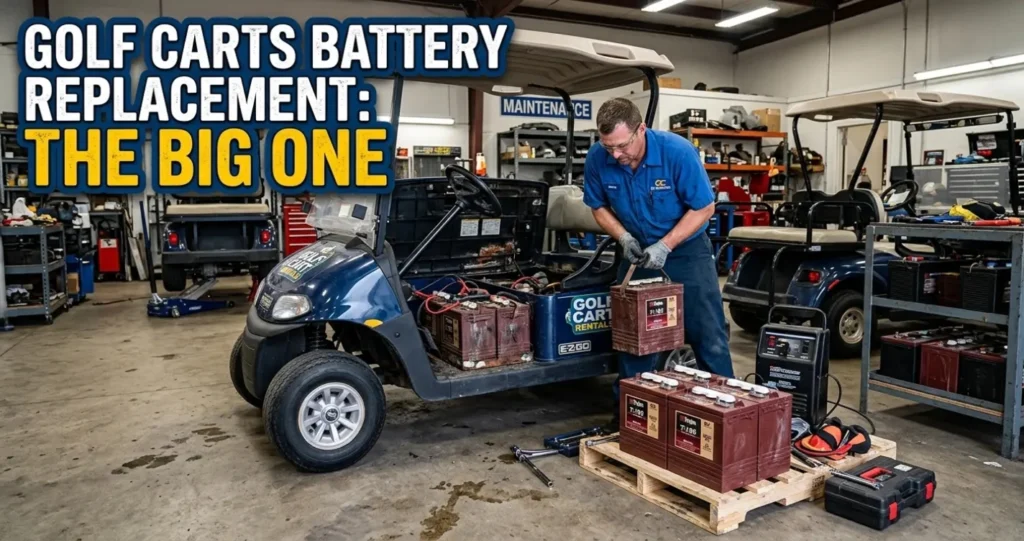
If you buy an electric golf cart — which the majority of buyers do — you will replace the battery pack at least once during a 10-year ownership period, and almost certainly twice. This is not a product defect. It is a chemistry reality. Lead-acid batteries have a finite number of charge cycles, and a regularly used golf cart will exhaust those cycles in four to six years.
A quality battery replacement for a standard 48-volt system costs $1,000 to $1,600 for the batteries, or $1,200 to $2,000 installed by a shop. Over 10 years, budget for one to two complete battery pack replacements at minimum.
The single best way to reduce this expense long-term is to switch to lithium iron phosphate batteries at the first replacement. A $2,200 to $3,500 lithium pack will typically last the entire remaining life of the cart with zero maintenance. The math almost always favours going lithium at the first replacement, not continuing to cycle through lead-acid packs.
Charger Replacement or Upgrade
OEM chargers typically last 5-8 years before performance degrades noticeably — longer if the cart is stored in temperature-moderated conditions, shorter in extreme heat environments. A replacement OEM charger runs $200-$400. An upgraded aftermarket charger like the Lester Summit II runs $300-$500 but includes selectable profiles for different battery chemistry, making it future-proof for a lithium conversion.
Budget $300-$500 over a 10-year ownership period for a charger upgrade or replacement. If you are converting to lithium, budget this as a simultaneous investment with the battery purchase — not a future option.
Tires and Wheels
Standard OEM golf cart tires on a regularly used cart typically last 3-5 years before tread wear or sidewall cracking warrants replacement. A set of four replacement tires in the standard 18×8.5-8 or 20×10-10 sizing runs $120-$300 depending on tread pattern and quality. If you are replacing tires on a lifted cart with larger 23-inch or 25-inch tires, budget $200-$500 for a quality set.
Wheel and rim upgrades are an optional aesthetic expense that many owners make once — typically when they are already replacing tires. A set of four aftermarket wheels plus new tires runs $300-$800 depending on wheel design and tire specification.
Accessories: Budget for What You Actually Want
Most first-time golf cart buyers underestimate how much they will spend on accessories in the first year of ownership. The cart feels incomplete without a windshield. Then comes the enclosure for cooler weather. Then a rear seat kit so the kids can ride. Then lights for evening use. Then a USB charger, a phone holder, a portable cooler. None of these are expensive individually — but together they easily add $500-$1,500 to first-year cost.
The most common first-year accessory purchases and their typical price ranges:
- Windshield (folding or fixed): $80 – $180
- Golf cart enclosure / weather protection: $150 – $350
- Rear seat or flip seat kit: $180 – $380
- LED light kit (headlights, taillights, turn signals): $120 – $280
- Cart cover for storage: $60 – $140
- USB / 12V power outlet: $25 – $60
- Side mirrors: $25 – $60 per pair
- Phone holder / mount: $20 – $45
- Bluetooth speaker: $60 – $200
- Cargo box or cooler mount: $80 – $200
Insurance
Golf cart insurance is required in most states and communities if the cart operates on public roads — which includes most LSV-classified carts and any cart used in a golf cart community with road access. Even for purely private property use, homeowner’s or renter’s insurance typically does not cover golf cart accidents, and many golf course community HOAs require proof of liability coverage.
Dedicated golf cart insurance (liability only) typically runs $75-$150 per year through insurers like State Farm, Progressive, or American Family. Full coverage including collision and comprehensive for a new cart runs $200-$450 per year. If your cart qualifies as an LSV, your state may require standard auto insurance, which can run $600-$1,200 per year for full coverage on a vehicle valued at $15,000-$20,000.
Storage
Golf carts stored indoors in a garage or covered shed live meaningfully longer than those stored outdoors. Heat, UV exposure, moisture, and seasonal temperature swings all accelerate aging in both the battery pack and the cart body. If you do not have covered storage and need to rent it — a storage unit sized for a golf cart runs $40-$120 per month depending on location, or $480-$1,440 per year.
True Cost of Ownership: The 5-Year and 10-Year Numbers
Here is the complete cost picture for three typical buyer scenarios, assembled from everything above. These are realistic estimates based on moderate-use patterns — a cart used three to five times per week, stored in a garage, and maintained consistently.
| Expense Category | Budget Buyer (Used + FLA) | Mid-Range (New EZGO + FLA) | Smart Long-Term (New EZGO + Lithium) | Notes |
| Initial Cart Purchase | $4,500 used | $10,500 new | $10,500 new | EZGO RXV 2-pass as benchmark |
| Batteries (5-yr period) | $1,200 (replace Yr 1-2) | $1,200 (replace Yr 4-5) | $2,400 (lithium at purchase) | Lithium pack at purchase vs FLA twice |
| Charger Upgrade | $350 | $0 (OEM sufficient) | $350 (lithium charger) | Lester Summit II for lithium compatibility |
| Tires (5-yr period) | $200 | $200 | $200 | 1 set standard 18×8.5-8 |
| Accessories (Year 1) | $400 | $700 | $700 | Windshield, enclosure, lights, seat kit |
| Insurance (5 years) | $500 | $625 | $750 | $100-150/yr for standard liability coverage |
| Maintenance / Misc. | $600 | $500 | $200 | Cables, cleaning, battery water etc. |
| TOTAL 5-YEAR COST | $7,750 | $13,725 | $15,100 | Lithium premium fully justified by Yr 8 |
| PROJECTED 10-YEAR COST | $11,500 – $13,500 | $18,500 – $21,000 | $18,500 – $20,000 | Lithium closes the gap entirely by year 10 |
The most important insight from this table is that the “budget” path of buying a cheap used cart and maintaining it with lead-acid batteries is only budget-friendly in year one. The recurring battery replacement costs, higher maintenance frequency, and shorter useful lifespan of an older cart progressively erode the initial savings. By year eight, a buyer who started with a $4,500 used cart has often spent more total than someone who bought a new mid-range cart with a proper lithium battery setup.
None of this makes buying used inherently bad. It makes buying used uninformed inherently expensive. A 2-4 year old cart with a verified good battery pack, from a reputable seller, at a fair price, is still an excellent purchase. The math is just different from what most first-time buyers expect.
Gas vs Electric Golf Cart: The Cost Breakdown
The gas versus electric decision is the first fork in the road for most buyers, and it has a meaningful impact on long-term cost that goes well beyond the upfront price difference (typically $500-$1,500 more for electric equivalents).
| Cost Factor | Gas Golf Cart | Electric Golf Cart |
| Upfront Price | Typically $500-$1,500 less than electric equivalent | Slightly higher upfront; difference has narrowed significantly |
| Fuel / Energy Cost | $200-$450/yr (depends on usage + gas price) | $40-$100/yr in electricity (at $0.12/kWh average) |
| Annual Maintenance | $200-$500/yr (oil changes, air filter, spark plugs, belts) | $80-$200/yr (battery water, terminal care, cables) |
| Major Service Intervals | Every 2 years or 500 hrs: carburetor, drive belt, fuel filter | Less frequent; battery replacement is the main large expense |
| Noise Level | Audible engine noise; exhaust emissions | Near-silent operation; no emissions |
| Best For | Large properties, extended range, no charging infrastructure | Regular/daily use, community living, lower long-term cost |
| 10-Year Running Cost | $3,000 – $5,500 in fuel and maintenance | $1,200 – $3,200 in electricity and maintenance |
Electric golf carts have a lower 10-year running cost than gas carts in virtually every moderate-use scenario. The gap narrows for infrequent users and widens for heavy daily users. The one scenario where gas genuinely wins is unlimited range without charging infrastructure — a large ranch, farm, or remote property where recharging stations are impractical and the cart runs continuously throughout the day. In that context, the ability to refuel in two minutes versus waiting eight hours for a recharge is a real operational advantage.
Expert Insights: What Experienced Buyers Wish They Had Known Earlier
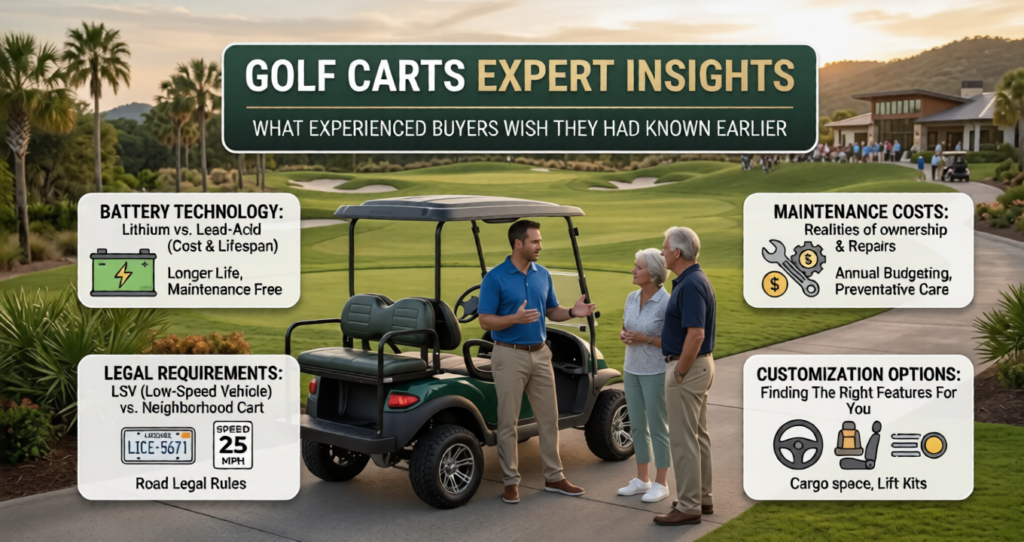
Over years of supporting golf cart owners through purchases, battery replacements, and upgrades, a few insights come up repeatedly in conversations with first-time buyers who call in after the fact.
The first is about dealer negotiation. Unlike new cars, golf cart MSRP pricing has meaningful flexibility — typically 5-12% from a motivated dealer, more at end of quarter, more if you are buying multiple units. Dealers rarely advertise this because most buyers do not ask. Simply asking “what is the best price you can do if I buy today?” moves more deals than you would expect. Bundling accessories into the deal rather than discounting the cart is also common — if the dealer will not move on price, ask them to throw in a windshield and a cart cover.
The second insight is about model year timing. Golf cart dealers take delivery of new model-year inventory in the spring. The best time to buy a new cart is typically October through December, when dealers are motivated to clear current-year inventory before new stock arrives. End-of-year discounts of $500-$1,500 below MSRP on new current-year models are not uncommon at reputable dealers.
The third insight is specific to used cart buyers: always prioritise battery condition over cosmetic condition. A used cart that looks beautiful but has a battery pack needing immediate replacement is worth $1,200 less than the asking price, period. A cart with scratched bodywork but a recently replaced or lithium battery pack is worth significantly more than its cosmetics suggest. Cosmetics are cheap to fix. Battery packs are not.
| E-E-A-T NOTE | Golf Cart Gears supports thousands of golf cart owners annually on purchasing decisions, battery replacements, and accessory upgrades through our toll-free line. Every insight in this article reflects real patterns from direct customer interaction — not assembled from other websites. We see these buyer mistakes repeatedly, and this guide exists specifically to prevent them. |
Buying Checklist: What to Confirm Before Any Golf Cart Purchase
For New Carts
- Confirm battery chemistry and brand — do not accept “standard batteries” as a complete answer
- Verify charger type, output amperage, and whether it has selectable chemistry modes
- Ask specifically about the OBC system on Club Car models and what the lithium conversion path looks like if you upgrade later
- Review the manufacturer warranty terms: most new golf carts come with a 2-year bumper-to-bumper warranty and a separate 1-2 year battery warranty — confirm both are in writing
- Understand what is included: do not assume a windshield, enclosure, or rear seat is standard on a premium model — ask the dealer to itemise what is and is not included at the quoted price
For Used Carts
- Perform a battery load test at a reputable shop before finalising any purchase
- Check battery date codes — most battery manufacturers stamp or etch a manufacture date on the case. Batteries older than four years on a daily-use cart are nearing end of life
- Inspect every cable for corrosion, cracking, and loose connections — cable replacement is a $200-$400 job that used cart sellers rarely disclose as needed
- Test the charger by plugging it in and confirming it initiates charging and shuts off cleanly at full charge — a failing charger that does not shut off will overcharge and destroy a new battery pack
- Ask for service records if available, or at minimum ask specifically: when were batteries last replaced, has the charger ever been serviced, and has the cart ever had motor or controller work done
- Do a full test drive at the expected use speed — if it is a 48V cart supposed to do 14-15 mph, drive it and check whether it actually reaches and holds that speed on a slight incline
Frequently Asked Questions
Is a Club Car worth the price premium over EZGO?
For most buyers, the answer is nuanced. Club Car’s welded aluminium frame is a genuine durability advantage — it simply does not rust the way a steel frame does over time, which matters a lot in humid coastal environments. Club Car also tends to have slightly higher resale values. However, EZGO’s RXV platform with its AC motor and regenerative braking offers genuinely better driving economics at a lower price. For buyers in dry inland climates buying primarily for performance value, EZGO is often the more rational choice. For buyers in humid coastal communities prioritising longevity and resale value, Club Car’s premium is easier to justify.
What is the cheapest way to get into a reliable golf cart?
Buy a 2-4 year old used cart from a reputable golf cart dealer — not from a private seller or general marketplace like Craigslist — after performing an independent battery load test. A dealer-inspected 3-year-old EZGO TXT or Yamaha Drive2 in good condition with a battery load test confirming 80%+ capacity remaining represents the best value in the market. Expect to pay $5,500-$7,500 and have $200-$500 in immediate accessories in your budget.
How much does a golf cart cost to run per month?
For a typical electric golf cart used four to five times per week: electricity cost runs $4-$10 per month at average US residential rates. Annual maintenance (water, terminal cleaning, occasional cable inspection) runs $50-$100. Insurance runs $7-$15 per month. Total monthly operating cost excluding battery depreciation: roughly $65-$125 per month. Including battery depreciation over a 5-year lead-acid pack lifespan, add approximately $18-$27 per month to that figure.
Are lifted golf carts worth the extra cost?
Lifted carts deliver a meaningfully better ride on uneven terrain, fit larger tires for improved traction and aesthetics, and significantly improve ground clearance for off-road or rough-path use. The factory-lifted models from Club Car and EZGO are the safest option — they are engineered with suspension geometry calibrated for the lift height. Aftermarket lift kits installed on standard carts can work well when done properly, but quality of installation varies enormously. Budget $2,000-$4,000 for a quality factory-lifted configuration, or $800-$2,500 for a quality aftermarket lift kit plus installation.
What is a street-legal golf cart and how much more does it cost?
A street-legal golf cart, legally classified as a Low Speed Vehicle (LSV), is federally certified to operate on roads posted at 35 mph or below. LSVs require headlights, taillights, turn signals, mirrors, seat belts, a windshield, and a VIN. The Club Car Villager, EZGO Liberty ELiTE, and Yamaha-based LSV conversions are common options. Expect to pay $14,000-$22,000 for a factory LSV versus $8,500-$13,000 for a comparable standard cart. The $5,000-$9,000 premium buys legal road access, which in many planned communities and resort towns is a significant quality-of-life value.
How much should I budget for accessories in the first year of cart ownership?
Budget $500-$1,000 for a realistic first-year accessory spend if you are buying a standard 2-passenger cart for family or community use. The most common essentials are a windshield ($80-$180), an enclosure ($150-$350), a rear seat kit if you have kids ($180-$380), and an LED light kit ($120-$280). These four items alone can reach $700-$1,200. Buying them bundled with a new cart purchase often gets you a 15-20% discount versus buying them separately after delivery.
Can I negotiate the price of a new golf cart?
Yes — and many buyers do not try. Golf cart dealers typically have 8-15% gross margin on new units at MSRP. Deals of $500-$1,500 below MSRP are achievable, especially at end of season (October-December), end of quarter, or for buyers willing to take a current-year model when new inventory is arriving. Bundling accessories into the negotiation rather than purely discounting the cart price is often more productive, as dealers protect their cart margins more aggressively than their accessory margins.
The Final Word: Spend Smarter, Not Just Less
Golf cart pricing is genuinely transparent once you understand all the layers. The sticker price is just the start of the conversation. What you spend on batteries, chargers, accessories, insurance, and maintenance over the life of the cart determines whether your purchase was a smart long-term decision or an expensive short-term one.
The buyers who come out ahead are the ones who think in 10-year ownership windows, not just the transaction at the dealership. They choose battery chemistry thoughtfully, they verify used cart condition before committing, they bundle accessories into the initial deal, and they understand that a $10,500 cart with a lithium battery pack is often a better 10-year investment than a $8,500 cart with a lead-acid pack that will need replacement in four years.
The bottom line: a realistic budget for a new golf cart with a proper setup and first-year accessories is $11,000-$16,000 depending on configuration. A realistic budget for a smart used cart purchase from a reputable dealer is $6,000-$9,000 including first-year accessory spend. Work from those numbers and adjust for your specific brand and feature preferences — not from the lowest advertised price you saw online.