
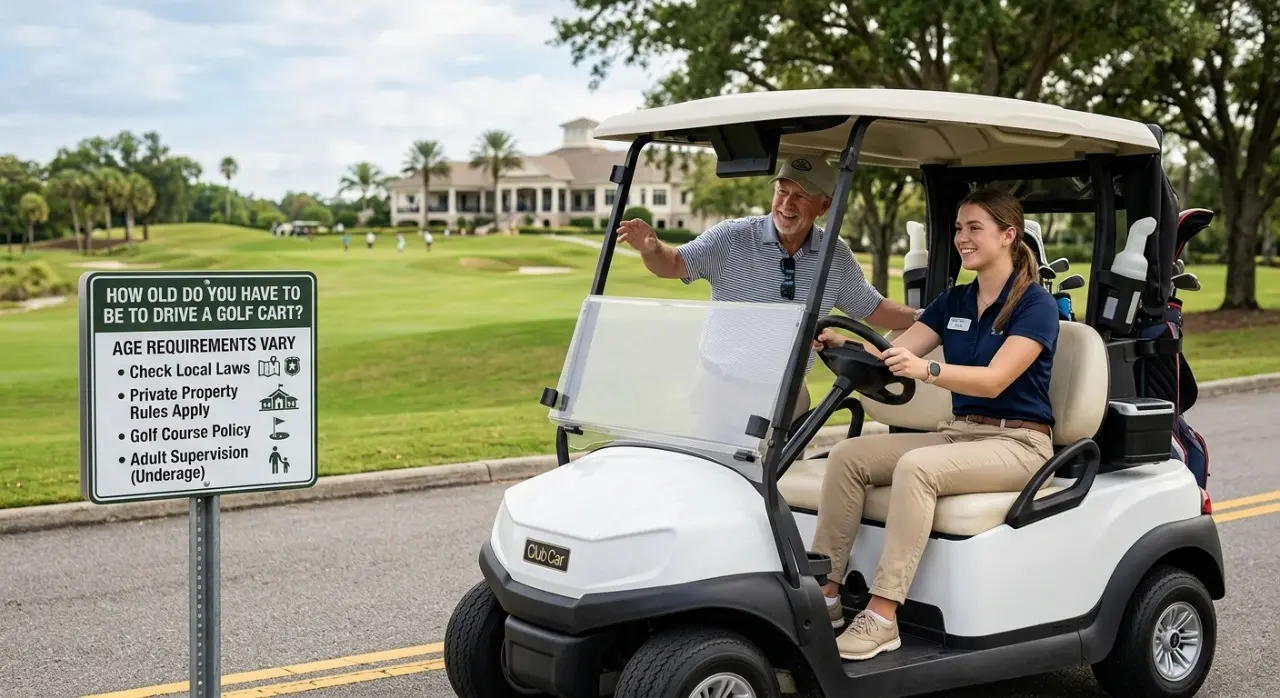
If you search “how old do you have to be to drive a golf cart” and expect a clean, simple answer, you are going to be disappointed — because there is not one. There are fifty. Every state in the US sets its own golf cart age requirements, and within those states, individual counties, municipalities, and HOA communities often layer on their own additional rules.
To make it more complicated, the age requirement depends on where the cart is being driven. On a private golf course? One set of rules. On a street or road within a planned community? A different set. On a public road with a posted speed limit? Potentially a completely different legal framework involving Low Speed Vehicle (LSV) classification, driver’s licence requirements, and insurance mandates.
We put this guide together because these questions come up constantly from our customers — parents wondering whether their teenager can drive the family golf cart to the pool, Florida retirees trying to understand what is actually legal in their community, and new cart owners who had no idea there were rules to research in the first place.
This guide covers the most commonly searched states in detail, explains the federal LSV framework that applies nationally, gives parents a practical safety framework for young drivers, and tells you exactly what accessories your cart needs to be legal in different contexts. Let us get into it.
| QUICK ANSWERHow old do you have to be to drive a golf cart?On private property (golf courses, farms, private communities): No minimum age set by law in most states. Property owners and parents set the rules.On public streets in golf cart communities: Typically 14-16 years old depending on state. A valid driver’s licence or learner’s permit is required in most states.For LSV / street-legal operation on public roads: A full, valid driver’s licence is required in virtually every state. Minimum age 16 in most jurisdictions. |
Table of Contents
The Federal Framework: Golf Carts vs Low Speed Vehicles
Before diving into state-by-state rules, it is important to understand the federal framework that all state laws work within. The National Highway Traffic Safety Administration (NHTSA) draws a clear legal line between two categories of vehicle that most people call “golf carts.”
A standard golf cart is not federally regulated as a motor vehicle. It is not required to meet Federal Motor Vehicle Safety Standards, does not require a VIN, and is not permitted on public roads unless a state or municipality specifically authorises it through local ordinance. A standard golf cart is legally considered an implement of husbandry or a recreational vehicle on private property.
A Low Speed Vehicle (LSV), by contrast, is federally regulated. The NHTSA defines an LSV as a four-wheeled motor vehicle with a top speed between 20 and 25 mph that meets a specific set of Federal Motor Vehicle Safety Standards. LSVs must have headlights, taillights, stop lights, turn signals, reflex reflectors, parking brakes, rearview mirrors, windshields, seat belts, and a VIN. They are permitted on public roads posted at 35 mph or lower in states that have enacted LSV provisions — which as of 2025 includes all 50 states in some form.
Why does this distinction matter for age requirements? Because your answer changes completely depending on which category your cart falls into. A standard golf cart operating in a planned community under a local ordinance may only require the driver to be 14. The same vehicle — if it is classified as an LSV and operated on a public street — legally requires a full driver’s licence in virtually every state. Same physical cart, different legal contexts, completely different age requirements.
| IMPORTANT DISTINCTION | The term “street-legal golf cart” used by dealers and buyers almost always refers to an LSV-equipped cart, not a standard golf cart. If a dealer tells you a cart is street-legal, confirm whether it is LSV-certified with a VIN. A cart with headlights and a windshield is not automatically street-legal — LSV certification requires compliance with federal safety standards and proper VIN assignment. |
State-by-State Golf Cart Age Requirements: The Most Comprehensive Guide Available
The following table covers the key golf cart age and licensing rules for all 50 states. Where state law is silent on a specific situation, local ordinance or property rules apply — and those vary enormously. Always verify with your local municipality or HOA for the specific rules in your community.
Highest-Traffic States: Detailed Rules
| State | Min. Age (Community) | Licence Required? | Key Rule | Notes |
| Florida | 14 years | No (14-15) Yes (on road) | Under 14 cannot operate on roads. 14-15 with learner’s permit allowed on designated cart paths. | Many Florida HOAs require 16 regardless of state law. Always check community rules. |
| Georgia | 15 years | Learner’s permit min. | Cart paths and crossing public roads allowed at 15 with learner’s permit. Full road use requires licence. | The Villages-style communities in GA follow local ordinances that may differ. |
| Arizona | 16 years | Yes | Driver’s licence required for any public road or designated cart path crossing a road. | Scottsdale, Peoria, and Sun City areas have local ordinances. Age 13+ on private property is not restricted. |
| Texas | 16 years | Yes | Golf carts may operate on roads with speed limits of 35 mph or less with valid driver’s licence. | Texas Transportation Code Section 502 defines golf cart road provisions. Local rules also apply. |
| California | 16 years | Yes | Golf carts on public roads require a valid driver’s licence regardless of street designation. | Private golf course use has no state minimum age. Several Palm Springs-area communities have local rules for 14+. |
| South Carolina | 16 years | Yes (roads) No (cart paths) | Hilton Head and Myrtle Beach areas have extensive cart path systems. Operators must be 16 on public roads. | Some beach communities allow 14+ on designated paths. Golf courses typically have no age floor for supervised minors. |
| North Carolina | 16 years | Yes | Must have valid licence to operate golf cart on public vehicular areas. Private property is unrestricted. | Outer Banks communities and Pinehurst have specific local cart ordinances worth checking separately. |
| Louisiana | No min. | No (private) Yes (public) | One of the more permissive states. No state minimum age for private property operation. | New Orleans French Quarter and resort communities have specific local rules. Public road use requires a licence. |
| Tennessee | 16 years | Yes | Golf carts on public roads require a valid driver’s licence. Local roads under 35 mph with municipal permission. | Nashville suburb communities vary. HOAs often set 16 as standard regardless. |
| Colorado | 16 years | Yes | Golf carts classified as slow-moving vehicles on public roads. Driver’s licence required. | Mountain resort towns like Vail and Aspen have local rules for specific cart zones. |
| Nevada | 16 years | Yes | Las Vegas area has specific regulations for resort and community cart use. State law requires licence on roads. | Henderson, Summerlin, and Sun City communities each have HOA rules that may be more restrictive. |
| New York | 16 years | Yes | Golf carts on public roads must be LSV-certified and operated by a licensed driver. | Private golf course use is unrestricted by state law. Hamptons communities have local cart ordinances. |
Complete 50-State Quick Reference
| State | Min. Age (Community) | Licence Required (Public Road) | State | Min. Age (Community) | Licence Required (Public Road) | |
| Alabama | 16 | Yes | Montana | 16 | Yes | |
| Alaska | 16 | Yes | Nebraska | 16 | Yes | |
| Arizona | 16 | Yes | Nevada | 16 | Yes | |
| Arkansas | 16 | Yes | New Hampshire | 16 | Yes | |
| California | 16 | Yes | New Jersey | 16 | Yes | |
| Colorado | 16 | Yes | New Mexico | 16 | Yes | |
| Connecticut | 16 | Yes | New York | 16 | Yes | |
| Delaware | 16 | Yes | North Carolina | 16 | Yes | |
| Florida | 14 (paths) 16 (roads) | Yes (roads) | North Dakota | 16 | Yes | |
| Georgia | 15 (permit) | Yes | Ohio | 16 | Yes | |
| Hawaii | 15 | Yes | Oklahoma | 16 | Yes | |
| Idaho | 16 | Yes | Oregon | 16 | Yes | |
| Illinois | 16 | Yes | Pennsylvania | 16 | Yes | |
| Indiana | 16 | Yes | Rhode Island | 16 | Yes | |
| Iowa | 16 | Yes | South Carolina | 16 (roads) 14 (paths) | Yes (roads) | |
| Kansas | 16 | Yes | South Dakota | 16 | Yes | |
| Kentucky | 16 | Yes | Tennessee | 16 | Yes | |
| Louisiana | None (private) | Yes (public) | Texas | 16 | Yes | |
| Maine | 16 | Yes | Utah | 16 | Yes | |
| Maryland | 16 | Yes | Vermont | 16 | Yes | |
| Massachusetts | 16 | Yes | Virginia | 16 | Yes | |
| Michigan | 16 | Yes | Washington | 16 | Yes | |
| Minnesota | 16 | Yes | West Virginia | 16 | Yes | |
| Mississippi | 15 | Yes | Wisconsin | 16 | Yes | |
| Missouri | 16 | Yes | Wyoming | 16 | Yes |
| LEGAL NOTE | State laws in this table reflect publicly available statutes as of 2025. Laws change, and local ordinances frequently set more restrictive rules than state minimums. Always verify with your local municipality, county, or HOA before allowing a minor to operate a golf cart on any path or road. Golf Cart Gears is not a legal authority — this guide is for informational purposes. |
Florida: The Most Important State to Understand in Detail
Florida deserves its own section because it has the highest density of golf cart communities in the country — The Villages, Sun City Center, On Top of the World, and hundreds of smaller retirement and resort communities all operate extensive cart systems — and because Florida’s law is more nuanced than most states, with a specific 14-year-old provision that often gets misquoted.
Under Florida Statute 316.212, a golf cart may be operated on a public road only under specific conditions: the road must be designated by local authorities for golf cart operation, the road must have a posted speed limit of 30 mph or less, and operation must be during daylight hours only unless the cart is equipped with appropriate lighting. The statute specifies that a person operating a golf cart on a public road must be at least 14 years of age.
However — and this is the part that gets missed — that 14-year minimum applies specifically to the designated golf cart road provisions. It does not automatically authorise a 14-year-old to drive a golf cart throughout a gated community that has its own internal road network and HOA rules. Most Florida gated communities and planned communities have their own internal regulations that set minimum ages of 16 or require all operators to hold a valid driver’s licence, regardless of what the state statute says.
For parents in Florida communities: do not assume the state’s 14-year minimum overrides your HOA’s rules. In almost every case, the HOA rules are more restrictive. Read your community documents carefully, because HOA violations can result in fines and in extreme cases affect your community standing.
For public road operation in Florida — meaning actual paved roads, not designated golf cart paths — the standard Florida traffic law applies: a valid driver’s licence is required, regardless of age. A 14-year-old with a learner’s permit cannot legally drive a golf cart on a public Florida road without a licensed adult in the passenger seat, just like any other motor vehicle operating under a learner’s permit.
Private Property: The Rules Most Parents Do Not Know Apply
Here is the part that surprises many parents: on genuine private property — a farm, a large private estate, a golf course itself, or a private marina — virtually no state sets a minimum age for golf cart operation. Private property is private property, and the state generally does not dictate age restrictions for vehicle operation that occurs entirely off public roads.
This creates a nuanced situation for families. A 12-year-old driving a golf cart around grandma’s large private property? Perfectly legal in virtually every state. That same 12-year-old driving the same cart on the path that runs through their HOA community? Almost certainly a violation of the HOA’s internal rules, even if technically on private property.
Golf courses occupy an interesting middle ground. The golf course itself is private property, and most clubs set their own internal rules for cart operation — typically a minimum age of 16 to drive a cart unaccompanied, with younger players allowed to operate in the passenger seat under adult supervision. Some courses allow accompanied minors to operate carts from age 12 or 13. These are the course’s own policies, not state law.
The practical advice for parents: make the distinction clearly in your child’s mind. Private property is one thing. Any path, road, or area that connects to a public road or that HOA documents describe as common-area infrastructure is a different context that may have different rules. Being clear about this boundary prevents misunderstandings that can have real consequences.
A Parent’s Practical Safety Guide for Young Golf Cart Drivers
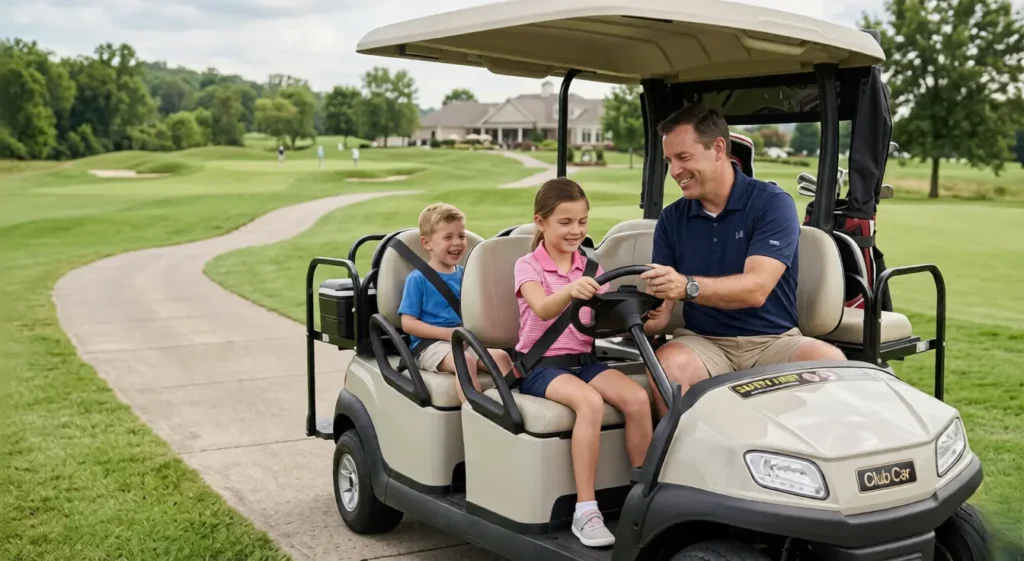
Whether the law technically permits your teenager to drive a golf cart or not, there is a meaningful conversation to have about readiness that goes beyond age. A 16-year-old who just passed their driver’s test may be less prepared for golf cart-specific hazards than a careful 14-year-old who has grown up around carts. Age is a legal threshold, not a measure of competence.
Golf Cart Hazards That Young Drivers Underestimate
Golf carts tip over more easily than they appear to. The high center of gravity, relatively narrow wheelbase, and light weight of most carts make rollover risk real when turning at speed, driving on slopes, or braking hard on downhill sections. A cart that feels stable at 10 mph on flat ground can become unstable quickly on a wet slope or a sharp turn. Teach young drivers that golf carts are not toys — they are slow-speed vehicles with genuinely serious tipping risk if not treated with respect.
Golf carts have no seatbelts on most standard models. Passengers who grab the overhead bar or side rail are doing the right thing instinctively, but many younger riders dangle their legs outside the cart body. This is how foot injuries happen — not from dramatic crashes, but from dragging feet that contact the ground or get caught under the cart frame. Establish a firm rule: all four limbs inside the cart body while moving, always.
Speed feels slower in a golf cart than it is. Fifteen miles per hour feels like nothing compared to driving a car, but a 15 mph collision with a parked vehicle, a concrete pillar, or another person is a significant impact event. Young drivers who get comfortable with cart speeds quickly start treating the throttle more aggressively than the physics warrant. Set a speed expectation early and reinforce it.
A Staged Introduction Framework for Parents
- Ride as a passenger through your community or property multiple times before any driving. Point out hazards, hills, sharp turns, and blind spots. Build the mental map.Stage 1 — Passenger first:
- Empty parking lot or large flat private area. Practice starting smoothly, stopping fully, and turning in both directions. No passengers other than the supervising adult.Stage 2 — Supervised driving on open flat ground:
- Actual paths or roads they will use regularly, with the adult present. Focus on intersections, uphill and downhill technique, and yielding to pedestrians and other carts.Stage 3 — Supervised driving on familiar paths:
- First few solo drives should be short and on familiar, low-traffic routes. Debrief after each one. What did they encounter? How did they handle it?Stage 4 — Solo driving with check-ins:
- Only after demonstrating consistent good judgment through the earlier stages. Set clear rules about passenger limits, time of day, and route boundaries.Stage 5 — Full independent use:
| SAFETY TIP | Install a governor or speed limiter if you are concerned about a young driver exceeding safe speeds. Most electric golf cart controllers allow a maximum speed reduction that takes less than 30 minutes to set and completely removes the temptation of top-speed driving during the learning phase. |
What Your Golf Cart Needs to Be Street-Legal (LSV Requirements)
If you want to operate a golf cart on a public road — not just a designated cart path, but an actual public road — in most jurisdictions the cart needs to meet LSV requirements. Here is what that means in practical terms for your cart and your budget.
| Required Equipment | Cost Range | Notes | Available at GolfCartGears.com |
| Headlights (low + high beam) | $80 – $180 | LED kits strongly recommended — brighter and longer-lasting than incandescent. FMVSS 108 compliant required for LSV. | Yes — LED light kits in stock |
| Taillights & Brake Lights | Included in light kit | Must activate independently of headlights and respond to brake pedal. Most complete LED kits include. | Yes — combo LED kits |
| Turn Signals (front + rear) | $40 – $100 | Separate turn signal kit or part of complete lighting kit. Self-cancelling preferred for convenience. | Yes — turn signal kits |
| Horn | $15 – $40 | Standard electric horn. Simple installation on most carts. | Yes — horn kits |
| Windshield | $80 – $200 | Must be safety glass or poly. Folding windshields accepted in most jurisdictions. | Yes — all major brands |
| Rearview Mirror | $20 – $60 | Interior rearview plus both side mirrors in many states. Club Car and EZGO brackets readily available. | Yes — mirror sets |
| Seatbelts | $60 – $160 | Lap belts minimum for most states; shoulder belts for LSV certification on newer models. | Yes — seatbelt kits |
| Reflex Reflectors | $10 – $30 | Front and rear amber/red reflectors. Often included in complete lighting kits. | Yes — reflector kits |
| Parking Brake | $0 – $80 | Most modern carts have one. Older carts may need a retrofit parking brake mechanism. | Parts available for major brands |
| Speed Capability (20-25 mph) | $0 – $600 (if upgrade needed) | Standard carts do 12-15 mph. Speed upgrade (controller/motor) may be needed to reach 20-25 mph for LSV range. | Controller upgrades in stock |
| VIN Assignment | Varies by state | Factory LSV carts come with VINs. Retrofitting a standard cart to LSV requires state-level inspection and VIN assignment — process varies widely. | Contact your state DMV |
An important practical note: outfitting a standard golf cart with all the physical equipment listed above does not automatically make it an LSV. True LSV certification requires a manufacturer-assigned VIN and compliance documentation. What the equipment does do is meet the practical inspection requirements many communities and local law enforcement look for when allowing golf carts on community roads under local ordinance — which is the actual operating environment for most cart owners.
If you are in a community that allows golf cart operation on community roads under a local ordinance, the equipment list above is what your inspector or HOA compliance officer will typically check. If you are trying to obtain full legal LSV registration for a retrofitted cart, contact your state DMV — the process varies significantly from state to state.
Golf Cart Insurance: What You Actually Need and When
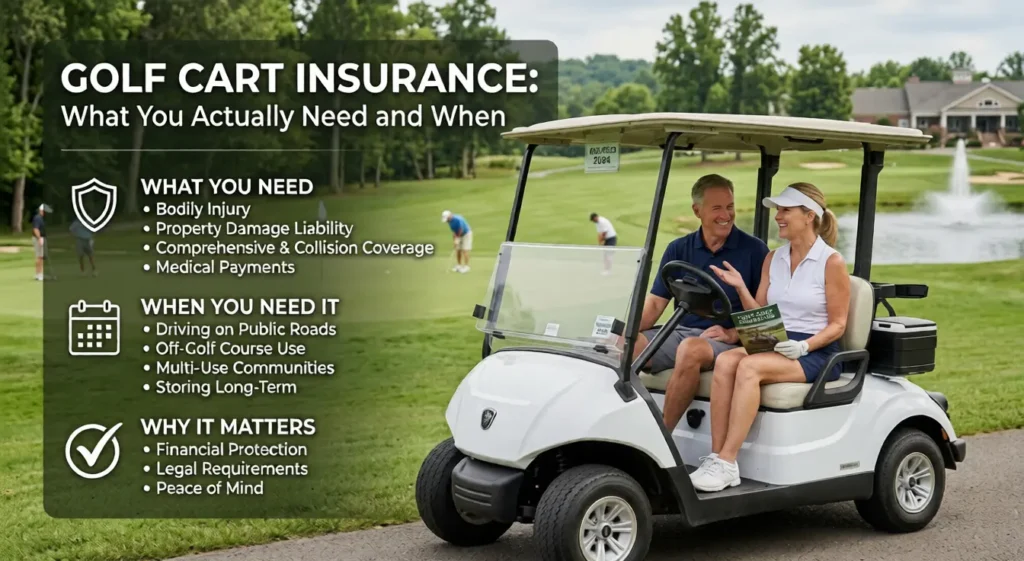
Insurance is where many golf cart owners — particularly those in planned communities — discover a gap they did not know existed. Your homeowner’s insurance policy almost certainly does not cover golf cart accidents that occur off your immediate property. And if a minor is driving and has an accident involving another person or property, the liability exposure without dedicated golf cart insurance is significant.
Golf cart liability insurance for a standard cart in a private community typically costs $75-$150 per year. This is genuinely one of the most affordable insurance products available for any vehicle, and the peace of mind it provides — particularly for families with teenage drivers — is completely disproportionate to the cost.
If your cart is LSV-classified and operates on public roads, most states require at minimum a liability insurance policy equivalent to the state’s minimum auto liability coverage. Full coverage (liability, collision, and comprehensive) on an LSV valued at $15,000-$20,000 typically runs $300-$600 per year. Insurers including Progressive, State Farm, and American Family all offer dedicated golf cart and LSV policies.
For families with young drivers specifically: confirm with your insurance provider whether your policy covers accidents caused by a minor operator. Some policies exclude unlicensed drivers entirely. Get that answer in writing before handing over the keys.
Frequently Asked Questions
Can a 12-year-old drive a golf cart on private property?
Yes, in virtually every US state. Private property has no state-mandated minimum age for golf cart operation. Whether this is safe and appropriate is a parenting decision, not a legal one. On community roads, cart paths, or any area governed by HOA rules, the answer is likely no — most HOA communities set a minimum of 16 for unsupervised cart operation.
Can a 14-year-old drive a golf cart in Florida?
Yes, under specific conditions. Florida Statute 316.212 permits golf cart operation by persons 14 or older on roads specifically designated by local authorities for golf cart use. This does not override HOA rules, which often require 16. And on any public road that is not specifically designated for golf cart use, a full driver’s licence is required regardless of age.
Do you need a driver’s licence to drive a golf cart?
For private property and golf course use — no, in most states. For operation on a public road or designated community road — yes, in the vast majority of states. For LSV classification and public road use — yes, a full driver’s licence is required in virtually every jurisdiction in the country.
What accessories do I need to make my golf cart street-legal?
At minimum: headlights, taillights, brake lights, turn signals, horn, windshield, rearview mirror, seatbelts, and reflex reflectors. True LSV street-legal status also requires a manufacturer-assigned VIN and compliance with Federal Motor Vehicle Safety Standards — which typically means buying a factory-built LSV rather than retrofitting a standard cart.
Can a teenager drive a golf cart with a learner’s permit?
On private property, yes. On public roads or community roads, it depends heavily on your state and local ordinance. In states like Georgia, a learner’s permit holder may operate a golf cart on cart paths. On public roads subject to standard traffic law, a learner’s permit typically requires a licensed adult in the passenger seat — just as with any other vehicle.
Is golf cart insurance required by law?
For standard carts on private property and designated community paths, insurance is generally not legally required — but is strongly recommended. For LSV-classified carts on public roads, most states require minimum liability insurance equivalent to standard auto insurance requirements. For carts in HOA communities, the HOA governing documents may require proof of insurance regardless of state law.
What happens if my child has an accident in a golf cart?
Without dedicated golf cart insurance, you are personally liable for property damage and injuries. Your homeowner’s insurance may have limited coverage for golf cart incidents that occur on your property, but typically excludes community road or path incidents. Get a dedicated golf cart liability policy — at $75-$150 per year, the protection-to-cost ratio is among the best available in any insurance category.
The Practical Takeaway
The answer to “how old do you have to be to drive a golf cart” is genuinely: it depends. On private property, there is typically no legal minimum age — parental judgement governs. In planned communities and golf cart zones, 14 to 16 is the most common legal floor, but your HOA’s rules almost certainly set a higher standard than state law. On public roads, a full driver’s licence is required in practically every US jurisdiction.
For parents: the legal age threshold and the readiness age are different conversations. Teach the hazards specifically — tipping risk, no seatbelts, the deceptive feel of low speeds — before worrying about whether the law technically permits it. A well-taught 15-year-old who understands golf cart physics is safer than a poorly supervised 17-year-old with a licence.
For cart owners getting compliant: the accessories list above covers every physical requirement for community road use in most jurisdictions. Use GolfCartGears.com to source LED light kits, windshields, mirrors, seatbelts, and everything else on the list — all the major brands and all the common cart models are covered.