
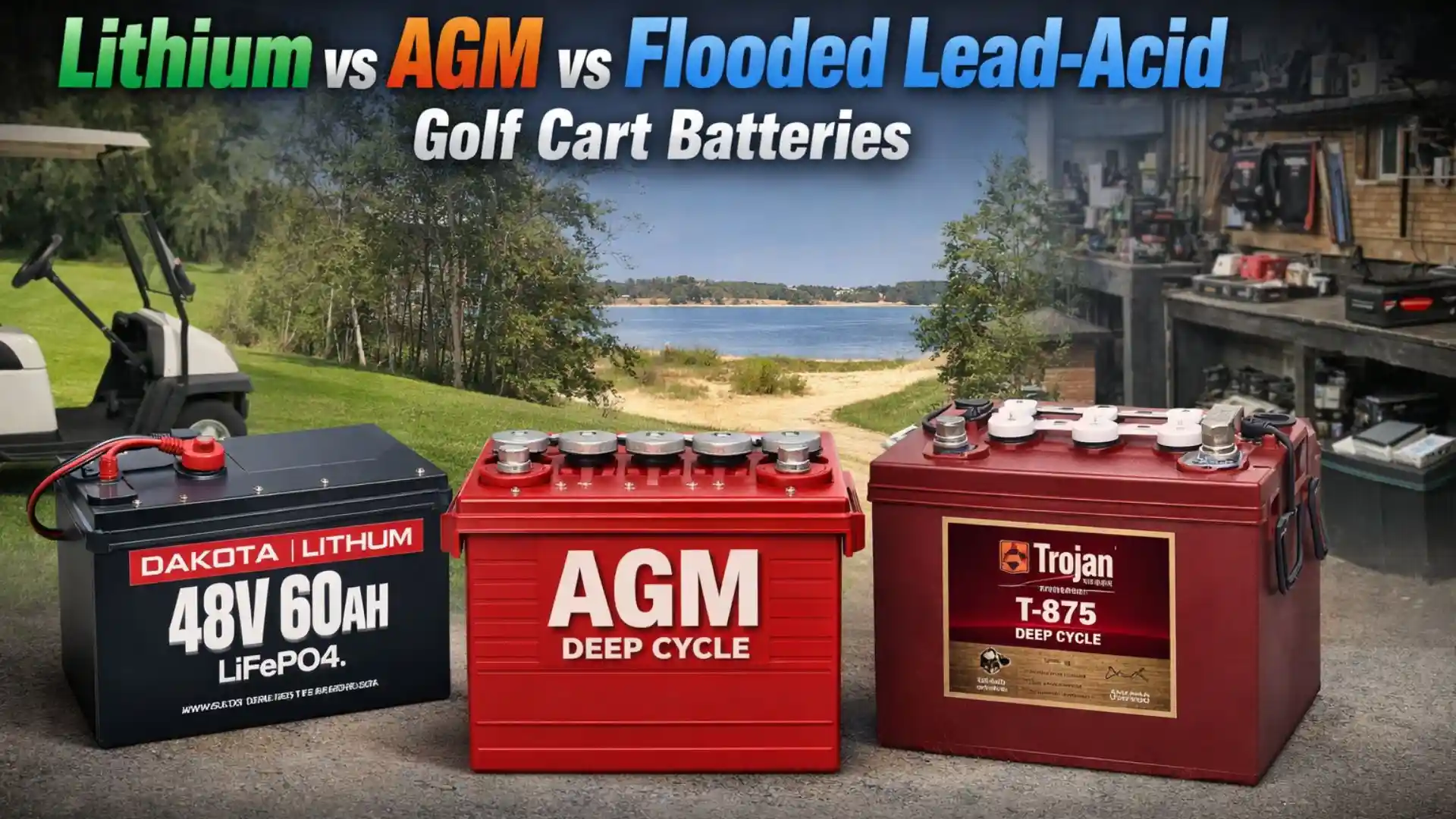
Here is a situation that plays out in golf cart shops every single week. A customer walks in, says their Golf Cart batteries are shot, and asks what to replace them with. The technician points at the row of Trojan flooded batteries on the shelf, says that is what they always use, and the customer walks out having never heard of two other options — or that the right choice depends entirely on how they actually use their cart.
Table of Contents
The golf cart battery market in 2026 has three genuinely different technologies: Flooded Lead-Acid (FLA), Absorbed Glass Mat (AGM), and Lithium Iron Phosphate (LiFePO4). Each performs differently, costs differently, ages differently, and demands a completely different level of attention from the owner. Yet almost every guide online collapses this into a simple lead-acid versus lithium debate — completely bypassing AGM, which is honestly the right answer for a meaningful chunk of golf cart owners.
This guide is written by the same specialists who field calls on our toll-free support line every day — people who have seen every battery failure mode, every charging mistake, and every mismatched setup imaginable. We are going to give you the complete, unfiltered picture so the $900 to $4,500 you spend on your next battery pack actually lasts as long as it should.
Whether you drive a Club Car Precedent, EZGO TXT, Yamaha Drive2, or an older 36-volt workhorse you have been nursing for years — this comparison is for you.
| QUICK ANSWER Which golf cart battery type should you buy? Flooded Lead-Acid (FLA): Best for budget-conscious owners comfortable with monthly maintenance. Trojan T-105 and T-875 are the industry benchmarks. Expect 4-6 years with proper care. AGM (Absorbed Glass Mat): Best for seasonal users, snowbirds, and owners who want zero maintenance without paying for lithium. Sealed, spill-proof, maintenance-free. Expect 4-7 years. Lithium LiFePO4: Best for daily and frequent users who want zero maintenance, faster charging, consistent performance, and a 10-15 year lifespan. Dakota Lithium and Eco Battery lead this category. |
Why Most Golf Cart Battery Buyers Choose Wrong
The default purchase is almost always flooded lead-acid. Not because FLA is objectively best — but because it is the most visible option in shops, the most commonly stocked product, and the technology most technicians have worked with for decades. Familiarity drives most decisions, not performance data.
Here is the uncomfortable truth: many flooded lead-acid packs replaced after just two or three years were not actually at end of life from a chemistry standpoint. They failed early because the owner skipped water top-ups, did not charge consistently, or never equalized once in their life. The battery was not wrong for the application — the maintenance habit was wrong for the battery. That is a critical distinction most salespeople never make.
AGM batteries get almost no attention in golf cart retail. Most shops do not stock them. Yet for the owner who stores their cart for four months every winter, drives it on weekends only, and has zero interest in checking electrolyte levels — AGM is demonstrably a better match than flooded lead-acid. The right product is simply not being offered to the right customer.
And lithium? Most guides frame it as a luxury option for wealthy buyers who want the best of everything. The actual math, when you look at 10-year total cost of ownership, tells a completely different story. For a cart used daily or several times per week, lithium is frequently the cheapest option over a decade. Not the most expensive. The cheapest. We will show you that math clearly.
How Each Battery Type Works: The Chemistry in Plain English
Flooded Lead-Acid — The Classic Deep-Cycle Workhorse
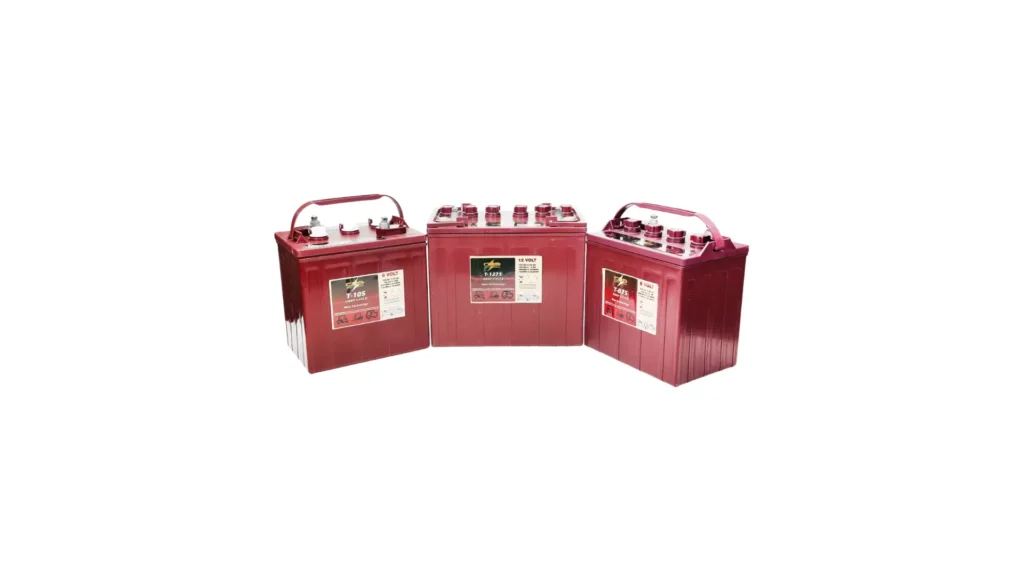
Flooded lead-acid batteries have powered golf carts since the industry began. The technology is straightforward: thick lead plates submerged in liquid electrolyte — a solution of sulfuric acid and distilled water. When the battery discharges, a chemical reaction converts lead dioxide and lead into lead sulfate, releasing electrons that power your motor. Charging reverses the reaction.
The word “flooded” simply means the electrolyte is in liquid form, free to move around inside each cell. This is why you need to top the batteries up with distilled water periodically — the charging process causes some water molecules to split into hydrogen and oxygen gas that vents through the cell caps. This is also why you must always charge in a well-ventilated area.
The key advantage of flooded batteries is plate design. Deep-cycle FLA batteries like the Trojan T-105 use thick, dense plates specifically engineered for the slow, deep discharge-and-recharge cycles that golf carts demand. This is completely different from a car battery, which uses thin plates optimised for short, powerful cranking bursts. Never use an automotive battery in a golf cart — even though both are technically lead-acid, they are built for opposite purposes.
The real weakness of FLA is not the chemistry itself — it is how sensitive that chemistry is to neglect. Lead sulfate crystals that form during discharge need to dissolve back into the electrolyte during charging. If a flooded battery sits discharged for days or weeks, those crystals harden into permanent formations on the plate surface — a process called sulfation. Once severe enough, no charging will restore the battery. This damage is irreversible. And it is, without question, the number-one cause of premature golf cart battery replacement we see.
AGM — The Most Underrated Option in the Market
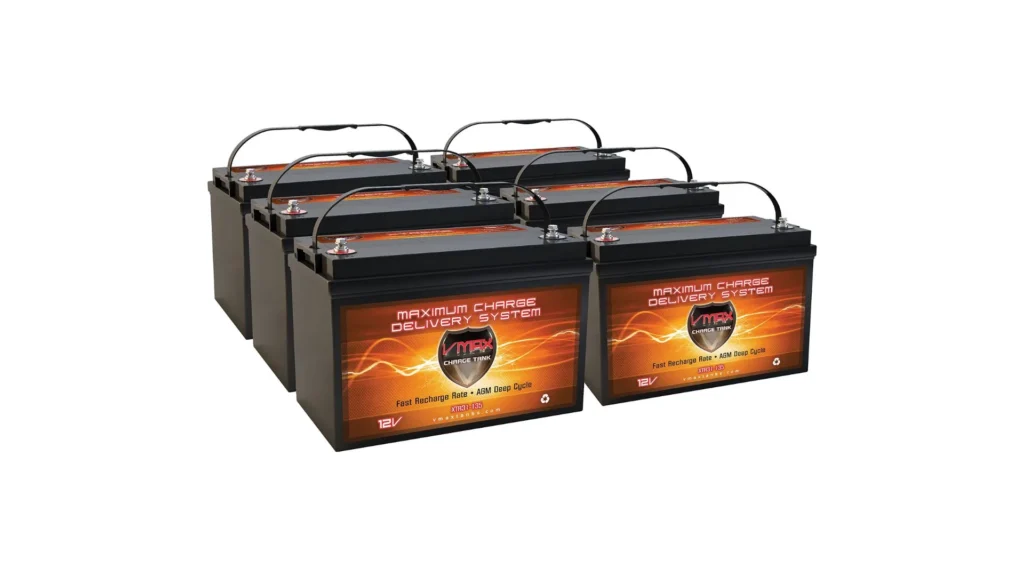
AGM batteries use the exact same lead-acid chemistry as flooded batteries, with one fundamental difference: the liquid electrolyte is absorbed into a fibreglass mat separator rather than sitting free. That single change transforms almost everything about the practical ownership experience.
Because the electrolyte is immobilised, AGM batteries are completely sealed. They cannot spill. They can be mounted in any orientation. They produce no hydrogen gas under normal charging. And — critically — they require absolutely no water top-ups. Ever. No cell caps, no distilled water, no monthly checking schedule. For the right owner, this alone makes AGM a fundamentally different product from flooded lead-acid, not just a slightly better one.
AGM also has lower internal resistance than flooded lead-acid, meaning it accepts charge faster and delivers slightly higher burst currents. Real-world driving? You notice marginally snappier throttle response — not dramatic, but real, especially noticeable when switching from an older, tired flooded pack.
The tradeoff is sensitivity to overcharging. Because AGM cells cannot vent gas the way flooded cells can, sustained overcharge builds internal pressure and causes permanent damage. This makes charger compatibility more critical with AGM than with FLA. A smart automatic charger with a proper AGM absorption profile is non-negotiable. Use a charger tuned for flooded batteries on an AGM pack and you can destroy it within a single season. We have seen it happen.
The second tradeoff is upfront cost: quality AGM batteries run 25-35% more than equivalent FLA. On a full 48-volt pack, that is $250-$400 more. Whether that premium is worth it depends entirely on usage pattern — which we cover directly in the buyer guide section below.
Lithium Iron Phosphate — Built Completely Differently
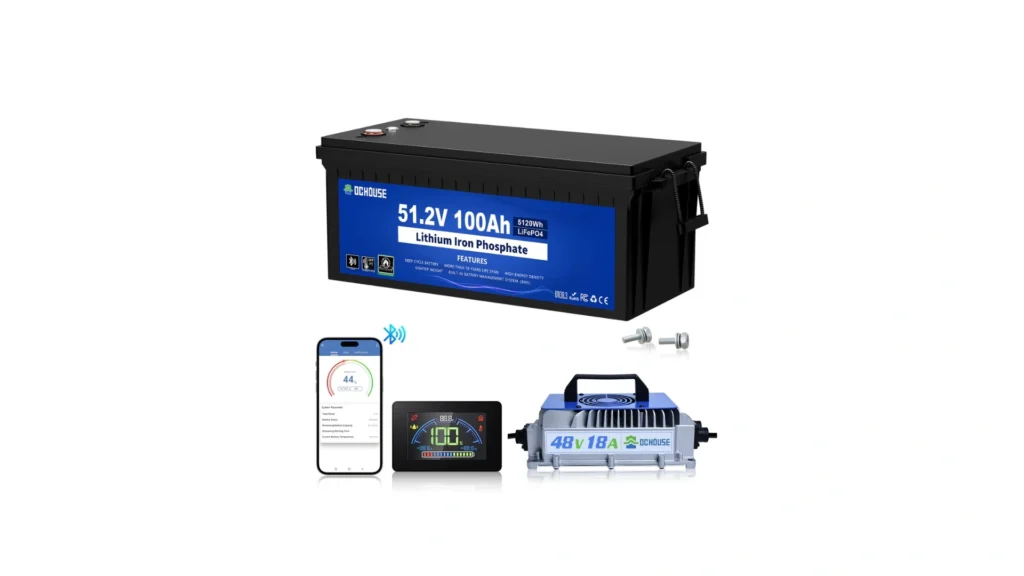
Lithium iron phosphate is a fundamentally different technology from lead-acid in every meaningful way. The chemistry, discharge curve, charge characteristics, weight, and maintenance requirements are all different. Comparing LiFePO4 to flooded lead-acid is like comparing LED to incandescent lighting — same function, completely different engineering.
LiFePO4 cells store energy through lithium-ion movement between a lithium iron phosphate cathode and a graphite anode. This specific chemistry is chosen for golf cart applications because it is the most thermally stable and chemically safe lithium variant available. Unlike lithium cobalt oxide batteries — the chemistry in early EV packs and some laptop batteries — LiFePO4 will not enter thermal runaway under overcharge or physical damage. This is an important safety distinction that gets lost in general conversations about lithium batteries.
Every quality lithium golf cart pack from reputable manufacturers — Dakota Lithium, Eco Battery, Trojan Trillium — includes a Battery Management System (BMS). This is an electronic circuit board inside the pack that monitors cell voltage, temperature, charge current, and discharge current in real time. It protects cells from overcharge, over-discharge, and thermal extremes automatically. The intelligence is built into the battery. That is why owning lithium feels like owning nothing — it just works.
Two performance characteristics define why lithium changes the driving experience. First, the discharge voltage curve is dramatically flatter. A flooded 48-volt pack might deliver 52V when full and sag to 44V when 80% depleted — you feel this as the cart getting progressively slower through the back nine. A lithium pack holds voltage consistently from 100% down to roughly 10% charge. Second, lithium allows 80-100% depth of discharge without damage. Lead-acid should only be discharged to 50% for maximum lifespan — meaning a 100Ah lithium pack delivers roughly the same usable energy as a 200Ah lead-acid pack.
Real-World Performance: What Each Battery Feels Like on the Course
Range Per Charge
A 48-volt flooded lead-acid pack in excellent condition should deliver 18-25 miles of moderate driving on a full charge for a standard two-passenger cart. The same cart with quality lithium typically achieves 25-40 miles. The gap is not just raw capacity — it is that lithium lets you use nearly all of it, while lead-acid becomes noticeably sluggish past 50% discharge. On a hilly course, you often feel that fade on the back nine.
AGM performance in controlled tests falls almost identically to FLA for range. Where AGM shows a real-world advantage is consistency over time. Flooded batteries that have experienced any maintenance gaps lose range progressively as sulfation accumulates. A well-maintained AGM pack in its third year reliably outperforms a flooded pack of the same age that missed even a few water checks.
Performance in Heat and Cold
Heat accelerates chemical degradation in all lead-acid batteries. Industry data consistently shows battery lifespan drops roughly 50% for every 15-degree Fahrenheit increase above the 77-degree rated baseline. For owners in Florida, Arizona, and Texas storing carts in hot garages or outdoor sheds all summer — this is a real operational factor with direct cost implications.
Lithium iron phosphate handles heat significantly better. LiFePO4 chemistry is inherently more thermally stable, and the BMS provides active protection at temperature extremes. Dakota Lithium and Eco Battery packs are rated to operate in temperatures exceeding 140 degrees Fahrenheit — conditions that would age any lead-acid battery at an accelerated rate.
Cold weather is lithium’s one genuine limitation versus lead-acid. LiFePO4 cells lose 10-20% capacity approaching 32 degrees Fahrenheit, and the BMS protection prevents charging below freezing to protect cell integrity. For most recreational users with a temperature-moderated garage, this is irrelevant. For commercial operators running carts year-round in harsh northern winters, it is worth factoring into the evaluation alongside heated storage options.
The Real Cost Comparison: 10-Year Total Cost of Ownership
This is the section most guides skip entirely — and it is the most important for making an intelligent decision. Upfront cost is almost irrelevant. What matters is what you spend over the lifetime of owning the cart. Here is the honest math for a standard 48-volt six-battery system:
| Cost Factor | Flooded FLA (Trojan T-875) | AGM (Quality Brand) | Lithium (Dakota / Eco) | Notes |
| Initial Pack Cost | $1,050 – $1,200 | $1,400 – $1,800 | $2,200 – $3,800 | Installed, 48V system |
| Expected Lifespan | 4 – 6 years | 4 – 7 years | 10 – 15 years | With proper care |
| Packs Needed / 10 Yrs | 1 – 2 packs | 1 – 2 packs | 0 replacements | Biggest differentiator |
| 10-Yr Battery Spend | $2,100 – $3,600 | $2,800 – $5,400 | $2,200 – $3,800 | Incl. 1 replacement |
| Annual Maintenance | $40 – $80 / yr | $0 / yr | $0 / yr | Water, terminal care |
| Full Charge Time | 8 – 10 hours | 7 – 9 hours | 2 – 4 hours | Major lifestyle gain |
| Weight (full pack) | ~220 – 260 lbs | ~200 – 240 lbs | ~60 – 100 lbs | Handles + efficiency gain |
| TOTAL 10-YEAR COST | $2,500 – $4,400 | $2,800 – $5,400 | $2,200 – $3,800 | Moderate-use scenario |
The table above surfaces something that genuinely surprises most buyers: over a 10-year horizon, lithium is frequently the cheapest option. You pay more at the register, yes — but you buy one pack instead of two, and you spend nothing on maintenance. Total dollars out of pocket often come in lower than two rounds of flooded lead-acid replacement.
The scenario where flooded lead-acid wins on total cost is specific: the cart is used infrequently — a few times a month at most — and the owner is genuinely disciplined about maintenance. A $1,100 set of Trojan T-875 batteries maintained perfectly may last six years, putting 10-year cost under $2,500. That is hard for lithium to beat at that usage frequency.
AGM’s profile is the most nuanced. You pay more upfront than FLA but still need two packs in ten years, making total cost the highest of the three in most scenarios. AGM earns its premium through convenience and storage resilience — not raw economics. Understanding that distinction is the key to knowing whether it is the right choice for you.
Maintenance Reality: What Each Battery Actually Requires From You
Flooded Lead-Acid — A Monthly Commitment (Non-Negotiable)
Let us be completely direct here: flooded lead-acid batteries reward disciplined owners and punish inconsistent ones. This is not a product criticism — it is the single most important fact in golf cart battery ownership, and it directly determines whether your pack lasts four years or eight.
Every 30-45 days, you need to open every cell on every battery and check the electrolyte level. On a six-battery 48-volt pack, that is 24 individual cells. If the level is low, add distilled water — not tap water, not filtered water, specifically distilled — using a battery watering gun or turkey baster. Do this after charging, not before, because the electrolyte level rises during charge and you will overfill if you add water first.
Every 60 days, run an equalization charge. This is a controlled overcharge that reverses early sulfation and balances charge across all cells. Most quality automatic chargers have an equalization mode. If yours does not, upgrading the charger is one of the most cost-effective battery maintenance investments you can make.
Every three to six months, clean the terminals. Mix a tablespoon of baking soda with warm water and scrub the posts and cable ends with an old toothbrush. This neutralises acid corrosion. Rinse, dry, and apply anti-corrosion spray or petroleum jelly. Fifteen minutes of work, meaningful impact on cable and battery life.
Twice a year, inspect every cable for cracked insulation, green-tinted corrosion inside cable ends, or loose connections. One corroded cable in a six-battery string can drop pack voltage by a full volt under load — making the cart feel like it has dead batteries when the batteries themselves are fine. We field this exact call regularly on our support line, and the fix is often just a cable, not a whole new pack.
AGM — No Maintenance Schedule Required
The AGM maintenance schedule is simple: there is none. Sealed cells mean no water to add, ever. No equalization required. No hydrogen venting to manage. The only attention an AGM pack needs is an occasional inspection of terminal connections and a compatible charger from day one.
Charger compatibility is the one thing AGM owners must take seriously upfront. AGM requires a slightly lower absorption voltage than flooded lead-acid, and sustained overcharging builds internal pressure that permanently damages sealed cells. Most modern smart chargers have a selectable AGM mode — use it. If you are running an older OEM charger from the original cart purchase, verify its absorption voltage setting before connecting it to a new AGM pack. This five-minute check protects a significant investment.
Lithium — Truly Set It and Forget It
Lithium golf cart batteries are as close to a genuinely maintenance-free power source as currently exists in this market. You charge them, you drive, you repeat. The BMS handles everything else: cell balancing, temperature monitoring, overcharge protection, and over-discharge cutoff — all automatically, all the time.
Once a year, check that cable connections are tight and inspect the battery housing for physical damage. That is the complete annual maintenance list. If your pack includes Bluetooth monitoring — standard on Eco Battery’s B-Plus series — you can check cell voltages, state of charge, and cycle count from your phone in under a minute. Beyond that, the battery manages itself completely.
One nuance for long-term storage: lithium cells age slightly faster when stored at 100% charge for extended periods. For winter storage of four months or more, storing the pack at 50-70% charge is the recommended best practice. Most quality BMS systems handle this automatically, but it is worth knowing.
Charger Compatibility: The Detail That Can Cost You Everything
This earns its own section because we have seen expensive lithium conversions fail — not because of the batteries, but because charger compatibility was never confirmed before installation. This is a straightforward thing to check before you buy, and an expensive lesson after.
Flooded and AGM chargers use different absorption voltage settings, but most quality automatic chargers handle both with a selectable mode. The real issue arises when switching to lithium. LiFePO4 batteries require a Constant Current / Constant Voltage (CC/CV) charging profile with a precise cutoff voltage — typically 58.4V for a 48V pack. They do not benefit from the float charging stage lead-acid chargers use, and some BMS systems interpret the float voltage as an overcharge condition, causing the BMS to repeatedly connect and disconnect through the night. The result: batteries that never reach full charge and a confusing fault that looks like a battery defect but is actually a charger protocol mismatch.
Club Car Precedent owners need to pay particular attention here. The On-Board Computer on Precedent models communicates with the battery pack during charging. When you switch to lithium, the OBC may not recognise the pack correctly and may refuse to initiate charging at all. Most quality lithium conversion kits for Club Car include an OBC bypass module specifically for this reason — it is not a workaround, it is a required installation component. Any supplier who sells you a Club Car lithium conversion without mentioning this is leaving out critical information.
The Lester Summit II charger is our most recommended aftermarket option for any lithium conversion regardless of cart brand. It has selectable profiles covering flooded, AGM, and LiFePO4 chemistry, outputs up to 25 amps for significantly faster charge times, and is built to commercial durability standards. If your OEM charger is more than five years old and you are switching chemistry, budget for the charger upgrade at the same time as the battery. It is battery insurance, not a luxury add-on.
| TECH TIP | Ninety percent of ‘bad lithium battery’ calls we receive turn out to be charger incompatibility issues, not battery defects. Before assuming the pack is faulty, confirm your charger is outputting the correct LiFePO4 profile. The Lester Summit II with lithium mode selected resolves this in almost every case. |
The Best Brands in Each Category: Who to Buy and Why
| Category | Brand | Model | Price Per Unit | Why We Recommend It |
| Flooded FLA | Trojan | T-875 (8V) | $165 – $195 each | The 48V industry benchmark. T2 plate technology, proven cycle life, widest dealer support network in North America. |
| Flooded FLA | Trojan | T-105 (6V) | $155 – $185 each | Best 6V option available. 225Ah capacity, Maxguard separators. Ideal for 36V systems and 8-battery 48V configurations. |
| Flooded FLA | US Battery | US2200 XC2 (6V) | $140 – $170 each | 232Ah — higher rated capacity than the Trojan T-105. Diamond Plate Technology. US-made. Strong value alternative. |
| AGM | Trojan | Trojan AGM 8V | $220 – $260 each | Sealed AGM from the most trusted brand in the market. Best for seasonal storage carts, snowbirds, and gated communities. |
| AGM | Lifeline | GPL-4CT (6V) | $210 – $240 each | Marine-grade AGM build quality. Exceptionally low self-discharge rate. Excellent for carts used infrequently or stored long-term. |
| Lithium | Dakota Lithium | 48V 60Ah Pack | $1,800 – $2,500 | 11-year warranty. Best cold-weather lithium performance. Drop-in compatible with Club Car, EZGO, and Yamaha without tray modification. |
| Lithium | Eco Battery | B-Plus 48V | $2,100 – $3,200 | Golf-cart-specific BMS design. Built-in Bluetooth SOC monitoring app. Most seamless OEM charger integration on Club Car and EZGO. |
| Lithium | Trojan | Trillium 48V | $2,500 – $3,500 | Premium lithium from the most trusted name in golf cart batteries. Best for buyers who want the strongest brand reputation behind their investment. |
The Honest Buyer’s Guide: Which Battery Type Is Right for You?
Buy Flooded Lead-Acid If You…
- Use your cart a few times per week and are genuinely comfortable with a monthly maintenance routine
- Have a firm budget under $1,300 for a full pack replacement
- Already own a quality automatic charger that handles equalization
- Store the cart in a temperature-moderated space (no extended freezing in discharged state)
- Are hands-on and actually enjoy maintaining your equipment properly
If those conditions all apply to you, Trojan T-875 or T-105 batteries are an excellent choice. Properly maintained, they deliver five to six years of reliable performance. The key word is maintained. If you know yourself well enough to admit that monthly schedules will slip, flooded lead-acid will underperform expectations — not because of the battery, but because of the biology of how people actually behave with maintenance tasks.
Buy AGM If You…
- Live in a snowbird community or store your cart for more than three months per year
- Drive on weekends and holidays, not as a daily-use vehicle
- Want zero acid smell, zero watering schedule, zero equalization routines
- Are willing to pay 25-35% more upfront for completely hands-off battery ownership
- Are not yet ready for the full lithium investment but want a clearly better experience than flooded
AGM is chronically underused and underappreciated in the golf cart market. It suits one specific owner profile almost perfectly: the seasonal driver, the weekend user, the person whose cart sits unused for four months while they are in another state. For that owner, AGM’s sealed chemistry, low self-discharge, and zero maintenance requirements make it a genuinely superior product to flooded lead-acid at any price — and most shops never even offer it as an option.
Buy Lithium If You…
- Use your cart daily or multiple times per week without fail
- Plan to keep the cart for eight or more years
- Never want to think about battery maintenance again — not once, not ever
- Want the best performance available: consistent power, faster charging, longer range
- Have confirmed charger compatibility and budgeted for any necessary upgrades
- Haul passengers or cargo and want the handling improvement from 150+ lbs of weight reduction
For the daily driver — the retiree in a Florida community taking the cart to the clubhouse twice a day, the property manager running a large resort, the homeowner using the cart as a genuine utility vehicle — lithium is the smartest financial and practical decision in this market. One purchase lasts the decade, charges in two to four hours instead of ten, and never demands a minute of maintenance. Customers who call us after their first lithium conversion almost universally say the same thing: they wish they had done it sooner.
Expert Insights From Years on the Shop Floor
One of the most consistent patterns in our customer support calls is genuine surprise at how quickly flooded batteries degraded, even from owners who insist they maintained them properly. When we walk through the specifics, the root cause almost always comes down to one of two things: inconsistent equalization, or allowing the cart to sit partially discharged for multiple days between uses.
The “charge after every use” rule sounds excessive to new cart owners. It genuinely is not. A lead-acid battery sitting at 60% charge for three days between outings experiences low-level sulfation throughout every one of those days. Over a year, the plates accumulate enough crystallised lead sulfate to reduce capacity by 20-30%. Over two years, the battery is functionally dead before its time — and no equalization charge in the world fully reverses that damage. This is not a flaw in a particular brand. It is a physics property of the chemistry.
The second insight we share with every customer considering a lithium conversion: budget for the complete system, not just the battery pack. The pack is one line item. A charger upgrade may be $250-$400. On a Club Car Precedent, an OBC bypass module adds $80-$120. Older carts sometimes need cable upgrades. A $2,200 lithium pack can become a $2,700 complete installation when done correctly. Still outstanding long-term value — but budget for the full scope upfront rather than discovering additional costs mid-project.
| E-E-A-T NOTE NOTE | Golf Cart Gears supports thousands of golf cart owners each year across Club Car, EZGO, and Yamaha platforms via our toll-free line and online store. The insights in this article come from direct, daily field experience — not from content aggregated from other sources. When we describe these failure patterns, we mean we see them literally every week. |
Making the Switch: What Changes and What to Watch
Converting From Flooded to AGM
This is the simplest conversion: physical size is typically the same, voltage configuration is identical, electrical connections do not change. The only critical step is charger compatibility — confirm your automatic charger has a selectable AGM mode and use it. If the charger is more than five years old or is the original OEM unit, strongly consider replacing it with a Lester Summit II or Delta-Q before installing new AGM batteries. A mismatched charger is the leading cause of premature AGM failure.
Converting From Lead-Acid to Lithium
Lithium conversion requires a systematic approach. Work through this checklist before ordering your pack:
- Confirm your cart’s voltage system (36V or 48V) and exact battery configuration (6x8V, 8x6V, or 4x12V)
- Verify your current charger has a selectable LiFePO4 charge algorithm — if not, budget for a Lester Summit II as part of the project
- Club Car Precedent owners: confirm whether your OBC requires a bypass module (most quality lithium kits include this for Club Car platforms)
- Measure your existing battery tray — lithium packs are physically smaller and some installations require adapter brackets for a secure fit
- Inspect cable gauge — older carts with undersized cables should have cables upgraded before connecting to a higher-current lithium system
- After installation: fully charge before first use, confirm charger shuts off cleanly at the correct target voltage, and do a test drive before considering the installation complete
When done correctly, a lithium conversion is one of the most rewarding upgrades you can make to an electric golf cart. The improvement in driving feel is immediately obvious — consistent power from full charge to nearly empty, no mid-round slowdowns, noticeably lighter handling. Most customers call us back within the week to say it has completely changed how they enjoy their cart.
The Bottom Line: Make One Smart Decision Instead of Two Expensive Ones
The golf cart battery market offers three genuinely good options, and the right answer is different for different people. That is the honest conclusion — not “lithium is always best” and not “stick with what has worked for decades.”
Flooded lead-acid from Trojan remains the most cost-effective option for the hands-on, budget-conscious owner who charges consistently and keeps a maintenance routine. The T-105 and T-875 are still the industry benchmarks for a reason, and quality has only improved.
AGM is the right answer for the seasonal driver and weekend user who wants zero maintenance hassle at a mid-range price. It is chronically under-offered in the market, and the right owner profile will be genuinely glad they discovered it.
Lithium is the right answer for the frequent driver who plans to keep their cart long-term and is done thinking about battery maintenance permanently. The 10-year cost math often makes it the most economical choice as well as the most convenient — a combination that is difficult to argue against once you see the numbers.
Whatever you choose: buy from a reputable brand, confirm charger compatibility before installation, replace your full pack at once rather than mixing old and new, and charge after every single use. Those habits matter more than any brand name stamped on the case.
Frequently Asked Questions
Can I mix lithium batteries with flooded lead-acid in the same pack?
No. Never mix battery chemistries or different ages in a series-wired pack. Different chemistries have different voltage profiles and charge requirements. Mixing them causes stronger batteries to over-discharge weaker ones, accelerating failure in both. Always replace the entire pack with batteries of the same type, brand, and age at the same time.
Is it safe to switch from flooded to AGM without replacing the charger?
Only if your charger has a selectable AGM mode and you use it. AGM requires a slightly lower absorption voltage than flooded lead-acid. Using a flooded charging profile on AGM over time causes mild chronic overcharging that meaningfully shortens pack lifespan. A compatible charger is the difference between a four-year AGM pack and a seven-year one.
How do I know if my golf cart is 36V or 48V?
Count the cells across all your batteries by counting the vent holes and multiplying by two. Or count batteries: six 6V batteries equals 36V, eight 6V or six 8V batteries equals 48V. You can also find this information in your owner’s manual or by searching your cart’s make, model, and serial number through the manufacturer’s online tool.
What actually happens if I do not water flooded lead-acid batteries?
The lead plates become exposed to air as electrolyte drops below plate level. Lead exposed to air oxidises rapidly, forming a layer of lead sulfate and oxide on the exposed surface — permanent damage that cannot be reversed. The battery does not fail immediately; it loses capacity progressively over subsequent charge cycles. This is why monthly water checks are a non-negotiable requirement, not an optional task.
What is the real difference between Dakota Lithium and Eco Battery for golf carts?
Both are excellent LiFePO4 manufacturers specifically for golf cart applications. Dakota Lithium offers an industry-leading 11-year warranty on select products and performs marginally better in cold temperatures. Eco Battery was designed from the ground up specifically for golf carts, offers Bluetooth state-of-charge monitoring as standard on the B-Plus series, and tends to integrate more seamlessly with OEM charger systems on Club Car and EZGO. For most buyers either is an outstanding choice — the decision often comes down to whether extended cold-weather performance or built-in Bluetooth monitoring matters more to your situation.
How much does a full 48V golf cart battery replacement cost in 2025?
For quality flooded lead-acid (six Trojan T-875 batteries): $990-$1,200 for batteries alone, or $1,200-$1,600 installed by a shop. For AGM: $1,320-$1,560 for batteries, $1,600-$2,000 installed. For lithium (Dakota or Eco Battery 48V pack): $1,800-$3,800 for the pack, $2,200-$4,500 fully installed including any required charger or wiring upgrades.
Is AGM worth the premium over flooded lead-acid?
For seasonal users and intermittent drivers — unambiguously yes. For daily users on a tight budget — probably not, since AGM’s 10-year total cost still tends to exceed flooded FLA under high-use conditions. For daily users with budget for a proper investment — lithium provides better value than AGM. AGM’s sweet spot is exactly the intermittent-use, convenience-first owner who values zero maintenance above all else and is not yet ready for the lithium price point.