
Why Golf Cart Dimensions Matter More Than Most Buyers Realise
Most golf cart buyers focus on battery type, voltage system, and price. Dimensions typically enter the conversation only when something goes wrong — the cart does not fit through the gate, the trailer is too narrow, the garage door opening is not quite wide enough, or the cart cover ordered from a well-reviewed listing turns out to be sized for a different platform.
But dimensions and weight govern a surprising range of practical decisions beyond the obvious fit questions. Trailer and transport selection, garage storage layout, carport clearance, street-legal width considerations in communities with designated cart lanes, lift and ramp load capacity, shipping and freight cost calculations, and the engineering calculations behind towing and hauling accessories all start from a cart’s actual physical footprint.
For accurate specifications, fitment guides, and expert insights, visit Golf Cart Gears—your trusted source for golf cart parts and golf cart accessories.
The problem is that accurate, consolidated dimension specifications for golf carts are genuinely hard to find in one place. Manufacturer websites scatter spec data across individual model pages. Dealer listings sometimes conflate measurements from different configuration variants. And the difference between a 2-passenger Club Car DS and a 4-passenger Club Car DS, or between a standard-height EZGO TXT and a factory-lifted variant, is significant enough to matter for the decisions above.
This guide is the consolidated spec database that does not exist anywhere else in one document. We have compiled factory OEM specifications for every major current and recent production model from Club Car, EZGO, and Yamaha—including 2-passenger, 4-passenger, lifted, and LSV variants where applicable. Every measurement is from manufacturer documentation or verified dealer spec sheets.
Table of Contents
Practical Applications: Why You Need to Know the Exact Specs
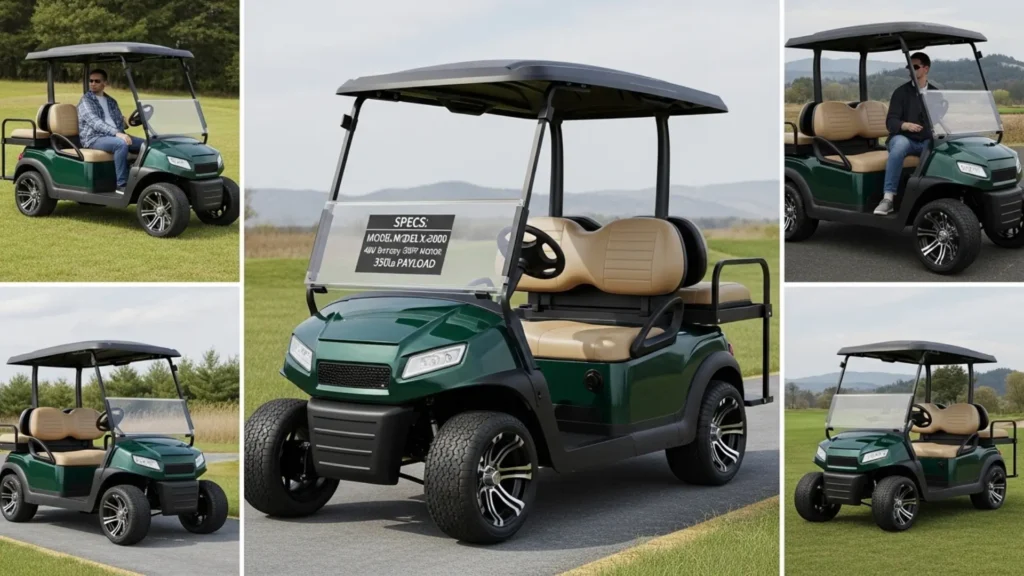
Before diving into the tables, it is worth understanding the specific decisions that these specifications inform—because the relevant dimension varies by decision, and knowing which measurement to consult saves time.
| Decision or Question | Key Measurement | What to Look For |
| Will the cart fit through my gate or door opening? | Width (overall) | Overall width is usually the limiting dimension. Standard 2-passenger carts are 47-49 inches wide. Add mirror width if mirrors are installed (typically 5-7 inches per side). Minimum gate opening should be cart width + 6-8 inches for comfortable clearance. |
| What trailer do I need to transport this cart? | Length, width, and weight | The trailer deck must be at least as long as the cart and wider than the cart. The trailer’s GVWR must exceed the cart’s loaded weight (cart weight + passengers + cargo) with an appropriate safety margin of 15-20%. |
| Will the cart fit in my garage or storage space? | Length and height | Measure from the front of the garage door opening to the deepest usable point. Standard 2-passenger carts need approximately 9 feet of floor depth. Height matters if the garage has low overhead obstacles, roof storage, or low-clearance windows. |
| Can my truck or SUV tow this cart? | Loaded weight | The cart’s curb weight plus 300-400 lbs of battery weight (lead-acid) or 80-120 lbs (lithium) plus any cargo. A standard 48V lead-acid 2-passenger cart weighs 950-1,100 lbs curbweight. Loaded with two adults and cargo, plan for 1,400-1,600 lbs on the trailer. |
| Which cover or enclosure fits my cart? | Length, width, and height | Covers are sized by platform and configuration. A DS cover does not fit a precedent. A 2-passenger cover does not fit a 4-passenger. Verify all three dimensions match the specific product’s listed fitment range. |
| Is my cart legal in a designated golf cart lane? | Width and speed | Many communities with designated golf cart lanes or roads specify maximum cart widths (typically 50-60 inches). An unlifted standard golf cart fits easily. A lifted cart with wider-offset wheels may exceed community width limits. |
| What size freight or shipping quote applies? | All dimensions + weight | Freight carriers calculate dimensional weight from length × width × height in cubic inches, divided by a divisor to produce ‘dimensional weight. ‘ The greater of actual weight or dimensional weight determines the freight rate. |
How Golf Cart Dimensions Are Measured: Understanding the Spec Terminology
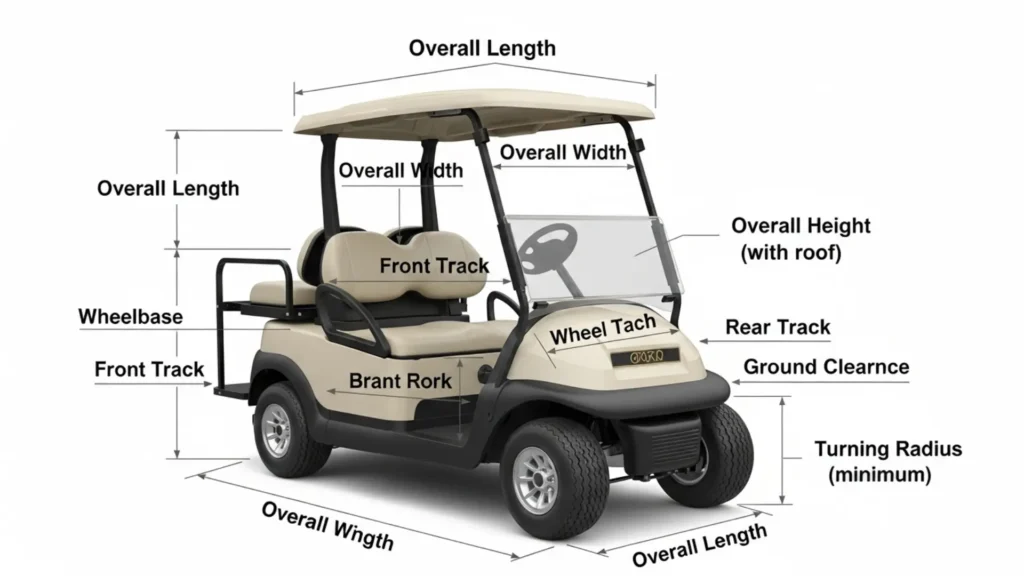
Golf cart specifications use consistent terminology that is worth understanding before consulting the tables, because the same physical cart can report different measurements depending on which dimension is being referenced.
- Overall Length (OAL): The longest measurement from the most forward point of the cart (typically the front bumper or tow hitch) to the most rearward point (typically the rear bumper or step). This is the dimension that matters for trailer selection, storage space planning, and shipping quotes.
- Wheelbase: The distance between the center of the front axle and the center of the rear axle. This measurement governs the cart’s handling characteristics and turning radius and is referenced by lift kit manufacturers when specifying suspension travel. The wheelbase is shorter than overall length.
- Overall Width: The widest measurement across the cart, typically from the outer edge of the tires or bodywork—whichever protrudes further. This is the dimension that governs gate clearance. Note: factory specs typically measure to the outer tyre edge without mirrors; with mirrors installed, add 5-7 inches per side to the stated width.
- Overall Height: Measured from the ground to the highest point of the roof canopy. This measurement is important for low-clearance storage spaces, carports, and transport containers. Lifted carts add approximately 3-6 inches to the standard height from the same platform.
- Curb Weight: The weight of the cart as it leaves the factory, including the battery pack but excluding passengers, cargo, and any aftermarket accessories. Lead-acid battery packs contribute 200-280 lbs to curb weight; lithium packs contribute 60-120 lbs. A curb weight figure without specifying battery type can be misleading.
- Gross Vehicle Weight Rating (GVWR): The maximum weight the manufacturer specifies for the cart to carry, including the vehicle itself, all passengers, and all cargo. Exceeding GVWR affects braking, handling, and component longevity.
Club Car Dimensions And Weight: Complete Specification Database
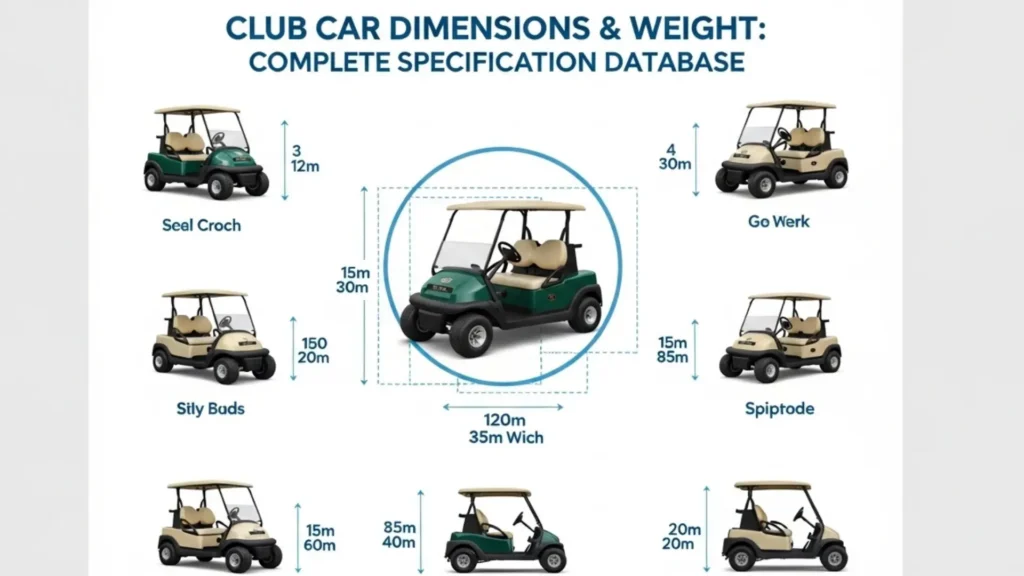
Club Car DS — 2-Passenger (2000–Present)
| Specification | Electric 48V | Gas (FE290/350) | Value | Unit | Config | Notes |
| Overall Length | 94.5″ | 94.5″ | — | inches | 2-pass | Front bumper to rear bumper |
| Wheelbase | 66.0″ | 66.0″ | — | inches | 2-pass | Center to center, front to rear axle |
| Overall Width | 47.0″ | 47.0″ | — | inches | 2-pass | Outer tyre edge to outer tyre edge |
| Overall Height (with roof) | 68.5″ | 68.5″ | — | inches | 2-pass | Ground to top of standard canopy |
| Curb Weight (lead-acid) | 975 lbs | 700 lbs | — | pounds | 2-pass | Includes full battery pack or fuel |
| GVWR | 1,275 lbs | 975 lbs | — | pounds | 2-pass | Max gross vehicle weight rating |
| Turning Radius | 10.5 ft | 10.5 ft | — | feet | 2-pass | Wall-to-wall turning radius |
| Ground Clearance | 4.0″ | 4.0″ | — | inches | 2-pass | Lowest chassis point to ground, standard height |
Club Car Precedent—2-Passenger (2004–Present)
| Specification | Electric 48V | Gas | Unit | Notes |
| Overall Length | 92.0″ | 92.0″ | inches | Slightly shorter than DS due to revised front suspension |
| Wheelbase | 66.0″ | 66.0″ | inches | Same as DS wheelbase |
| Overall Width | 47.5″ | 47.5″ | inches | Marginally wider than DS from revised body styling |
| Overall Height (with roof) | 70.0″ | 70.0″ | inches | Slightly taller than DS from revised canopy design |
| Curb Weight (lead-acid) | 1,001 lbs | 715 lbs | pounds | Heavier than DS from additional OBC and Precedent suspension hardware |
| GVWR | 1,300 lbs | 1,000 lbs | pounds | Maximum gross vehicle weight rating |
| Ground Clearance | 4.0″ | 4.0″ | inches | Standard height, OEM tires |
Club Car Onward — All Variants (2017–Present)
| Specification | Onward 2-Pass Standard | Onward 2-Pass Lifted | Onward 4-Pass | Villager 4 LSV | Unit / Notes |
| Overall Length | 92.5″ | 93.0″ | 112.0″ | 118.0″ | inches. 4-pass and Villager significantly longer |
| Wheelbase | 66.0″ | 66.0″ | 84.0″ | 84.0″ | inches. Extended wheelbase for 4-pass models |
| Overall Width | 47.5″ | 52.0″ | 47.5″ | 47.5″ | inches. Lifted model wider from upsized tires |
| Overall Height (with roof) | 70.0″ | 76.0″ | 71.5″ | 71.5″ | inches. Lifted adds approx. 6″ to height |
| Curb Weight (lead-acid 48V) | 1,020 lbs | 1,085 lbs | 1,150 lbs | 1,300 lbs | pounds, with full lead-acid pack |
| GVWR | 1,320 lbs | 1,350 lbs | 1,520 lbs | 1,600 lbs | pounds maximum gross |
| Ground Clearance | 4.0″ | 8.0″ | 4.0″ | 4.0″ | inches. The lifted model’s clearance advantage clearly visible |
EZGO Dimensions & Weight: Complete Specification Database
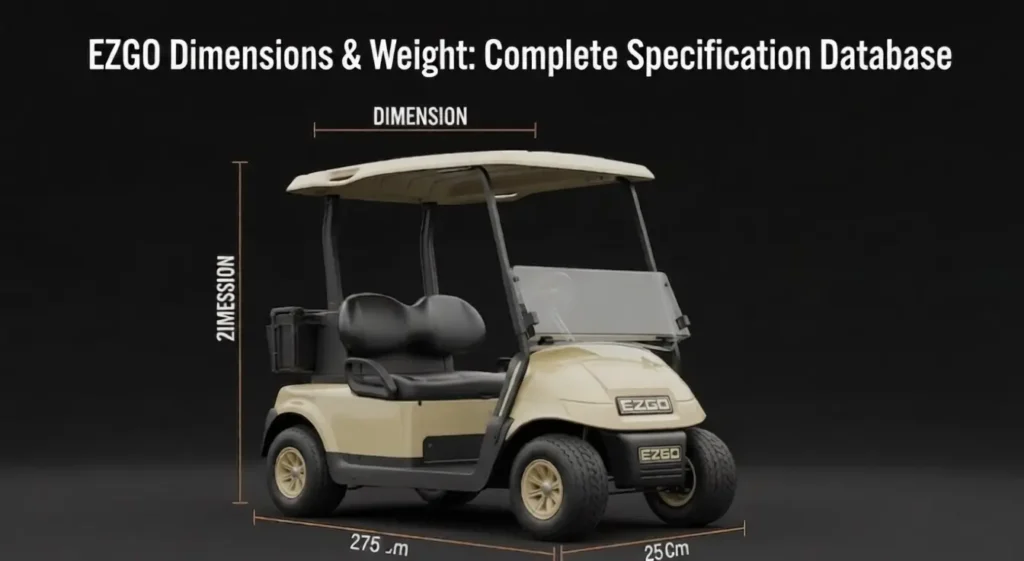
EZGO TXT — 2-Passenger (2001–Present)
| Specification | Electric 48V | Gas | Unit | Notes |
| Overall Length | 95.5″ | 95.5″ | inches | Slightly longer than Club Car DS and Precedent |
| Wheelbase | 68.0″ | 68.0″ | inches | Longer wheelbase than Club Car — affects turning radius |
| Overall Width | 47.5″ | 47.5″ | inches | Standard OEM tires, outer edge measurement |
| Overall Height (with roof) | 70.5″ | 70.5″ | inches | Standard canopy, OEM configuration |
| Curb Weight (lead-acid) | 990 lbs | 685 lbs | pounds | Full 48V lead-acid pack vs full fuel tank |
| GVWR | 1,290 lbs | 985 lbs | pounds | Max rated load capacity |
| Turning Radius | 10.8 ft | 10.8 ft | feet | Slightly larger than Club Car from longer wheelbase |
| Ground Clearance | 4.5″ | 4.5″ | inches | Slightly more clearance than Club Car DS/Precedent |
EZGO RXV — 2-Passenger (2008–Present)
| Specification | Electric 48V AC | Gas EFI | Unit | Notes |
| Overall Length | 93.0″ | 93.0″ | inches | Shorter than TXT from revised front suspension design |
| Wheelbase | 67.5″ | 67.5″ | inches | Slightly shorter wheelbase than TXT |
| Overall Width | 48.0″ | 48.0″ | inches | Marginally wider than TXT from revised body |
| Overall Height (with roof) | 71.0″ | 71.0″ | inches | Standard OEM configuration |
| Curb Weight (lead-acid) | 1,020 lbs | 720 lbs | pounds | Heavier than TXT from AC motor system components |
| GVWR | 1,300 lbs | 1,005 lbs | pounds | Maximum rated gross vehicle weight |
| Ground Clearance | 4.25″ | 4.25″ | inches | Slightly less than TXT from lower suspension geometry |
EZGO Express / Freedom — 4 & 6 Passenger (2014–Present)
| Specification | Express S4 (4-pass) | Express S6 (6-pass) | Liberty ELiTE (LSV) | Unit | Notes |
| Overall Length | 112.0″ | 132.0″ | 115.0″ | inches | 6-pass significantly longer—verify storage space |
| Wheelbase | 78.0″ | 98.0″ | 84.0″ | inches | Greatly extended for 6-passenger |
| Overall Width | 48.0″ | 48.0″ | 48.5″ | inches | Width consistent across models |
| Overall Height (with roof) | 71.5″ | 71.5″ | 73.0″ | inches | LSV slightly taller from full windshield |
| Curb Weight (lead-acid) | 1,130 lbs | 1,280 lbs | 1,350 lbs | pounds | Weight increases substantially with sitting. |
| GVWR | 1,755 lbs | 2,155 lbs | 1,800 lbs | pounds | Higher GVWR reflects full passenger capacity |
Yamaha Dimensions & Weight: Complete Specification Database

Yamaha Drive2 — 2-Passenger (2017–Present)
| Specification | Drive2 PTV Electric 48V | Drive2 Gas | Unit | Notes |
| Overall Length | 93.0″ | 92.5″ | inches | Among the most compact 2-passenger carts in production |
| Wheelbase | 66.5″ | 66.5″ | inches | Tightest turning radius in class benefits from compact wheelbase |
| Overall Width | 48.0″ | 48.0″ | inches | Standard OEM tires, outer edge to outer edge |
| Overall Height (with roof) | 70.0″ | 70.0″ | inches | Standard OEM canopy |
| Curb Weight (lead-acid) | 985 lbs | 680 lbs | pounds | Among the lightest electric 2-passenger carts |
| GVWR | 1,280 lbs | 980 lbs | pounds | Maximum rated gross vehicle weight |
| Turning Radius | 9.8 ft | 9.8 ft | feet | Best-in-class turning radius among major brands |
| Ground Clearance | 4.0″ | 4.0″ | inches | Standard height, OEM tires |
Yamaha Drive / G-Series — Legacy Models (Reference)
| Model | Overall Length | Overall Width | Overall Height | Curb Weight (elec.) | Notes |
| Yamaha G2 (1985-1994) | 90.0″ | 46.5″ | 67.5″ | 880 lbs | 36V system. Still widely used. Narrower than modern carts. |
| Yamaha G9 (1993-1995) | 91.5″ | 46.5″ | 68.0″ | 900 lbs | 36V. Same narrow profile as G2. |
| Yamaha G14/G16 (1995-2002) | 92.5″ | 47.0″ | 68.5″ | 935 lbs | 48V, near-modern dimensions. Precursor to the Drive platform. |
| Yamaha G22 (2003-2006) | 92.5″ | 47.5″ | 69.0″ | 955 lbs | 48V, near-modern dimensions. Precursor to the Drive platform. |
| Yamaha Drive (2007-2016) | 93.5″ | 47.5″ | 70.0″ | 980 lbs | 48V. Immediate predecessor to Drive 2. Many parts are cross-compatible. |
Side-by-Side Comparison: All Major 2-Passenger Models
This table provides a direct, at-a-glance comparison of the key dimensions for every major current-production 2-passenger electric golf cart from the three primary brands. Use this for trailer selection, storage planning, and platform comparison shopping.
| Model | Length (in) | Wheelbase (in) | Width (in) | Height (in) | Curb Wt. (lbs, elec.) | GVWR (lbs) | Turn Radius |
| Club Car DS Electric | 94.5″ | 66.0″ | 47.0″ | 68.5″ | 975 | 1,275 | 10.5 ft |
| Club Car Precedent Electric | 92.0″ | 66.0″ | 47.5″ | 70.0″ | 1,001 | 1,300 | 10.5 ft |
| Club Car Onward Electric | 92.5″ | 66.0″ | 47.5″ | 70.0″ | 1,020 | 1,320 | 10.5 ft |
| EZGO TXT Electric | 95.5″ | 68.0″ | 47.5″ | 70.5″ | 990 | 1,290 | 10.8 ft |
| EZGO RXV Electric | 93.0″ | 67.5″ | 48.0″ | 71.0″ | 1,020 | 1,300 | 10.5 ft |
| Yamaha Drive2 PTV Electric | 93.0″ | 66.5″ | 48.0″ | 70.0″ | 985 | 1,280 | 9.8 ft |
Key findings from this comparison. The EZGO TXT is the longest 2-passenger cart in current production at 95.5 inches. The Yamaha Drive2 is the lightest at 985 lbs curb weight (electric) and has the tightest turning radius at 9.8 feet—a real practical advantage in tight spaces. Club Car platforms are the most compact in overall length among standard-height models. Width is essentially uniform across all platforms at 47-48 inches, meaning gate clearance is not a meaningful differentiator between brands.
How Weight Affects Real-World Golf Cart Performance

The weight specifications in the tables above are not just logistics figures — they have direct implications for battery range, hill-climbing ability, braking distance, and towing capacity. Understanding these relationships helps buyers make better configuration choices.
Battery Weight and Range: The Lead-Acid vs Lithium Difference
The most significant weight variable in an electric golf cart is the battery pack. A standard 48V battery lead-acid pack (six Trojan T-875 batteries) weighs approximately 240-270 lbs. A comparable 48V lithium iron phosphate pack from Dakota Lithium or Eco Battery weighs 60-120 lbs. The weight saving of 150-200 lbs has two compounding effects on performance.
First, the lighter cart requires less energy to accelerate and maintain speed, extending range per charge. A cart that weighs 200 lbs less draws proportionally less current under the same load conditions—the motor works less hard and the battery discharges more slowly. Second, the reduced unsprung weight (weight supported by the suspension rather than the chassis) improves handling and reduces suspension wear.
The range improvement from lithium conversion in a 2-passenger cart is typically 15-25% beyond the capacity advantage alone — meaning a 48V 60Ah lithium pack provides meaningfully more range than the pure energy capacity comparison would predict, because the cart is also lighter and more efficient.
Payload Capacity: The GVWR Calculation
GVWR minus curb weight equals the maximum payload the cart is rated to carry—passengers plus cargo. For a standard Club Car DS electric (GVWR 1,275 lbs, curb weight 975 lbs), the rated payload is 300 lbs. Two average US adults weigh approximately 360 lbs—already over the rated payload without any cargo.
In practice, golf cart manufacturers set GVWR conservatively, and most carts handle modest overloads without immediate damage. But consistently operating significantly over-rated payload accelerates brake wear, suspension component fatigue, and motor heat generation. For 4-passenger carts carrying four adults regularly, the weight calculation becomes even more important — verify that the specific model’s GVWR accommodates your typical passenger and cargo load.
Trailer and Transport Planning: Specifications You Need Before You Buy a Trailer
Transporting a golf cart by trailer requires matching three measurements: trailer deck length to cart overall length, trailer deck width to cart overall width, and trailer Gross Vehicle Weight Rating (GVWR) to the loaded cart weight.
| Cart Configuration | Min. Trailer Deck Length | Min. Trailer Deck Width | Min. Trailer GVWR | Notes |
| Standard 2-passenger (any brand) | 8 feet (96″) | 5 feet (60″) | 1,800 lbs | With ramp access factored. Standard single-car open trailer covers this. Add tie-down allowance to GVWR. |
| 4-passenger extended body | 10 feet (120 inches) | 5 feet (60″) | 2,200 lbs | Requires a longer deck than standard small car trailers. A tandem-axle trailer is recommended for 4-pass carts. |
| 6-passenger (EZGO Express S6) | 12 feet (144″) | 5 feet (60″) | 2,500 lbs | Requires a full-size utility trailer. A tandem axle is mandatory. Confirm tongue weight rating with the tow vehicle spec. |
| Lifted 2-passenger (4″ lift + 22″ tires) | 8 feet (96″) | 5.5 feet (66″) | 1,900 lbs | A wider tire footprint requires wider trailer deck clearance. Height increases loading ramp angle—verify ramp can handle steeper angle. |
A practical note on loading ramps: the steeper the ramp angle, the more likely the rear body of the cart will scrape the junction between the ramp and the trailer deck during loading. Carts with rear-facing seating, low rear bumpers, or significant rear overhangs are most susceptible. A longer ramp (10-12 feet versus the standard 5-6-foot ramp) creates a shallower loading angle that prevents scraping. For 4-passenger carts with rear flip seats, an extended ramp is strongly recommended.
Garage and Storage Planning: Space Requirements by Configuration
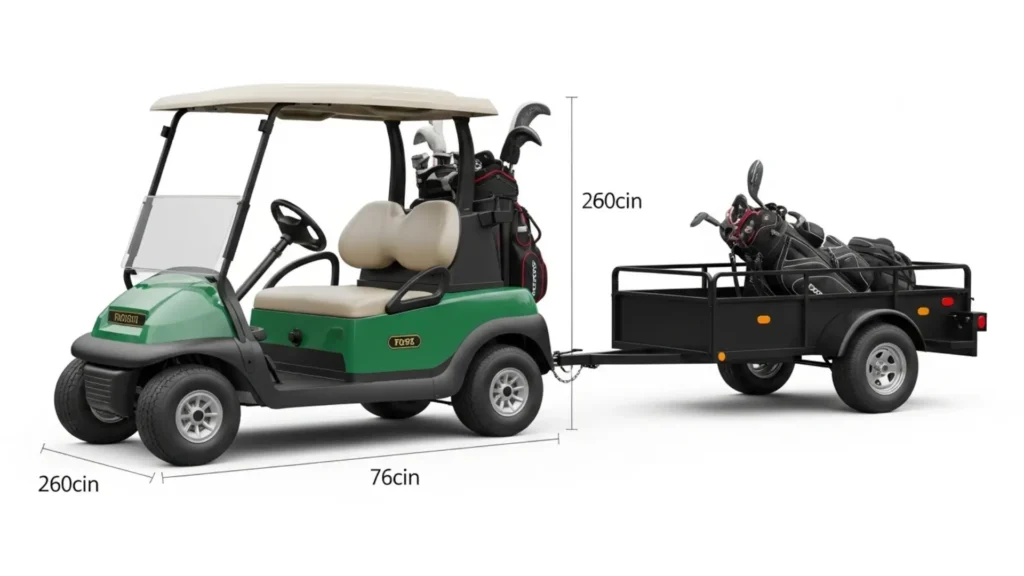
Planning the storage layout for one or more golf carts requires accounting for the cart’s dimensions plus working clearance on all sides for access, charging connection, and comfortable entry and exit from the cart.
| Configuration | Floor Space Needed | Width per Cart (including access) | Height Clearance | Notes |
| Single 2-passenger cart | 9 ft × 5 ft | 5.5 ft | 7.5 ft | Minimum floor space. Access on one side for entry/exit and charger connection. |
| Single 4-passenger cart | 11 ft × 5 ft | 5.5 ft | 7.5 ft | Additional length is the key constraint. Plan for 11 feet of depth from the garage door to the first obstacle. |
| Two 2-passenger carts side by side | 9 ft × 10 ft | 10 ft total | 7.5 ft | Allows access on outer sides of each cart. Inner sides are tight—consider charger position planning. |
| Lifted 2-passenger (4″ lift + roof) | 9 ft × 5.5 ft | 5.5 ft | 8.0 ft | Height clearance is the primary concern for lifted carts. A standard 7-foot garage door opening may be tight for a 4-inch lifted cart with a roof. |
The height clearance for lifted carts deserves particular attention. A standard 4-inch lift adds approximately 4 inches to the cart’s overall height, raising a typical 70-inch standard-height cart to approximately 76-78 inches. A standard residential garage door opening is 84 inches (7 feet). This leaves 6-8 inches of clearance between the roof of a lifted cart and the top of a standard garage door, which is adequate but not generous. For 6-inch lifts or for carts with overhead roof accessories, verify the specific height before assuming a standard garage door clears.
Frequently Asked Questions
How wide is a golf cart? Will it fit through my gate?
Standard 2-passenger golf carts from all major brands are 47-48 inches wide at the tire edges. A gate opening of at least 54-56 inches provides comfortable clearance (3-4 inches on each side). If mirrors are installed, add 5-7 inches per side — a cart with mirrors extended requires a 60-inch or wider opening for comfortable passage. Lifted carts with wider offset tires or wider fender flares may be 50-54 inches wide at the widest point.
How much does an electric golf cart weigh?
A standard 2-passenger electric golf cart with a full 48V lead-acid battery pack weighs approximately 950-1,020 lbs, depending on the model and brand. With a lithium battery pack, subtract 150-180 lbs. A 4-passenger electric cart weighs approximately 1,130-1,350 lbs with lead-acid batteries. These are curb weights—add 300-800 lbs for passengers and cargo for the loaded weight.
Which golf cart has the tightest turning radius?
The Yamaha Drive2 has the tightest turning radius among major current-production 2-passenger golf carts at approximately 9.8 feet, wall-to-wall. Club Car DS and Precedent are close behind at 10.5 feet. The EZGO TXT has the widest turning radius at approximately 10.8 feet, a result of its longer 68-inch wheelbase compared to the Club Car’s 66-inch wheelbase. For tight-space applications — navigating through buildings, narrow pathways, or confined storage areas — the Yamaha Drive2’s tighter turning characteristic is a meaningful practical advantage.
How long is a golf cart? What size trailer do I need?
Standard 2-passenger carts are 92-96 inches (approximately 7.7-8 feet) long. An 8-foot trailer deck provides minimal clearance—a 10-foot deck is more comfortable and recommended for standard 2-passenger carts. For 4-passenger extended-body carts at 112-118 inches (9.3-9.8 feet), a 10-12 foot trailer deck is required. Always verify the specific model’s overall length from the tables in this guide before trailer selection.
How much does a golf cart weigh without batteries?
Subtracting the lead-acid battery pack weight (approximately 240-270 lbs for a full 6x8V 48V pack) from the curb weight gives the approximate battery-less cart weight. A Club Car DS at 975 lbs curb weight less 255 lbs of batteries is approximately 720 lbs as a rolling chassis without batteries. This is the relevant figure for manual loading scenarios, ramp load calculations, and lithium conversion payload estimates.
Are all golf carts the same size?
No, though they are similar in width. Among 2-passenger carts, overall length varies from approximately 92 inches (Club Car Precedent) to 95.5 inches (EZGO TXT)—a 3.5-inch difference that matters for close-tolerance storage and trailer selection. Height varies from 68.5 inches (Club Car DS) to 71 inches (EZGO RXV) in standard configuration. The most significant size differences occur between 2-passenger and 4-passenger models, where length increases by 17-22 inches for the extended body.
Using This Database: A Practical Reference Guide
The specification tables in this guide are the most comprehensive consolidated golf cart dimension database available in a single source. Bookmark this page or save this document before your next purchase, accessory order, trailer selection, or storage planning exercise.
The three measurements that answer the most common questions: overall width (47-48 inches for standard models—add mirror width for gate clearance), overall length (92-96 inches for 2-passenger models, 110-120 inches for 4-passenger), and curb weight with lead-acid batteries (950-1,020 lbs for standard 2-passenger electric). These three numbers address gate fit, trailer selection, and transport logistics in most practical scenarios.
For any specific model that falls outside the tables above, or for production year variants where dimensions may have changed, GolfCartGears.com’s product team can provide verified specifications by model year for any Club Car, EZGO, or Yamaha platform from 1975 through current production.