
Your golf cart depends entirely on its batteries. When battery performance drops, you lose range, power, speed, and reliability.
Choosing the right battery can feel confusing at first — lead-acid or lithium, 36V or 48V, four batteries or six?
Table of Contents
Golf Cart Battery Buying Guide: What to Know Before You Buy
This Golf Cart Batteries Buying Guide makes it simple. You’ll learn how to identify or buy the right golf cart batteries for your golf cart, understand voltage and battery types, and know what to check before buying. It also covers the essential accessories needed to maintain battery performance and extend battery life.
What to Check Before Buying Golf Cart Batteries
Before you buy golf cart batteries online, check:
- Your golf cart brand and model
- Model year and battery tray size
- Battery pack voltage: 36V, 48V, 70V, or 72V
- Battery type: lead-acid, AGM, or lithium
- Battery size, height, and terminal position
- Charger compatibility with your battery type
- Controller and BMS compatibility for lithium upgrades
- Battery capacity, amp-hours, and expected range
- Whether you need matching accessories like cables, chargers, meters, or watering system
Choosing the right golf cart batteries helps prevent poor fitment, charging issues, weak performance, reduced range, and wrong battery orders.
What Are Golf Cart Batteries?
Golf cart batteries are deep-cycle batteries designed to provide steady power over long periods and handle repeated charging cycles.
Unlike car batteries, which deliver a short burst of power to start an engine, golf cart batteries continuously power the motor throughout the ride.
Battery capacity is measured in amp-hours (Ah), which determines how much energy the battery can store. Higher Ah ratings usually mean better range and longer run time. Most golf cart batteries range from 150Ah to 240Ah.
Golf carts use battery packs made of multiple batteries connected together to create the required system voltage. For example, a 48V golf cart may use six 8V batteries or four 12V batteries working as a single power system.
Why Choosing the Right Golf Cart Battery Matters
Choosing the wrong golf cart battery can lead to poor performance, shorter battery life, and even damage to your cart’s electrical system.
A properly matched battery provides the following:
- Full driving range on every charge
- Consistent power throughout the ride
- Longer battery lifespan with proper maintenance
- Lower long-term replacement costs
Quality golf cart batteries typically last 4–7 years when correctly installed and maintained. Taking a few extra minutes to decide the right battery can save significant money and problems later.
Types of Golf Cart Batteries
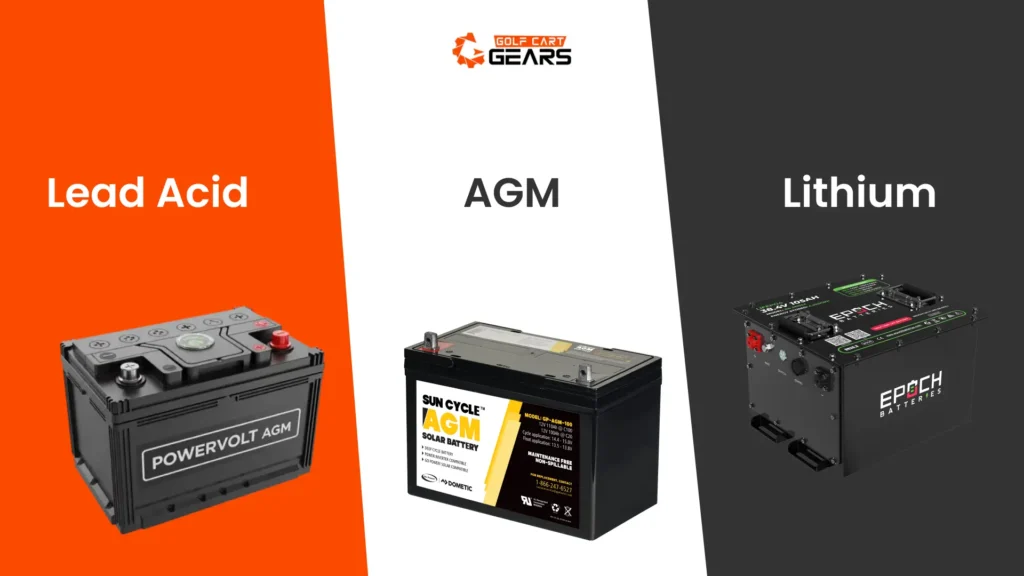
Golf cart batteries come in three main types—each with its own technology, performance, lifespan, and cost. Understanding the differences helps you choose the right battery for how you actually use your cart.
Lead-Acid Golf Cart Batteries
Lead-acid batteries are the original and still the most widely used golf cart battery technology. They’re reliable, proven, and the most affordable upfront option.
How they work:
Lead plates immersed in a liquid electrolyte create and store electricity through a chemical reaction during charging and discharging.
Maintenance:
Flooded lead-acid batteries require regular water refills every 30–60 days. If electrolyte levels drop too low, exposed plates can suffer permanent damage.
Best for:
● Budget-conscious buyers
● Occasional or seasonal cart use
● Owners comfortable with routine maintenance
What to know:
● Heavier than AGM or lithium alternatives
● Must be stored and charged properly to avoid sulfation (a common failure mode)
● Typically last 3–5 years with proper care
Lead-acid batteries are sold by voltage — 6V, 8V, and 12V are the most common sizes for golf carts.
AGM Golf Cart Batteries
AGM (Absorbed Glass Mat) batteries are an upgraded form of lead-acid technology. Instead of liquid electrolyte, they use fiberglass matting to absorb and hold the electrolyte—creating a sealed, maintenance-free battery.
Key advantages:
● No water refills or routine maintenance
● Better vibration resistance for rough terrain
● Slower self-discharge during storage
● Safer operation with minimal off-gassing
● More tolerant of inconsistent charging habits
Things to consider:
● Higher cost than flooded lead-acid batteries
● Heavier than lithium options
● Shorter lifespan compared to lithium
● Requires an AGM-compatible charger
AGM batteries are ideal for buyers who want dependable lead-acid performance without the maintenance demands.
Lithium Golf Cart Batteries
Lithium Golf Cart Batteries (LiFePO₄) are the premium option in the golf cart market—and the one that’s growing fastest. The performance gap over lead-acid is substantial enough that for many buyers, the higher upfront cost pays for itself within the battery’s first life cycle.
The performance advantages are significant:
| Factor | Lead-Acid | Lithium |
| Weight | 60–75 lbs per battery | 25–40 lbs per battery |
| Usable capacity | ~50% of rated Ah | ~80–100% of rated Ah |
| Charge time | 8–10 hours | 2–4 hours |
| Cycle life | 500–800 cycles | 2,000–5,000 cycles |
| Maintenance | Regular watering | None |
| Lifespan | 3–5 years | 8–15 years |
Usable capacity is the key detail most buyers miss. A 200 Ah lead-acid battery should only be discharged to 50%—so you’re only using 100 Ah in practice. A 100Ah lithium battery can be discharged to 80–100%, delivering comparable or more real-world range at less than half the weight.
What to know:
● Higher upfront cost — typically 2–4x more than lead-acid per equivalent pack
● Requires a lithium-compatible charger (not compatible with standard lead-acid chargers)
● May need a Battery Management System (BMS)—most quality lithium batteries include one
● Some older cart controllers need to be verified for lithium compatibility
For high-use carts, neighborhood drivers, and anyone who wants to install once and forget it, lithium is the right long-term investment.
Golf Cart Battery Voltage: 36V, 48V & 72V
The voltage of your battery pack is determined by your cart’s motor and controller—it’s not something you choose. It’s something you identify and match. Installing the wrong voltage pack will damage your cart’s electrical system.
36V Golf Cart Batteries
36V golf cart batteries are the older standard voltage, most common in carts manufactured before the mid-2000s. A typical 36V pack uses six 6-volt batteries wired in series.
36V carts are generally
● EZGO TXT (gas and electric, older production years)
● Club Car DS (pre-2000s electric)
● Yamaha G-series (older models)
36V systems produce less torque and top speed than 48V or 72V systems. If you’re running a 36V cart primarily on a golf course or flat neighborhood, the performance is adequate. If you want more power, upgrading to a 48V system is possible but requires a full electrical system conversion — not just a battery swap.
Battery options for 36V carts: six 6V batteries (most common) or other combinations that produce 36V total.
48V Golf Cart Batteries
48V golf cart batteries are the current industry standard and the most widely supported voltage across all three major brands. Most carts manufactured in the past 15–20 years run on 48V systems.
Common 48V battery configurations:
● Six 8V batteries — the most common setup for flooded lead-acid
● Four 12V batteries — popular for AGM and lithium conversions; easier to package
● Single 48V lithium battery — available from some manufacturers as a drop-in pack
48V systems deliver better torque, higher top speed, and more consistent power delivery than 36V systems. If you’re buying a newer cart or upgrading, 48V is where you want to be.
72V Golf Cart Batteries
72V golf cart battery systems that are less common but increasingly popular in high-performance and lifted carts designed for off-road or high-speed neighborhood use. Some factory LSVs and custom builds run on 72V for maximum torque and speed.
72V configurations typically use the following:
● Six 12V batteries wired in series
● Single 72V lithium pack (available from premium lithium manufacturers)
If you have a 72V cart, verify voltage and controller specs carefully before purchasing batteries. Not all chargers, meters, or BMS systems support 72V natively.
How to Know What Battery Your Golf Cart Needs
Before you buy anything, confirm three things about your cart:
Step 1: Find your cart’s serial number — usually located under the driver’s seat, on the frame rail, or behind the front wheel well. It identifies your cart’s exact model and year.
Step 2: Count your batteries and check their voltage (6V, 8V, or 12V). Multiply the voltage by the number of batteries to find your total system voltage.
Example: six 8V batteries = 48V.
Step 3: Measure your current batteries. Battery sizes vary, and your tray is designed for specific dimensions — especially important when switching to lithium.
Still unsure? Your owner’s manual or a quick call to Golf Cart Gears can confirm the correct setup.
Golf Cart Batteries by Brand
Each major golf cart brand has specific battery requirements tied to their models and production years. Here’s what to know for each.
Club Car Batteries
Club Car batteries for electric carts mainly come in DS, Precedent, Onward, and Tempo models — most running on 48V systems, with older DS models using 36V.
Many Club Car carts use an On-Board Computer (OBC). If switching to lithium, ensure your battery or BMS is compatible with the OBC’s charging logic to avoid issues.
Top Trendy Club Car Batteries
| Product Name | Best Fit / Use | Voltage | Price |
|---|---|---|---|
| Club Car DS (36V) Eco Lithium 36V 105Ah Battery Bundle | Older Club Car DS 36V electric carts | 36V | $2,197.99 |
| Club Car DS Eco Lithium 48V 105Ah Battery Bundle | Club Car DS 48V lithium upgrade | 48V | $2,498.99 |
| Club Car Precedent/Onward/Tempo 2004+ Eco Lithium 51V 105Ah Battery Bundle – Thru Hole | Club Car Precedent, Onward and Tempo 2004+ | 51V | $2,426.99 |
| Club Car Precedent 09-Up/Onward/Tempo Eco Lithium 72V 105Ah Battery Bundle | Higher-voltage Club Car Precedent, Onward and Tempo setups | 72V | $3,149.99 |
| Club Car Carryall Eco Lithium 48V 105Ah Battery Bundle – Skinny | Club Car Carryall 48V lithium replacement | 48V | $2,447.99 |
| Club Car Carryall Eco Lithium 48V 105Ah Battery Bundle – Thru Hole | Club Car Carryall 48V lithium replacement option | 48V | $2,473.99 |
EZGO Golf Cart Batteries
EZGO electric platforms mainly include the TXT, RXV, and Express L6.
- TXT (electric): Older models (pre-1994) are 36V. Most post-1994 models are 36V or 48V depending on year and version—always confirm via serial number due to overlap.
- RXV: 48V system using EZGO’s DCS (Drive Control System), which is sensitive to voltage and charge levels. Requires an RXV-compatible charger.
- Express L6: 48V six-passenger cart. Similar setup to RXV but often needs a higher-capacity charger due to extra weight.
| Product Name | Best Fit / Use | Voltage | Price |
|---|---|---|---|
| EZGO Freedom TXT 36V Eco Lithium 36V 105Ah Battery Bundle – Cube | Older EZGO TXT 36V electric carts | 36V | $2,197.99 |
| EZGO TXT Eco Lithium 48V 105Ah Battery Bundle – Skinny | EZGO TXT 48V lithium upgrade | 48V | $2,432.99 |
| EZGO TXT Eco Lithium 72V 105Ah Battery Bundle | High-power EZGO TXT 72V setup | 72V | $3,190.99 |
| EZGO Freedom RXV Eco Lithium 48V 105Ah Battery Bundle – Thru Hole | EZGO RXV 48V setup | 48V | $2,498.99 |
| EZGO Freedom RXV with Metal Battery Tray Eco Lithium 48V 105Ah Battery Bundle – Skinny | EZGO RXV with metal battery tray | 48V | $2,554.99 |
| EZGO Freedom RXV with Metal Battery Tray Eco Lithium 72V 105Ah Battery Bundle | EZGO RXV 72V metal tray setup | 72V | $3,190.99 |
| EZGO Freedom RXV with Plastic Battery Tray Eco Lithium 72V 105Ah Battery Bundle | EZGO RXV 72V plastic tray setup | 72V | $3,193.99 |
EZGO is also one of the most popular platforms for lithium battery upgrades thanks to strong aftermarket support and wide availability.
Yamaha Golf Cart Batteries
Yamaha’s main electric platforms are the G-series (older) and the Drive/Drive2.
- Yamaha G-series (G2, G9, G16, G19, G22): Older carts. Run on 36V or 48V depending on year. G9 and earlier are typically 36V; G22 and later are 48V.
- Yamaha Drive (G29, 2007–2016): 48V. Uses six 8V batteries. Yamaha’s YDRE electric system has specific charging requirements—confirm charger compatibility.
- Yamaha Drive2 (2017–present): 48V. Updated electrical system. Strong compatibility with lithium conversions.
| Product Name | Best Fit / Use | Voltage | Price |
|---|---|---|---|
| Yamaha G1-G16 (36V) Eco Lithium 36V 105Ah Battery Bundle – Cube | Yamaha G1–G16 36V electric carts | 36V | $2,169.99 |
| Yamaha G19/G22 Eco Lithium 48V 105Ah Battery Bundle – Skinny | Yamaha G19 and G22 48V lithium upgrade | 48V | $2,473.99 |
| Yamaha G29/Drive 2007-2010 Eco Lithium 48V 105Ah Battery Bundle – Thru Hole | Yamaha G29/Drive 2007–2010 48V setup | 48V | $2,498.99 |
| Yamaha G29/Drive 2007-2010 Eco Lithium 72V 105Ah Battery Bundle | Yamaha G29/Drive 2007–2010 72V setup | 72V | $3,142.99 |
| Yamaha G29/Drive 2011-Up & Drive2 Eco Lithium 70V 105Ah Battery Bundle | Yamaha G29/Drive 2011+ and Drive2 higher-voltage setup | 70V | $3,142.99 |
| Yamaha G29/Drive 2011-Up & Drive2 Eco Lithium 48V 105Ah Battery Bundle – Thru Hole | Yamaha G29/Drive 2011+ and Drive2 48V setup | 48V | $2,498.99 |
Always confirm your Yamaha model, year, voltage, tray style, and charger compatibility before ordering.
Yamaha carts tend to be less commonly discussed in lithium conversion guides, but the Drive2 in particular handles lithium upgrades well with a properly configured BMS.
Universal Golf Cart Battery Options
Some battery products — particularly lithium packs designed with adjustable BMS settings — are marketed as universal fits across brands. These can work well if:
● The physical dimensions fit your battery tray
● The BMS is configurable for your system voltage
● The pack is compatible with your charger and controller
Universal lithium packs are ideal for custom builds, lifted carts, or less common models that don’t follow standard battery setups.
Before buying, always verify BMS compatibility with your cart’s controller to ensure safe and proper performance.
Key Factors Before Buying Golf Cart Batteries
Run through this checklist before you buy:
● Voltage match:
Your new batteries must match your system voltage (36V, 48V, or 72V). This is non-negotiable.
● Amp-hour (Ah):
Higher Ah means more range. Don’t go lower than your current setup if you want to keep range. Higher is fine if it fits physically.
● Battery type compatibility:
Switching to lithium? Confirm compatibility with your controller, charger, and any onboard computer. Older systems may need updates or replacement parts.
● Physical size:
Measure your battery tray (L × W × H). Batteries must fit properly with space for cables and airflow.
● Charger compatibility:
Lead-acid chargers don’t work with lithium. AGM needs an AGM-compatible charger. Changing battery type usually means changing the charger too.
● Warranty:
Lead-acid/AGM: typically 1–2 years. Lithium: usually 3–5+ years. Very short warranties often indicate lower quality.
● Cycle life (lithium):
Look for at least 2,000+ cycles for solid long-term performance.
Related Golf Cart Battery Parts & Accessories
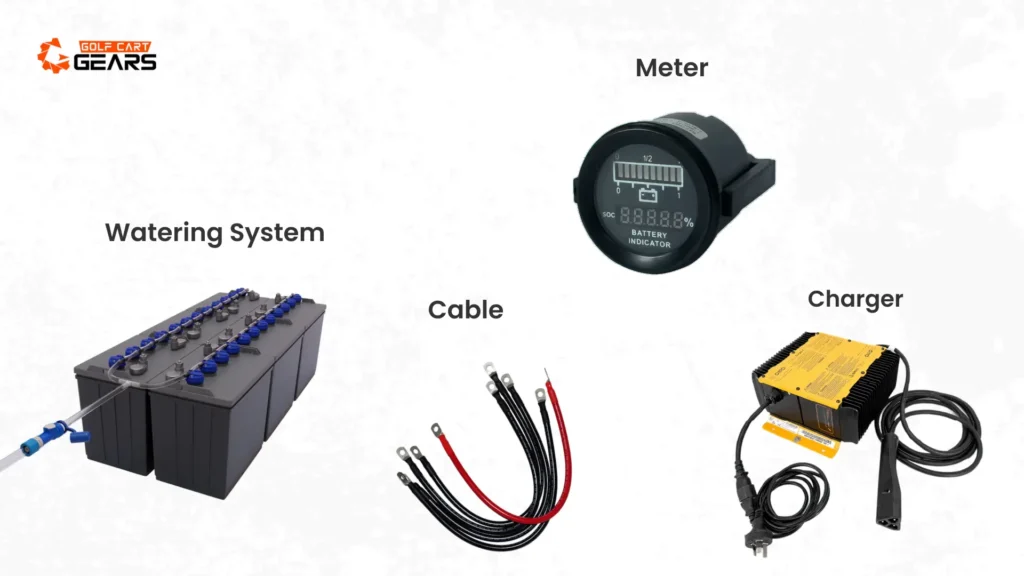
Batteries don’t work alone. These accessories are either required or strongly recommended with any battery purchase.
Golf Cart Battery Chargers
A golf cart battery charger is not optional—and the wrong charger will damage your batteries. Every battery type requires a charger matched to its chemistry:
● Flooded lead-acid: Standard golf cart charger; automatic shutoff when full
● AGM: Requires an AGM-specific charge profile (multi-stage charging at controlled voltage)
● Lithium: Requires a lithium-compatible charger; standard lead-acid chargers will overcharge and damage lithium cells
When replacing batteries, always assess your charger at the same time. If your charger is more than 5 years old or you’re changing battery chemistry, replace it. A bad charger is the #1 cause of premature battery failure.
Golf Cart Battery Cables
Golf cart battery cables are the connectors between your batteries and between the pack and your cart’s electrical system. They carry significant current—degraded cables create resistance, reduce performance, and generate heat that accelerates battery wear.
Signs you need new golf cart battery cables:
● Visible corrosion on the terminals or cable ends
● Cables that feel warm or hot during operation
● Performance loss that improves temporarily after wiggling connections
Replace cables whenever you install new batteries for a clean, low-resistance connection from day one.
Golf Cart Battery Meters
A golf cart battery meter (also called a state-of-charge meter or fuel gauge) tells you how much charge you have left. Most carts come with a basic charge indicator, but aftermarket meters give you more accurate, more detailed readings.
Why it matters: Running lead-acid batteries below 50% discharge repeatedly shortens their life significantly. A good meter helps you charge before you damage the pack.
Look for meters compatible with your specific voltage (36V, 48V, or 72V).
Golf Cart Battery Watering Systems
If you use flooded lead-acid batteries, a golf cart battery watering system is one of the best maintenance upgrades you can add.
These systems connect all batteries at once and automatically fill each cell to the correct level—removing the need to manually water each one.
Single-point kits are available for common 6-battery (36V/48V) and 4-battery setups. Most use a simple hose connection with automatic shutoff valves in each cell cap.
Underwatering is a leading cause of early battery failure, and a watering system helps prevent it by ensuring consistent, correct levels every time.
Golf Cart Battery Accessories
Additional battery accessories help protect your battery pack, keep batteries secure, and make routine maintenance easier. These products are useful for owners who want cleaner battery watering, better battery hold-down support, and longer-lasting battery performance.
- Battery Fill Bottle—helps fill batteries cleanly with a no-spill nozzle design and prevents overflow issues.
- Battery Water Deionizer—deionizes water for batteries and includes a gun for easier use.
- Battery Hold Down Plate, Club Car DS Electric—helps secure batteries in Club Car DS electric carts.
- Battery Hold Down Plate, E-Z-Go TXT/Medalist Electric—supports battery hold-down fitment for EZGO TXT/Medalist electric carts.
- Yamaha Battery Hold Down Rod—helps secure the battery setup on Yamaha G29/Drive models.
Common Mistakes to Avoid When Buying Golf Cart Batteries
Choosing based on price only:
The cheapest option usually has the shortest lifespan. Low-cost batteries wear out faster and cost more in the long run.
Mixing old and new batteries:
Replacing just one battery in a worn pack causes imbalance and weak performance. Always replace the full set.
Ignoring the charger:
An old or incompatible charger can damage new batteries and shorten their life. Plan to replace it if needed.
Skipping voltage checks:
Don’t assume your cart is 48V. Always verify by counting batteries and checking individual voltage.
Switching to lithium without checking compatibility:
Ensure your controller, charger, and (if applicable) OBC support lithium before upgrading.
Letting batteries sit discharged:
Lead-acid batteries left uncharged can sulfate quickly and become permanently damaged. Always store them fully charged with a maintainer.
When Should You Replace Golf Cart Batteries?
Golf cart batteries don’t fail all at once—they degrade gradually. Knowing the warning signs prevents you from getting stranded.
When to Replace Your Golf Cart Batteries
Watch for these clear warning signs:
- Reduced range: You’re getting noticeably less distance per charge
- Weak power: Slower acceleration, especially on hills or with passengers
- Longer charging time: Batteries take much longer to reach full charge
- One battery overheating: A single hot battery usually indicates failure and drags the whole pack down
- Visible damage: Cracks, heavy corrosion, or swelling mean immediate replacement
- Age: If your lead-acid or AGM pack is 4–5+ years old and performance is dropping, replacement is often the better option
Typical lifespan:
- Lead-acid: 3–5 years (with proper maintenance)
- AGM: 3–5 years (lower maintenance)
- Lithium: 8–15 years depending on use and charging habits
A quick load test at a service center or battery shop can confirm remaining battery health before you replace the pack.
Why Buy Golf Cart Batteries from Golf Cart Gears?
At Golf Cart Gears, our goal is simple: help golf cart owners find the right parts, batteries, and accessories without confusion. We built our store for everyday cart owners who need dependable products, clear fitment, and support before ordering. From Club Car to EZGO and Yamaha, we focus on quality golf cart battery options that help keep your cart powered, reliable, and ready to drive.
Why Buy Golf Cart Batteries from Golf Cart Gears?
Golf Cart Gears is a trusted American source for golf cart parts & accessories, repairs, and upgrades, helping cart owners find the right battery setup with confidence.
- Golf cart battery options for Club Car, EZGO, Yamaha, and other popular models
- Lead-acid, AGM, lithium, 36V, 48V, 70V, and 72V battery options where available
- Related battery products like chargers, cables, meters, watering systems, and accessories
- Easy online ordering with secure checkout
- Fast USA shipping on golf cart batteries and accessories
- Price Match Guarantee and refund/returns support
- Helpful fitment guidance before you order
FAQs
What type of battery is best for a golf cart?
It depends on your budget and how you use your cart. Flooded lead-acid batteries are the most affordable upfront and work well for occasional or seasonal use with regular maintenance. AGM batteries are a strong middle ground — maintenance-free, reliable, and longer-lived than flooded lead-acid. Lithium (LiFePO₄) batteries cost the most upfront but deliver the best performance, longest lifespan (8–15 years), fastest charge times, and lowest total cost of ownership for high-use carts.
How do I know if my golf cart is 36V, 48V, or 72V?
Open your battery compartment and count the individual batteries. Check the voltage printed on each one (usually 6V, 8V, or 12V). Multiply the individual voltage by the number of batteries to get your total pack voltage. Six 8V batteries = 48V. Six 6V batteries = 36V. Six 12V batteries = 72V. You can also check your cart’s serial number plate — the model year and configuration will confirm the correct voltage.
Can I replace lead-acid golf cart batteries with lithium?
Yes — in most cases. Before switching, confirm that your motor controller is compatible with lithium battery voltage characteristics, your charger supports lithium chemistry (you’ll need a new charger if not), and your cart’s onboard computer (if it has one, like Club Car’s OBC) works with lithium. Many lithium battery manufacturers offer drop-in kits with built-in BMS systems designed to handle these compatibility requirements automatically.
How long do golf cart batteries last?
Flooded lead-acid batteries typically last 3–5 years with proper watering and charging. AGM batteries last a similar range with less maintenance. Lithium batteries last 8–15 years depending on use and charging habits. Battery lifespan is significantly affected by how deeply you discharge them, how consistently you charge them, and whether you store them correctly during off-seasons.
Do I need a special charger for lithium golf cart batteries?
Yes. Standard golf cart chargers are designed for lead-acid chemistry and will overcharge lithium cells, causing permanent damage or creating a safety hazard. Lithium batteries require a charger with a lithium-specific charge profile. When buying a lithium battery pack, always purchase a compatible lithium charger at the same time — most lithium battery suppliers offer matched charger options.
Should I replace all golf cart batteries at once?
Yes—always replace all batteries in your pack at the same time. Mixing new and old batteries in the same pack is one of the most common causes of premature battery failure. Old batteries have higher internal resistance than new ones, which causes the new batteries to overwork and the old ones to hold the pack back. The result is that neither the old nor the new batteries reach their full service life.
Where can I buy golf cart batteries online?
Golf Cart Gears carries golf cart batteries for Club Car, EZGO, Yamaha, and universal applications—across all battery types and voltages. You can search by your cart’s exact make, model, and year to find batteries confirmed to fit your system, along with matching chargers, cables, and accessories in one place.
Final Thoughts
Replacing or buying golf cart batteries is one of the most important maintenance decisions you’ll make for your cart—and one of the easiest to get wrong if you don’t know what to look for.
Start by confirming your cart’s voltage. Then choose a battery type that matches your budget, your usage habits, and how much maintenance you’re willing to do. If you use your cart daily and want a long-term solution, lithium is worth the investment. If you drive occasionally and want to keep costs low, quality flooded lead-acid batteries with a good watering routine deliver solid value.
Buy the right charger at the same time. Replace all batteries together. And buy from a source that lets you search by your specific card—not just a generic shelf.
Golf Cart Gears makes all of that simple. Find the right batteries for your cart today and get back on the road with a pack built to last.