
The 4-Seat Decision Is More Complicated Than Most Buyers Realise
The question ‘how do I get four people in my golf cart?’ sounds simple. The answers available in 2026 range from buying a factory 4-passenger cart to installing a $200 flip seat kit to purchasing a rear seat assembly designed specifically for your existing 2-passenger cart. Each option represents a different set of trade-offs around cost, seating quality, cargo flexibility, range impact, safety, and — in ways most guides never address — the fundamental question of how you actually use the cart day to day.
At Golf Cart Gears, we help you choose the right 4-passenger golf cart solution by offering premium OEM-style seats and flip seat kits for EZGO, Club Car, and Yamaha models, improving comfort, safety, and everyday usability.
The ‘four seat’ category breaks down into at least five meaningfully different products: factory 4-passenger carts with forward-facing rear seats on an extended body, rear flip seat conversions that replace the cargo area with rear-facing passenger seating, fold-down rear seat kits for standard-body carts, 6-passenger factory models with two rows of rear seating, and purpose-built LSV passenger vehicles that happen to accommodate four. Each configuration has a different seating experience, a different impact on the cart’s range and handling, and a different price point.
This guide maps all of those options against each other with the kind of economic and practical analysis that makes the decision clear rather than confusing. We cover OEM 4-passenger cart pricing and specifications, the economics of flip seat conversions on existing 2-passenger carts, safety differences between forward and rear-facing configurations, range impact of carrying four passengers versus two, and the specific buyer profiles for which each option makes the most financial and practical sense.
Table of Contents
| QUICK ANSWER: Should I buy an OEM 4-passenger cart or add a flip seat to my 2-passenger cart? Buy OEM 4-passenger if: You need 4-passenger capacity regularly, want forward-facing rear passengers on a proper seat, care about resale value, or are buying new, and the extended body is within budget. Factory 4-passenger carts are purpose-built for the task — no compromises. Install a flip seat if: You already own a 2-passenger cart in good condition, occasional 4-passenger use is the need rather than daily, you want cargo flexibility (seat flips up to restore cargo bed), and the $200-$450 conversion cost versus $12,000-$14,000 for a new 4-passenger cart is the deciding factor. The key distinction: Flip seats face rearward on an exposed cargo area with no enclosure. OEM 4-passenger carts have enclosed forward-facing rear seating. The comfort, safety, and weather protection difference is significant for regular passengers, much less significant for occasional adult riders who understand the configuration. |
OEM 4-Passenger Golf Cart Options: What the Manufacturers Actually Offer
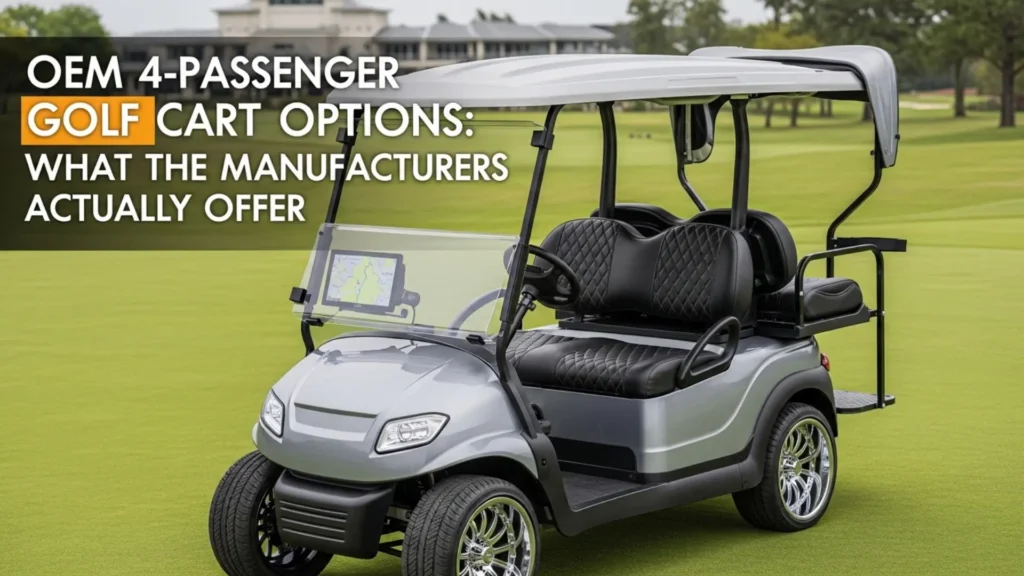
The factory-built 4-passenger market has matured significantly in the last decade. All three major brands — Club Car, EZGO, and Yamaha — now offer purpose-designed 4-passenger configurations that are engineered from the ground up for four-person occupancy, not adapted from a 2-passenger chassis.
Club Car 4-Passenger Offerings
Club Car offers 4-passenger configurations across both the Onward and Villager platforms. The Onward 4-passenger uses an extended wheelbase (84 inches versus 66 inches on the 2-passenger) and a stretched body that places the rear seat in a forward-facing configuration with a proper seatback. The rear passengers sit higher than the front passengers, facing forward, with a clear sightline over the front seat occupants. This is the most comfortable rear seating configuration in any standard golf cart and is the reason the Onward 4-passenger commands a significant price premium over flip seat conversions.
The Club Car Villager series offers 4 and 6-passenger LSV configurations with street-legal certification. The Villager 4 includes seatbelts for all four positions, full windshield, headlights, taillights, turn signals, and mirrors — the complete LSV package. At $16,500-$19,500, the Villager 4 is priced for buyers who need genuine street-legal 4-passenger capability and are willing to pay the LSV premium.
EZGO 4-Passenger Offerings
EZGO’s 4-passenger lineup includes the Freedom RXV 4-passenger, Express S4, and Liberty ELiTE LSV. The Freedom RXV 4-passenger shares the RXV’s AC motor advantage — regenerative braking, consistent power delivery, and maintenance-free AC motor — in an extended-body 4-passenger configuration. The rear seating faces rearward on this model, which distinguishes it from the Club Car Onward 4-passenger’s forward-facing configuration.
The EZGO Express S4 is a purpose-built 4-passenger platform with rear-facing seating and a full canopy that extends over both front and rear seating positions. The Express range also extends to a 6-passenger S6 model, making EZGO the most comprehensive factory multi-passenger lineup among the three major brands.
The Liberty ELiTE is EZGO’s premium 4-passenger LSV, featuring full street-legal equipment, an ELiTE AC motor system, and a design aimed at the premium community cart segment. At $15,500-$18,500, it sits in the same price band as Club Car’s Villager.
Yamaha 4-Passenger Offerings
Yamaha’s Concierge 4 and 6 models are the company’s 4-passenger offerings, available in both gas and electric configurations. The Concierge 4 uses Yamaha’s proven Drive2 platform extended to accommodate rear seating. Yamaha’s 4-passenger products are particularly well-regarded in golf resort and hospitality fleet applications — the company’s reliability reputation carries through to the multi-passenger models.
The Yamaha Umax Bistro and Umax Rally offer additional 4-passenger configurations aimed at commercial and utility applications rather than the consumer market. For buyers looking at 4-passenger carts in commercial or light-fleet applications, Yamaha’s Umax range deserves consideration alongside the Club Car Carryall and EZGO Express commercial equivalents.
| Model | Seating Config | Rear Facing | MSRP Range | Motor Type | Key Differentiator |
| Club Car Onward 4-Pass | 2+2 | FORWARD | $12,500– $14,200 | Electric or Gas | Forward-facing rear seat — most comfortable 4-pass configuration. Premium Club Car quality. |
| Club Car Onward Lifted 4-Pass | 2+2 | FORWARD | $14,500– $17,500 | Electric or Gas | Best combination of 4-passenger capacity and off-road capability in the factory market. |
| Club Car Villager 4 (LSV) | 2+2 | FORWARD | $16,500– $19,500 | Electric | Full LSV street-legal certification. Seatbelts, VIN, all safety equipment standard. |
| EZGO Freedom RXV 4-Pass | 2+2 | REAR | $11,200– $13,500 | AC Electric or Gas | AC motor + regen braking advantage. Best value 4-passenger at this spec level. |
| EZGO Express S4 | 2+2 | REAR | $12,000– $14,500 | Electric or Gas | Purpose-built 4-pass platform. Extended full canopy covers all four seats. |
| EZGO Liberty ELiTE (LSV) | 2+2 | FORWARD | $15,500– $18,500 | AC Electric | Street-legal LSV with AC motor. Premium EZGO LSV offering. |
| Yamaha Concierge 4 | 2+2 | REAR | $12,000– $15,500 | Electric or Gas | Yamaha reliability in 4-pass format. Strong in commercial/resort fleet applications. |
Flip Seat Conversions: How They Work and What They Cost
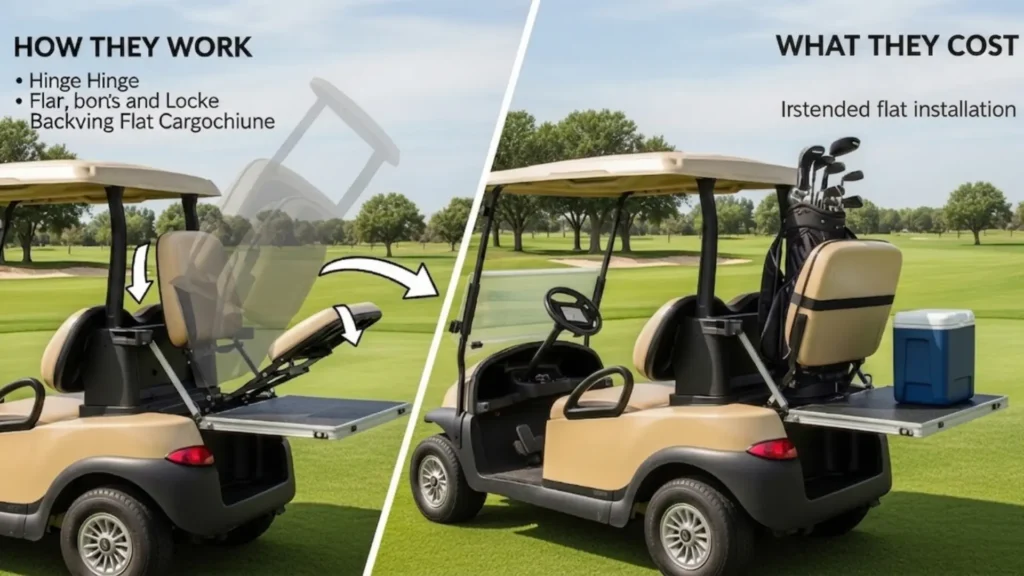
A rear flip seat kit converts the cargo area of a standard 2-passenger golf cart into a two-person rear seating area. The mechanism is a folding bench seat that attaches to the cargo bed: when unfolded it provides a rear-facing bench seat for two passengers, and when folded forward, it restores the cargo bed function. This dual-purpose design is the core appeal of the flip seat — you get occasional 4-passenger capacity without permanently sacrificing cargo utility.
The flip seat market ranges from basic bolt-on assemblies at $180-$250 to complete premium kits with cushioned seating, armrests, adjustable seat backs, and integrated grab handles at $350-$600. The quality difference between these tiers is real and has direct implications for passenger comfort, safety, and longevity.
Types of Rear Seat Kits
Flip seat kits come in three main configurations, each with different installation requirements and trade-offs:
Type 1 — Rear-facing flip seat (most common): The seat faces rearward over the tailgate, providing seating for two additional passengers who face backward. The seat folds flat against the rear of the front seat backs to restore cargo function. This is the most common and lowest-cost configuration. Passengers face rearward, which provides a different but not necessarily inferior riding experience — they can see where they have been, have a clear rearward view, and are sheltered from forward wind by the front seat back.
Type 2 — Side-facing bench seat: A bench seat that runs along the side of the cargo area, facing inward. Less common and less stable than rear-facing seats. Not recommended for moving carts at normal speeds — side-facing seats provide the least passenger support during cornering and braking.
Type 3 — Fold-down rear-facing seat with full frame: A complete seat assembly on a steel or aluminium frame that attaches to the cart’s chassis rather than just the cargo bed. More structurally sound than a simple cargo bed flip seat, these kits are better suited for regular passenger use rather than occasional use. Pricing runs $350-$600.
| Kit Type | Price Range | Install Time (DIY) | Passenger Comfort | Cargo Flexibility | Best For |
| Basic flip seat (bolt-on) | $180–$280 | 1–2 hours | Basic | GOOD | Occasional adult riders. Budget conversion. Cargo bed restored when seat is folded. |
| Premium flip seat with cushion | $280–$420 | 2–3 hours | Good | GOOD | Regular adult riders who want more comfort. Better cushioning and grab handles. |
| Full frame rear seat kit | $350–$600 | 3–4 hours | Very Good | MODERATE (partial fold) | Regular 4-passenger use. Closest to OEM experience without buying a new cart. |
| OEM 4-passenger factory cart | $11,200–$17,500 | Not applicable (new purchase) | Excellent | NONE (no cargo bed) | Regular 4-passenger use where comfort, safety, and resale value justify the investment. |
The Economics: OEM vs Flip Seat — The True Cost Comparison

The economics of the OEM versus flip seat decision depend entirely on your starting point. If you already own a 2-passenger golf cart in good condition, the comparison is between a $200-$450 conversion kit and a $11,000-$14,000 new cart purchase. If you are buying new and considering whether to select the 4-passenger option at the dealership, the comparison is between a $1,500-$2,500 factory upgrade and the flip seat’s $200-$450 cost on a cart you have not yet purchased.
Scenario 1: You Already Own a 2-Passenger Cart
This is the most common scenario, and the economics strongly favour the flip seat conversion if the cart is in reasonable mechanical condition. Here is the complete cost comparison:
| Cost Component | Flip Seat Conversion | Replace With New 4-Pass OEM Cart |
| Initial acquisition cost | $280–$500 (kit + installation) | $11,200–$14,500 (new EZGO or Club Car 4-pass) |
| What you give up from existing cart | Partial cargo area when seat is deployed | Nothing — you sell or keep the 2-pass cart |
| Value retained from existing cart | Existing cart retains full value | Trade-in value of existing 2-pass cart reduces cost by $3,500–$8,000 |
| Net out-of-pocket cost | $280–$500 | $3,500–$11,000 depending on trade-in |
| Seating quality for rear passengers | Rear-facing, exposed, basic cushioning | Forward-facing (Onward) or rear-facing (EZGO/Yamaha) in proper enclosed seat |
| Cargo utility retained | Yes — seat folds to restore cargo area | No — dedicated 4-pass cart has no cargo bed |
| Resale value impact | Flip seat adds modest value ($100–$200) to existing cart | Factory 4-pass commands $1,500–$2,500 more than 2-pass equivalent at same age |
| Best justified when | Occasional use, working cart, budget constraint, cargo flexibility needed | Regular 4-pass use, new purchase decision, resale value matters, adult passenger comfort required |
For the existing-cart owner, the flip seat’s $280-$500 cost versus the net $3,500-$11,000 cost of a new 4-passenger cart makes the financial case for the flip seat overwhelming for any usage pattern that is not daily 4-passenger operation. The question is really whether the seating experience of a flip seat — rear-facing, on an open cargo bed, without enclosure — meets the needs of the specific passengers you plan to carry.
Scenario 2: You Are Buying New and Deciding Between 2-Pass and 4-Pass
When comparing new purchase options, the calculation shifts. The 4-passenger factory configuration from EZGO (Freedom RXV 4-pass at $11,200-$13,500) versus the 2-passenger EZGO TXT ($7,500-$9,200) plus a flip seat ($300) produces a total of approximately $7,800-$9,500 for the 2-passenger-plus-flip-seat option versus $11,200-$13,500 for the factory 4-passenger.
The $3,000-$4,000 premium for the factory 4-passenger configuration buys: forward-facing rear seats or properly enclosed rear-facing seats, better rear passenger weather protection, a GVWR specifically rated for four passengers, factory warranty coverage on the full 4-passenger system, and potentially higher resale value. Whether that premium is justified depends on how frequently four people ride and how much the rear passenger experience matters.
The honest answer for most families: if four-person riding is a regular occurrence — two adults plus two kids to the pool every weekend, four adults for evening community rides — the factory 4-passenger configuration is the correct purchase for long-term satisfaction. If four-person use is occasional — a few times per month when extra passengers visit — the 2-passenger plus flip seat delivers 90% of the functionality at 70% of the cost.
Safety: The Factor Most Buyers Underweight in This Decision
The safety differences between a factory 4-passenger cart and a flip seat conversion are real and deserve honest attention, particularly when the rear passengers are children.
Structural Safety
Factory 4-passenger golf carts are engineered and tested as a complete 4-passenger system. The extended chassis, rear seat mounting points, GVWR, and braking system are all designed and validated together for the four-person load. The rear seat is attached to the chassis at engineered load points that have been tested for the forces generated during braking, cornering, and minor collision scenarios.
Flip seat kits attach to the cargo bed or cargo bed frame rails — components that were designed for cargo load, not passenger seating load. The forces generated by a passenger holding on during braking or a sudden turn are different in character from cargo load forces. Quality full-frame rear seat kits from reputable brands attach to the main chassis rather than just the cargo bed, which is meaningfully better than basic cargo bed-mounted flip seats. When purchasing a flip seat kit, specifically verify whether it attaches to the chassis frame or only to the cargo bed rails — this is the most important structural specification to check.
The Seatbelt Question
Standard golf carts — both 2-passenger and 4-passenger OEM models that are not LSV-certified — do not come with seatbelts from the factory. Adding seatbelts to an OEM 4-passenger cart or to a flip seat conversion are both an aftermarket tasks that require approximately the same effort and cost ($60-$160 per seat position).
For flip seat configurations specifically, seatbelts are strongly recommended even though the addition is not standard. A rear passenger on an open flip seat who is not belted can be thrown from the seat during a sharp turn or emergency braking. The forces required to eject a passenger are lower at the rear of the cart than at the front because rear passengers have less structural support around them. Investing in seatbelts on a flip seat conversion significantly changes the safety profile of the configuration.
Child Passenger Safety on Flip Seats
Children are the most common rear passengers on golf cart flip seats, and they are also the passengers most at risk from the flip seat’s limitations. A child sitting on a rear-facing flip seat with legs dangling has no natural containment — there is nothing on three sides and behind. In the event of any braking or turning event, a child can easily slide off the seat.
The explicit safety recommendation for children on flip seats: seatbelts on all rear seat positions, establish a firm rule that all limbs remain inside the seat area at all times, reduce maximum speed when rear passengers are children, and ensure rear passengers hold the provided grab handle or integrated roll bar rather than the tailgate. None of this is overcautious — these are the specific scenarios that generate the child golf cart injuries described in our Golf Cart Safety Guide.
For families whose primary use case is transporting young children, the safety case for a proper enclosed OEM 4-passenger cart with available seatbelt retrofit is meaningfully stronger than a flip seat conversion. The forward-facing rear seat with enclosed seat back in the Club Car Onward 4-passenger, for example, provides a much more contained passenger environment for children than an open rear-facing flip seat.
| SAFETY NOTE | Never allow children to ride in golf cart cargo beds, even while stationary. This rule applies equally to flip seat situations: before the seat is folded out to the seating position, no passenger should be in the cargo area. Only once the seat is fully deployed, secured, and all passengers are seated and holding on should the cart be placed in motion. |
Range and Performance: What Four Passengers Do to Your Golf Cart
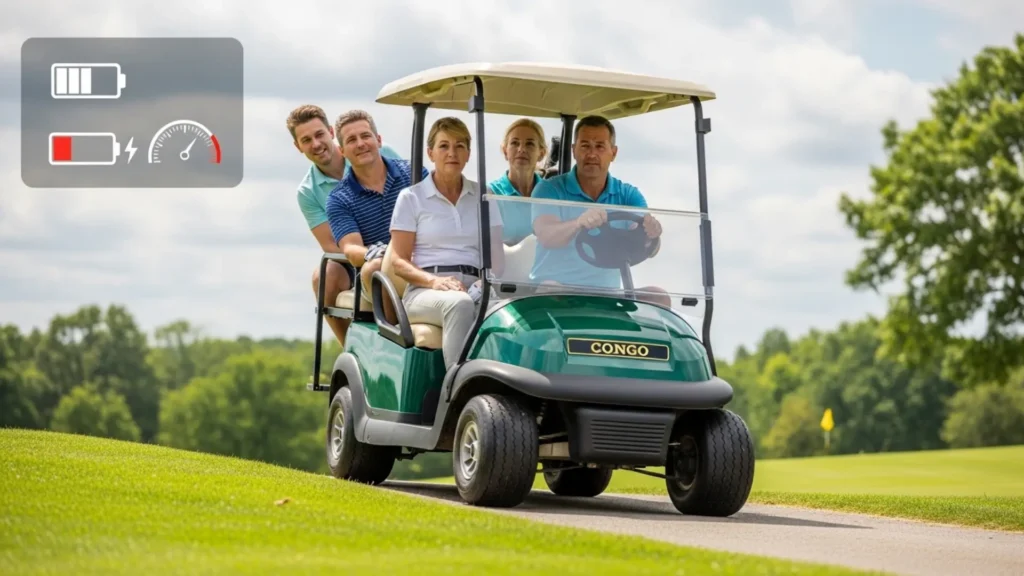
Carrying four passengers instead of two has measurable effects on battery range, hill-climbing performance, and braking distance. Understanding these effects helps set realistic expectations and makes a better case for the right cart-or-conversion choice for your specific terrain and use pattern.
Battery Range Impact
The range reduction from adding two passengers is primarily a function of weight. Two additional adult passengers at an average of 180 lbs each add 360 lbs to the cart’s load. A standard electric golf cart loses approximately 0.8-1.2% of range per 10 lbs of additional load under normal driving conditions.
Calculating the range impact: 360 lbs × 1% per 10 lbs = approximately 36% range reduction in the most pessimistic calculation, though real-world results typically show 20-30% range reduction for two additional passengers on flat terrain. A cart that achieves 22 miles per charge with two passengers will typically achieve 15-18 miles with four adults under the same conditions.
On hilly terrain, the range penalty is more severe because the motor works harder to overcome both the cart’s weight and the grade force simultaneously. A 4-passenger cart on a community with significant elevation changes may see 25-35% range reduction compared to 2-passenger operation. This is worth considering before a flip seat conversion if your community has meaningful hills — confirm that the reduced range with four passengers still covers your typical trip distance with an adequate margin.
The GVWR Consideration for Flip Seat Users
Here is the flip seat factor that most buyers do not check: a standard 2-passenger golf cart has a GVWR of approximately 1,275-1,300 lbs with a curb weight of 975-1,020 lbs for the electric models. This means the rated payload capacity is 275-325 lbs.
Two average adults at 180 lbs each = 360 lbs of passengers. This already exceeds the rated payload for a standard 2-passenger cart. Adding a flip seat kit and two more passengers creates a total passenger weight of 720 lbs — more than double the cart’s rated payload capacity.
Golf cart manufacturers set GVWR conservatively, and golf carts are routinely operated at or above rated payload without immediate failure. But consistently operating at 2x rated payload over many months accelerates brake wear, stresses suspension ball joints and bushings, increases motor and controller thermal load, and can cause premature battery degradation from the higher current draw under sustained heavy load. For occasional 4-passenger trips, this is an acceptable compromise. For daily 4-passenger use, the OEM 4-passenger cart — which is specifically rated for four-person loads with a higher GVWR — is the engineered-correct solution.
| Load Configuration | Approx. Load (4 avg adults) | Range vs 2-Pass Baseline | Performance Notes |
| 2 passengers (baseline) | 360 lbs | 100% (baseline) | Standard operation. All manufacturers design for 2-passenger loads as baseline. |
| 4 passengers on flip seat (standard 2-pass cart) | 720 lbs | 70–80% range | Operating above GVWR. Acceptable for occasional use. Reduces braking effectiveness and increases motor temperature on sustained use. |
| 4 passengers on OEM 4-pass cart | 720 lbs | 72–82% range | Within GVWR on OEM 4-pass cart. Braking and suspension designed for this load. Better sustained performance. |
| 2 passengers + full cargo (tools/gear) | 600 lbs+ | 78–85% range | Shows why flip seat cargo flexibility is valuable — different load patterns for different use cases on the same cart. |
Flip Seat Kit Brands: Who Makes Quality Products and What to Look For
The flip seat kit market has several reputable players and a large number of low-quality imports that look similar in photos but differ significantly in hardware quality, seat frame rigidity, and cushion durability. Here is an honest guide to the leading brands.
GTW (Golf Trolley Worldwide) — Best Overall
GTW produces platform-specific flip seat kits for EZGO TXT, Club Car DS, Club Car Precedent, and Yamaha Drive platforms. Their full-frame rear seat kit — which mounts to the chassis frame rather than just the cargo bed rails — is the most structurally sound aftermarket option in the market at $350-$450. GTW uses powder-coated steel frames, UV-resistant vinyl cushions, and powder-coated hardware throughout. Their installation documentation is platform-specific and detailed.
The GTW chassis-mount rear seat kit is the product we most commonly recommend to owners who want the closest thing to an OEM 4-passenger experience without purchasing a new cart. The chassis mounting significantly improves the structural integrity versus cargo bed-only mounting, and the quality of the cushioning is measurably better than basic flip seat kits.
Madjax — Mid-Range Quality
Madjax offers flip seat kits across the same major platforms as GTW, typically at $10-$30 lower price points. Build quality is solid for standard use, though the hardware gauge is slightly lighter than GTW and the cushion foam density is lower. For occasional use applications where the very best structural quality is not the priority, Madjax is a legitimate option.
Nivel/RHOX — Accessories-Focused
Nivel’s RHOX brand offers seat accessories, cushion upgrades, and seat covers for flip seat installations rather than complete structural kits. If you have an existing flip seat frame and want to upgrade the cushioning or add armrests, RHOX’s accessory range is the best source. RHOX is not the right brand for the structural seat frame — look to GTW or Madjax for that component.
What to Avoid
Generic flip seat kits from no-name marketplace sellers, often listed at $120-$180 and described as fitting ‘most golf carts,’ should be avoided. These kits almost universally mount only to the cargo bed rails (not the chassis), use thin-gauge steel or aluminium hardware, and include minimal foam cushioning that compresses flat within a season of use. At $180 saved versus a GTW kit, the trade-off is structural integrity and durability that most buyers regret within the first year.
Platform-specific fit verification is the other essential check. A flip seat kit that fits an EZGO TXT may not fit a Club Car DS even though both are described as ‘2-passenger golf carts.’ The cargo bed rail spacing, mounting hole pattern, and body clearance differ between platforms. Always confirm the specific platform and year in the kit’s listed fitment, not just the general category.
Installing a Flip Seat Kit: What the Process Actually Involves
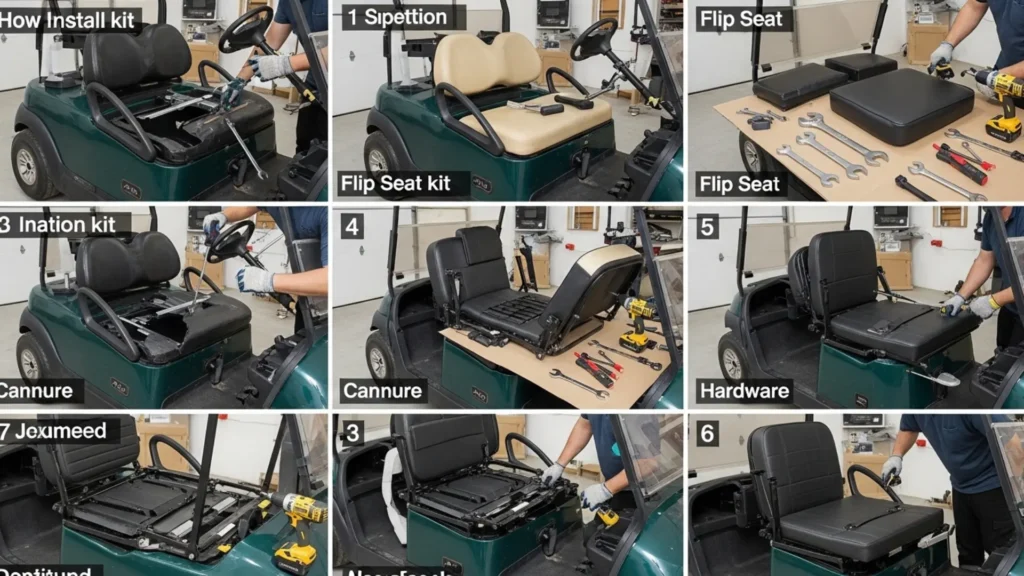
Flip seat installation is a legitimate DIY project for most mechanically confident owners. Here is what to expect for a standard rear flip seat kit installation on the most common platforms.
Tools required: socket set (3/8 inch drive with metric and imperial sockets), ratchet, combination wrenches, power drill, measuring tape, level, and the hardware included with the kit. Most quality kits include all mounting hardware, but have a few extra stainless steel bolts and washers on hand.
- On most platforms, this means removing any existing cargo box, floor mat, or accessories from the cargo area. On some carts with an existing cargo bed assembly, the entire cargo bed assembly must be removed to expose the frame rail mounting points. Remove cargo bed area.
- These brackets attach to the cart’s frame rails or to the cargo bed rail mounting points, depending on the kit type. Chassis-mount kits require more access to the frame but provide significantly better structural attachment. Hand-tighten all hardware first — do not fully torque until all brackets are positioned correctly.Install the seat mount brackets.
- The seat frame hinges onto the mounting brackets. Work with a second person for this step — the seat frame assembly is manageable but awkward to position solo while simultaneously aligning the hinge pins. Attach the seat frame assembly.
- Fold the seat forward and backward several times to confirm smooth operation and that the locking mechanism (which holds the seat in either the seating or cargo position) functions correctly. Test the flip mechanism.
- Most kits use a clip or bolt mounting system for the cushion. Secure it fully before testing with occupants. Attach the seat cushion.
- Use a torque wrench on all structural fasteners. Most flip seat kits specify 25-35 ft-lbs for the main mount bolts. Under-torqued hardware produces noise and eventually loosens — address this correctly at installation. Tighten all hardware to the specified torque.
- Have two passengers sit in the rear seat and drive at walking speed in a safe area. Listen for any unusual sounds from the mount brackets, feel for any seat movement, and confirm the grab handles are secure and comfortable. Test with occupants at slow speed before normal use.
| INSTALLATION NOTE | The most common flip seat installation problem is under-tightened mounting hardware that produces a creaking or knocking noise on the first use. This is almost always at the main bracket mount bolts rather than the cushion hardware. If you hear any noise from the rear seat after installation, stop and recheck all structural fasteners before carrying passengers. |
Platform-Specific Flip Seat Recommendations: Which Kit for Which Cart
| Cart Platform | Best Kit Option | Kit Price Range | Install Difficulty | Platform-Specific Notes |
| EZGO TXT (2001+) | GTW Full-Frame Rear Seat Kit | $350–$450 | Moderate | Best-supported platform for flip seat kits. GTW chassis-mount kit for TXT is the most thoroughly engineered option. Year matters — 2001-2013 and 2014+ kits may differ. |
| EZGO RXV (2008+) | GTW or Madjax Platform-Specific | $280–$400 | Moderate | RXV has a different cargo bed configuration from TXT. Must use RXV-specific kit. Confirm 2008-2013 vs 2014+ generation if kit listing splits them. |
| Club Car DS (all years) | Jake’s Seat Kit or GTW DS | $320–$480 | Moderate | Club Car DS has a longer production history with more body variation than EZGO. Confirm which DS body era your cart is (pre-2000 vs post-2000 body style). |
| Club Car Precedent (2004+) | GTW Precedent Specific | $320–$450 | Moderate | Precedent cargo bed dimensions differ from DS. Precedent-specific kits only. 2004-2013 and 2014+ Precedents may have different kit requirements. |
| Yamaha Drive2 (2017+) | GTW or Madjax Drive2 Kit | $300–$420 | Moderate | Drive2 cargo area has a different profile from Drive (2007-2016). Verify kit lists specifically for Drive2 rather than generic Yamaha Drive. |
Real Talk: Patterns We See From 4-Passenger Cart Owners

After years of talking with customers who have gone both routes — flip seat conversion and new 4-passenger cart — two patterns emerge consistently.
The first is that flip seat owners who use the configuration for regular adult passengers almost always end up upgrading to a better kit or a new 4-passenger cart within two to three years. The initial $300 kit is fine for the first season. By the second season, regular adult passengers have given honest feedback about the rear-facing, exposed seating experience — it is fine for a few short trips but becomes genuinely uncomfortable for longer rides, in hot weather, or in any precipitation. Owners who know upfront that their use case involves regular adult passengers more than 2-3 times per week typically end up at the new 4-passenger cart eventually, having spent $300 on an interim solution.
The second pattern is that flip seat owners whose primary rear passengers are children typically love the configuration and use it happily for years. Children in the 5-12 age range, who understand that the rear-facing open bench is the exciting part of the ride, tend to enjoy the flip seat experience. They are not bothered by the rearward orientation, they love the view of where they have been, and the open environment feels adventurous rather than uncomfortable. The caveat is the safety measures outlined earlier — seatbelts in rear positions, clear rules about limbs inside the cart, and adjusted speeds when children are passengers.
The practical guidance from these patterns: be honest with yourself about who will regularly ride in the rear seats. Adults going to dinner at the clubhouse or running errands in a community? OEM 4-passenger is likely worth the investment for the comfort and weather protection it provides. Kids going to the pool or the playground on a sunny day? Flip seat works great, and the cost savings are real. Mixed use? A quality GTW chassis-mount kit at $400 with seatbelts added is the reasonable middle path that covers both use cases adequately.
| E-E-A-T NOTE | GolfCartGears.com stocks GTW, Madjax, and RHOX rear seat kits for EZGO TXT and RXV, Club Car DS and Precedent, and Yamaha Drive2 platforms, with year-specific fitment verified for each kit listing. We also stock seatbelt retrofit kits for rear seat positions on all platforms. Our product team can confirm compatibility for your specific cart’s year and body style before any order ships. |
Frequently Asked Questions
Are flip seat golf carts safe for passengers?
With the right precautions, yes — flip seats are a legitimate seating option for golf cart passengers. The key safety requirements are: quality chassis-mounted seat frame (not just cargo bed rail mounted), seatbelts on rear positions, all-limbs-inside rule enforced for all passengers, especially children, and adjusted driving habits with reduced speed and wider turns when rear passengers are on board. Without these measures, the exposed rear-facing configuration creates meaningful ejection risk during sharp turns or emergency braking.
How much range do I lose with four passengers?
Typically 20-30% range reduction versus 2-passenger operation on flat terrain. On hilly terrain with four adults, range reduction can reach 30-40%. A cart that achieves 22 miles per charge with two passengers should be expected to achieve 15-18 miles with four adults under moderate conditions. Plan trips accordingly, particularly on hilly courses or routes.
Do Club Car and EZGO flip seat kits interchange between brands?
No. Flip seat kits are platform-specific. Club Car DS, Club Car Precedent, EZGO TXT, EZGO RXV, and Yamaha Drive2 all have different cargo bed dimensions, rail spacing, and mounting configurations. A kit designed for EZGO TXT will not correctly fit a Club Car DS. Always verify the specific platform and year range in the kit’s fitment listing before ordering.
What is the difference between a forward-facing and rear-facing 4-passenger seat?
Factory 4-passenger carts (notably the Club Car Onward 4-passenger) have rear passengers seated facing forward — they see where the cart is going, have a backrest supporting them from behind, and are enclosed within the cart’s body structure. Most flip seat conversions and some factory 4-passenger models (EZGO Express, Yamaha Concierge) seat rear passengers facing rearward — they see where the cart has been, have no backrest support from behind, and sit on the open edge of the cart. Forward-facing is significantly more comfortable for adult passengers on longer trips.
Can I add a rear seat to any golf cart?
Most standard 2-passenger golf carts with a cargo area can accept a rear seat kit. The platforms with the widest kit availability are EZGO TXT, Club Car DS, Club Car Precedent, and Yamaha Drive2. Golf cart models with very small or no cargo areas, or special-purpose utility models, may not have compatible rear seat kits available. Confirm with a parts supplier that a fitment-verified kit exists for your specific model and year before purchasing the cart with the intent to add rear seating.
Is it better to buy a used OEM 4-passenger cart or a new 2-passenger cart with a flip seat?
A used OEM 4-passenger cart in the 3-5 year age range with verified good battery condition represents genuine value — particularly a factory Club Car Onward 4-passenger or EZGO Freedom RXV 4-passenger at $7,000-$10,000 in that condition range. This is a strong option for buyers who need regular 4-passenger capacity and want the OEM seating quality without the new cart price. The caution applies to used carts generally: always perform a battery load test before purchasing, as a battery pack that needs immediate replacement adds $1,000-$1,600 to the actual cost of the used cart.
The Honest Bottom Line: Match the Solution to the Use Case
The 4-seat golf cart decision is fundamentally a question of how often four people ride and who those passengers are. Those two variables determine whether the flip seat’s $300-$450 cost is the right answer or whether the OEM 4-passenger cart’s $11,000-$14,000 price tag is the justified investment.
The flip seat is the right choice when: you already own a good 2-passenger cart, four-person use is occasional rather than daily, your rear passengers are primarily children who enjoy the open-air experience, and cargo flexibility matters to you on days when the rear seat is not deployed. Buy a quality GTW chassis-mount kit, add rear seatbelts, establish clear rules, and you have a versatile cart that handles four people when needed and a useful cargo area when not.
The OEM 4-passenger cart is the right choice when: you are buying new, regular adult passengers are the use case, the rear passenger experience matters (forward-facing enclosed seating versus open rear-facing bench), resale value is a consideration, or your community’s terrain and distances mean that consistent 4-passenger operation with adequate range and within GVWR is important. The Club Car Onward 4-passenger’s forward-facing rear seat remains the benchmark for the 4-person passenger experience in standard golf cart configurations.
Whatever you choose: install seatbelts on all rear positions, verify GVWR against your typical passenger and cargo loads, and plan your range expectations before the first multi-passenger trip. The four-person golf cart experience is genuinely excellent when the right configuration is matched to the right use case.