
Golf cart enclosures are the accessory category with the highest buyer remorse rate in the market. The reason is almost always the same: the buyer purchased based on price and photos, installed an enclosure that fit the cart correctly, and watched it fail within one to two seasons in ways that were both predictable and preventable.
At Golf Cart Gears, we offer durable, well-fitted, best golf cart enclosures designed to help avoid these common issues, delivering better weather protection, long-term reliability, and lasting value for EZGO, Club Car, and Yamaha models.
Every one of these failures has a specific material science cause that is entirely predictable from the specifications of the product. Vinyl panels without UV stabilizers degrade in direct sunlight at a known rate. Zippers without corrosion-resistant plating seize in high-humidity environments at a predictable pace. Seam tape that is not ultrasonically welded begins to separate as the adhesive creeps under thermal cycling. These are engineering facts, not bad luck.
This Golf Cart Enclosures Buying Guide teaches you to read enclosure specifications the way a material scientist would—understanding what each specification actually means for longevity, what the quality markers are that differentiate a 2-season enclosure from a 5-season one, and which brands invest in the right materials versus which ones cut the specific corners that cause the failures described above. By the end, you will have the knowledge to buy once and be satisfied, rather than buying twice because the first purchase was based on incomplete information.
The Material Science Behind Golf Cart Enclosures: What Every Specification Actually Means
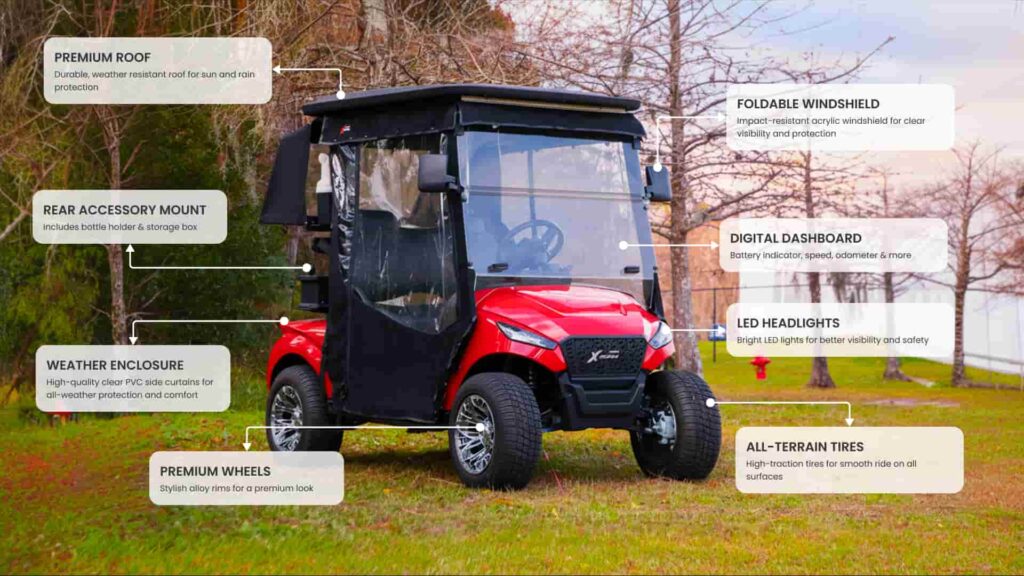
Most golf cart enclosure listings include a handful of specification numbers and material descriptions that sound similar across products at very different price points. Understanding what these specifications actually mean in practice is the foundation of an informed purchase decision.
Main Body Material: Vinyl Weight and Composition
Golf cart enclosure panels are made from either PVC laminate or solution-dyed polyester fabric with a vinyl or polyurethane coating. These two material families look similar in photos and feel similar when new, but they degrade at very different rates under UV and thermal cycling.
PVC laminate — the cheaper material — is made by pressing a thin PVC film to a polyester or nylon woven base. The PVC film provides water resistance and determines the surface characteristics. The problem with PVC laminate is that the UV stabilizer and plasticizer compounds in the PVC film are surface-concentrated and begin migrating out of the material under UV exposure. Within one to two seasons of direct sun exposure in climates like Florida, Arizona, or the Gulf Coast, PVC laminate becomes brittle, cracks along fold lines, and the surface begins to show micro-cracking that collects dirt and becomes permanently discolored. discolored.
Solution-dyed acrylic or polyester fabric with a marine-grade vinyl or polyurethane coating is a better material. The term ‘solution-dyed’ means the color pigments and UV stabilizers are incorporated into the fiber during the extrusion process—they are throughout the material, not just on the surface. Marine-grade coatings used on boat covers and outdoor upholstery are specifically formulated for extended UV and salt-spray exposure, and they maintain their flexibility and weather resistance significantly longer than standard PVC.
Window Material: The Most Critical Specification
The clear windows are the component that most visibly and commonly fails on golf cart enclosures, and it is where material quality differences have the most dramatic effect on owner experience. Window materials range from inexpensive PVC film that costs pennies per square foot to quality polycarbonate or optical-grade vinyl that costs substantially more.
PVC film windows (typically 4-8 mil thickness) are found on budget enclosures. They are perfectly clear when new. Within one hot season of direct UV exposure, they begin to yellow at the edges, then throughout the panel. By the second season, they are often so discolored or crazed that visibility through them is significantly impaired. They also scratch easily—cleaning them with anything other than a dedicated soft cloth removes surface material and creates a permanent haze.
Crystal-clear vinyl (typically 20-40 mil thickness) is the mid-range window material. The additional thickness provides structural integrity that prevents the billowing and distortion that thin PVC film exhibits at speed. 20-40 mil vinyl with UV inhibitors—a specification you should specifically look for in product listings—significantly extends clarity retention versus uncoated PVC films. Quality enclosures from National Golf Cart Enclosures and Caddytek use 20-30 mil crystal vinyl as standard.
| Window Material | Typical Thickness | UV Resistance | Expected Clarity Life | Notes |
| Thin PVC film (budget) | 4–8 mil | POOR | 1 season | Yellows rapidly in direct UV. Found on lowest-cost enclosures. Avoid it for anything other than occasional shade use. |
| Standard vinyl (uncoated) | 10–15 mil | MODERATE | 1–2 seasons | Acceptable for cooler or shadier climates. Still yellows in direct Sun Belt exposure. Common in mid-range enclosures. |
| Crystal-clear vinyl with UV inhibitors | 20–30 mil | GOOD | 3–5 seasons | It has the same UV resistance as standard crystal vinyl, plus an anti-fog treatment reduces interior condensation and fogging. Best choice for humid climates and morning use. |
| Crystal-clear vinyl with anti-fog coating | 20–40 mil | GOOD | 3–6 seasons | It has the same UV resistance as standard crystal vinyl, plus an anti-fog treatment reduces interior condensation and fogging. Best choice for humid climates and morning use. |
| Polycarbonate panels | 1–3 mm | EXCELLENT | 5–8 seasons | Best long-term clarity. Scratch-resistant. Premium price. Less flexible — does not roll for storage. Cold weather slightly increases brittleness. |
Seam Construction: The Most Commonly Misrepresented Specification
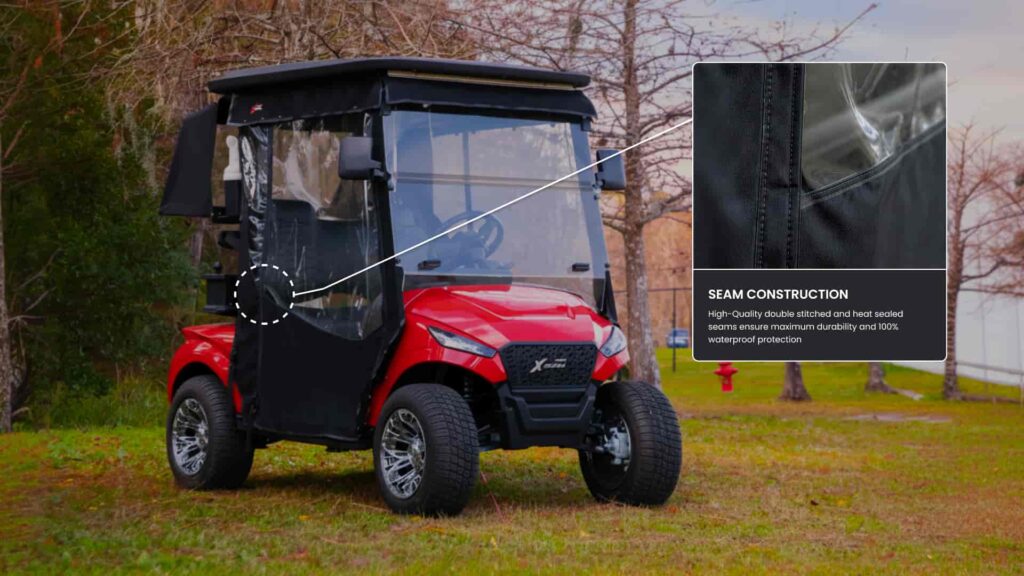
‘Waterproof’ is one of the most overused words in golf cart enclosure marketing. Virtually every enclosure at every price point is described as waterproof. The reality is that the waterproofing of the main panel material and the waterproofing of the seams are completely separate questions, and it is the seams that almost always leak first.
A sewn seam — even with waterproof thread — has needle holes through the material at regular intervals. Each needle hole is a path for water to enter. In light rain, surface tension keeps water from entering these holes. In sustained rainfall, driving rain, or heavy morning dew, water finds its way through. This is not a defect — it is a fundamental limitation of sewn construction. Most golf cart enclosures are constructed with sewn seams because it is faster and cheaper to sew than to weld.
Mounting Hardware and Closure Systems: Where Budget Enclosures Fail First
The mounting hardware — the straps, snaps, zippers, and attachment systems that hold the enclosure to the golf cart — fails before the panel material in the majority of cases where enclosures are returned or replaced. This is not because the hardware is inherently poor quality; it is because hardware selection that works in a temperature-moderate showroom environment often fails in the real operating environment of a golf cart.
Zippers
Golf cart enclosures use zippers for the main door opening and often for window panel access. A zipper that works smoothly when new and progressively becomes more difficult to operate — eventually seizing or developing broken teeth — is the single most common hardware failure in golf cart enclosures.
The cause is almost always one of two things: standard brass or steel zipper teeth that corrode in high-humidity or salt-air environments, or inadequate zipper size for the loads imposed when pulling a taut enclosure panel closed.
Quality enclosures use marine-grade nylon zippers (YKK #10 or equivalent is the benchmark) with corrosion-resistant plating on the slider. Marine-grade zippers are specifically designed for the humidity and UV exposure conditions of outdoor fabric applications. They cost significantly more than standard garment zippers, which is why budget enclosures use standard zippers and have the zipper problems described above.
Attachment Straps and Snaps
Velcro straps, sewn elastic bands, and snap fasteners are the primary methods for attaching enclosure panels to the golf cart frame. Each has a different durability profile.
Velcro (hook-and-loop) fasteners lose their holding strength progressively as the hook side collects fibers, dirt, and debris that prevent engagement with the loop side. In a golf cart environment where the enclosure is regularly removed and reinstalled, a Velcro attachment system shows meaningful holding strength reduction within one to two seasons. Regular cleaning of the hook side with a stiff brush helps but does not fully arrest the degradation.
The UV Degradation Timeline: What to Expect Over the Life of an Enclosure
UV radiation is the primary environmental factor that degrades outdoor fabric products. Understanding the degradation timeline by material type helps set realistic expectations and makes a clear case for the cost premium of better materials.
Solar UV radiation breaks down polymer chains in both the coating materials and the structural fibers of outdoor fabrics through a process called photo-oxidation. The rate of degradation depends on the UV stabilizer concentration in the material, the UV intensity of the local environment (highest in South Florida, Arizona, and at altitude), and the proportion of time the enclosure is deployed in direct sun versus stored.
| Material Type | Year 1 | Year 2 | Year 3-4 | Year 5+ | Climate Factor |
| Budget PVC laminate body + thin window | Like new | Window yellowing starts. Body stiffening. | Windows opaque. Body cracks at folds. | Worse in the Sun Belt | Window yellowing is visible but serviceable. Body holding. |
| Mid-range vinyl body + standard vinyl window | Like new | Minor window yellowing. Good body condition. | Good to very good. The body maintains flexibility. Windows are still serviceable. | Windows noticeably degraded. Body seam tape may lift. Acceptable performance in cooler climates. | Sun Belt: add 1-2 yrs |
| Marine-grade solution-dyed + UV crystal vinyl window | Excellent | Still excellent. No visible degradation. | Good to very good. The body maintains flexibility. Windows still serviceable. | Minor window haze is possible in the Sun Belt’s direct sun. Body fully intact. | Sun Belt: add 1 yr |
| Premium marine fabric + polycarbonate window | Excellent | Excellent. No degradation. | Excellent throughout. | Still performing well. Minor body fading possible. Windows remain clear. | Sun Belt: negligible |
The acceleration factor for Sun Belt climates is significant. UV intensity in Miami, Phoenix, or Tucson is 60-80% higher than in Seattle or Minnesota. An enclosure that lasts 5 seasons in the Pacific Northwest may last only 3 seasons in Florida under the same use conditions. Buyers in high-UV climates should move at least one tier up in material quality from what would be sufficient in cooler northern climates. This is not a marketing upsell — it is a straightforward material science adjustment for actual operating conditions.
Installation and Fit: Why Platform-Specific Matters More Than Most Buyers Think
The fit of a golf cart enclosure affects not just aesthetics but also the enclosure’s fundamental weather protection function. An enclosure that does not fit correctly has gaps that allow wind and rain entry, panels that flap at speed, and tension imbalances that stress the seams and mounting points more than a correctly fitted enclosure. Platform-specific enclosures are engineered for the specific dimensions of the target cart; generic universal enclosures are compromises that fit no cart perfectly.
The Platform and Year Problem
As with body panels and seat kits, enclosure fit is dependent not just on the platform (EZGO TXT, Club Car DS, etc.) but also on the year range within that platform. EZGO TXT enclosures for 2001-2013 are dimensioned differently from 2014+ TXT enclosures because the body profile changed. A 2012 EZGO TXT and a 2016 EZGO TXT are on the same platform name but have different canopy frame dimensions and mounting rail profiles.
Before purchasing any enclosure, confirm three things: the brand, the specific platform, and the year range the enclosure is designed for. An enclosure listed as ‘fits EZGO TXT 2001-2013’ should not be purchased for a 2016 TXT, and a listing that says ‘fits all EZGO TXT models’ without a year-range qualifier is either incorrect or has not been verified for all years claimed.
Installation Quality Factors
Even a correctly specified platform-specific enclosure requires proper installation to perform as designed. The most common installation errors that reduce enclosure performance:
- Uneven panel tension: Each panel section should be attached with consistent tension across all mounting points. Uneven tension causes one area to flap while adjacent areas are over-tensioned, stressing the material at the over-tensioned points.
- Skipped mounting points: Enclosures have more attachment points than buyers often use. The temptation to use only the primary straps and skip the secondary attachment points creates the panel-flapping problem. Every provided attachment point serves a purpose.
- Zipping over material folds: Forcing a zipper over a fold or overlap in the panel material instead of smoothing the material flat before zipping puts lateral stress on the zipper that accelerates slider failure. Always smooth the panel flat before drawing the zipper.
- Storing wet: Rolling up and storing an enclosure while it is still wet from rain or dew promotes mildew growth in the folds. Even mildew-resistant treated fabrics benefit from drying before storage. Store dry whenever possible.
Best Golf Cart Enclosures Buying Picks: Best Options by Cart Model
| # | Product to Internally Link | Price | Description |
|---|---|---|---|
| 1 | DoubleTake Enclosure & Valance for Kwick-Track Rail System, 4 Pass, Club Car Precedent 04+ | $688.99 | A strong option for Club Car Precedent owners who want rain and wind protection for everyday driving. |
| 2 | DoubleTake Enclosure & Valance for Kwick-Track Rail System, 4 Pass, E-Z-Go TXT 14+ | $694.99 | A good fit for newer E-Z-GO TXT carts used for neighborhood driving and cooler weather. |
| 3 | DoubleTake Enclosure & Valance for Kwick-Track Rail System, 4 Pass, E-Z-Go TXT 94-13 | $694.99 | Built for older E-Z-GO TXT models and helpful for model-specific weather coverage. |
| 4 | DoubleTake Enclosure & Valance for Kwick-Track Rail System, 6 Pass, CC DS New Style 00+ | $782.99 | A useful enclosure choice for 6-passenger Club Car DS New Style carts. |
| 5 | DoubleTake Enclosure & Valance for Kwick-Track Rail System, 6 Passenger, E-Z-Go RXV 08+ | $782.99 | A strong option for E-Z-GO RXV owners who want better passenger weather protection. |
| 6 | Doubletake Enclosure & Valance for Titan with 120″ Kwick-Track Top, E-Z-Go TXT 14+ | $782.99 | Made for extended Titan/Kwick-Track top setups and longer carts needing more coverage. |
| 7 | DoubleTake Enclosure & Valance, 4 Passenger, Club Car DS Old Style 99-0099-00 | $661.99–$727.99 | A good option for older Club Car DS carts where year and body style fitment matters. |
| 8 | DoubleTake Enclosure & Valance, 6-Passenger, Icon | $782.99 | A smart choice for larger Icon cars used by families, communities, resorts, or daily passenger driving. |
Golf Cart Enclosure Brand Comparison: Who Makes What and at What Quality Level
The enclosure market has several established brands worth knowing and a large number of marketplace imports that compete on price alone. Here is an honest assessment of the major brands by quality tier.
| Brand | Price Range (Per Enclosure) | Material Features | Window Features | Best For |
|---|---|---|---|---|
| Classic Accessories | $160–$300 | Heavy-duty vinyl construction designed for seasonal weather protection and everyday storage use | Clear vinyl windows with zippered access panels | Daily driving, seasonal weather protection, and general-purpose enclosure use |
| NIVEL | $180–$320 | Platform-specific enclosure designs with durable marine-style materials and reinforced mounting systems | High-visibility vinyl windows with model-specific fitment | OEM-style fitment, multi-cart compatibility, and consistent installation quality |
| Red Dot | $250–$450 | Premium enclosure materials engineered for commercial and all-weather use with reinforced stitching and heavy-duty hardware | Commercial-grade clear window panels designed for durability and visibility | Frequent use, commercial fleets, utility carts, and long-term outdoor protection |
Enclosure Types and Configurations: What Your Use Case Actually Needs
The golf cart enclosure market offers several configurations that provide different levels of weather protection and passenger access. Understanding which configuration matches your actual use pattern prevents the common mistake of over-buying full protection for a cart used primarily in mild weather, or under-buying and installing a half enclosure on a cart that regularly operates in sustained rain.
Full Enclosure (4-Sided with Zippered Door)
A full enclosure closes all four sides of the cart, providing complete protection from rain, wind, and cold. The front panel has a zippered or snap-open section that allows easy entry and exit. Full enclosures are the correct choice for carts used in regular rain, sustained cold, or significant wind. A good example of a model-specific option is the RedDot 3-Sided Beige Vinyl Enclosure Valance for EZGO TXT, which is designed for E-Z-GO TXT 120″ top setups and provides durable, weather-ready coverage.
The trade-off is ventilation and comfort during warm weather operation. A fully enclosed cart in 85-degree weather without interior airflow becomes hot and uncomfortable quickly. Quality full enclosures address this with roll-up side panels and ventilation windows that can be opened for airflow when the weather permits while still providing the structural attachment points for full closure when needed.
Half Enclosure (Front and Rear Only)
Half enclosures cover the front and rear of the golf cart while leaving the sides open. They are commonly used in golf course fleets and light personal use where basic protection from wind and front-facing rain is needed without restricting entry and exit. A good example of a half-body enclosure option is the DoubleTake Half Body Enclosure System for Club Car Precedent (04+), designed to provide simple front and rear coverage with easy access.
Winter Storage Cover vs Active Use Enclosure
A storage cover and an active use enclosure are different products that are sometimes confused. A storage cover is designed to sit on a parked cart and protect it from dust, moisture, and UV rays while stationary. An active-use enclosure is designed to remain on the cart while it is being driven—it must withstand wind loads at 15-20 mph and the vibration of the cart in motion.
Using a storage cover as an active use enclosure is a common mistake that produces rapid failure — storage covers are not designed for the wind and vibration loads of a moving cart, and the attachment system for a storage cover is typically less secure than an active enclosure’s mounting system. Buy the correct product for the intended use.
Maintaining Your Enclosure: Simple Habits That Double the Service Life
The maintenance required to maximize an enclosure’s service life is modest but specific. The window panels require the most attention because they are the most optically sensitive component and the easiest to damage through improper cleaning.
Cleaning Windows Correctly
The single most damaging thing most owners do to their enclosure windows is wiping them with a dry cloth or paper towel. Vinyl and polycarbonate window panels collect fine dust and grit particles that act as abrasives when a dry cloth is drawn across the surface. The resulting micro-scratches accumulate into a permanent surface haze that cannot be polished out.
The correct window cleaning procedure: rinse the surface with clean water first to float off grit particles, then clean with a dedicated plastic lens cleaner or a small amount of mild dish soap on a microfiber cloth using very light pressure. Rinse again and blot (do not wipe) dry with a clean microfiber cloth. For vinyl windows, a periodic application of plastic conditioner (303 Aerospace Protectant or equivalent) maintains flexibility and provides additional UV protection.
Cleaning the Body Panels
Marine-grade vinyl and solution-dyed fabric body panels clean well with a mild soap solution applied with a soft brush. Rinse thoroughly to remove all soap residue — soap residue left on fabric accelerates UV degradation by concentrating on the surface. Avoid bleach-based cleaners on fabric enclosures—they attack the UV stabilizer compounds in the material.
For mildew spots (common on enclosures stored wet or in humid environments), a diluted solution of white vinegar (1 part vinegar to 4 parts water) applied with a soft brush and rinsed thoroughly is effective without damaging the material. Allow to air dry fully in the shade before reinstalling or storing.
Zipper Maintenance
Regular application of a dedicated zipper lubricant (zipper wax or silicone spray) keeps zippers operating smoothly and significantly extends their service life. Apply lightly to the zipper teeth before each seasonal installation and after any exposure to salt water or heavy rain. Do not use petroleum-based lubricants on plastic zipper components—they can swell and degrade some nylon materials.
Expert Insights: Patterns We See in Failed Enclosures

After years of customer interaction on enclosure purchases and replacement inquiries, three failure patterns recur consistently—each one entirely predictable and preventable.
The first is the Sun Belt buyer who purchased a mid-market enclosure because the photos looked identical to the premium option at half the price. By season two, the windows were noticeably yellowed. By season three, the front window panel had developed a permanent surface haze that made driving into low sun genuinely dangerous because glare through the hazy window was much worse than no window at all. The replacement enclosure was a National Golf Cart Enclosures unit with 30 mil UV crystal vinyl windows, which they are still using three seasons later. The total cost of the two purchases exceeded what the premium enclosure would have cost from the start.
The second is the zipper failure pattern on enclosures used near saltwater—coastal communities, marinas, and beach properties. Standard steel or plated brass zippers corrode visibly within one season in salt air. The zipper slider begins to bind, requiring force to operate, and eventually the slider mechanism fails or the zipper teeth begin to separate. Marine-grade YKK nylon zippers in the same environment show no degradation after four seasons. The corrosion is entirely predictable from the material specification, and the fix is entirely preventable by buying the correct zipper specification from the start.
The third is the mismatch problem that generates the most returns. A buyer purchases an EZGO TXT enclosure without verifying the year range, installs it on a 2016 TXT, and finds that the side panel attachment points do not align with the cart’s canopy frame rails because the 2016 body profile changed from the pre-2014 configuration. The enclosure is the right brand and the right platform — just the wrong year range. The five-minute confirmation step of matching the year range in the product listing to the year from the serial number prevents this entirely.
Frequently Asked Questions
What is the best golf cart enclosure for Florida or the Sun Belt?
National Golf Cart Enclosures (NGCE) is the most recommended brand for high-UV Sun Belt climates. Their use of solution-dyed marine fabric for the body panels and 30 mil UV-inhibited crystal vinyl for windows specifically addresses the accelerated UV degradation that standard enclosures experience in Florida, Arizona, and Texas. For year-round use in these climates, the NGCE investment is justified by the extended service life — 5+ seasons versus 2-3 seasons for mid-range alternatives in the same environment.
How do I prevent my enclosure windows from yellowing?
Window yellowing is primarily a UV degradation process that cannot be reversed once it begins, but it can be significantly slowed with proper care. Apply a UV protectant (303 Aerospace Protectant is the most widely recommended product for vinyl) to both sides of vinyl windows every 2-3 months. Store the enclosure out of direct UV exposure when not in use—folded and stored in the cart’s storage area rather than left deployed in the sun when the cart is parked for extended periods. If you are purchasing a new enclosure, buying one with UV-inhibited crystal vinyl windows prevents the yellowing problem from starting.
Are golf cart enclosures waterproof or just water-resistant?
Most golf cart enclosures are water-resistant, not fully waterproof. The panel material itself is typically waterproof, but the seams—where two panels are joined—may allow water entry through needle holes in sewn construction. Quality enclosures with ultrasonically welded seams or heavy seam tape are significantly more waterproof than sewn-only construction. In sustained heavy rain, even quality water-resistant enclosures may allow small amounts of moisture entry at stress points like corners and zipper edges. Fully waterproof enclosures with welded seams perform better in heavy sustained rain but cost significantly more.
Can I use my golf cart enclosure year-round without taking it off?
You can, but it is not recommended for maximum enclosure longevity. UV degradation is significantly faster in an enclosure that is deployed year-round versus one that is stored during the months when it is not needed. Taking the enclosure off during seasons when weather protection is not needed — summer months in most northern climates — extends total service life by 30-50% compared to year-round deployment. If you use the enclosure in winter and store it in spring, the UV exposure is limited to the period when it is actually deployed, which significantly reduces the total annual UV dose.
What size enclosure fits my EZGO TXT?
EZGO TXT enclosures are year-range specific; they are not one size fits all. TXT enclosures for 2001-2013 models fit the original body profile. TXT enclosures for 2014 and later models fit the revised body profile introduced in 2014. Verify your specific year from the serial number (the two-digit year is embedded in positions 4-5 of the serial number, as described in our EZGO Serial Number Lookup guide) before ordering. An enclosure listed for the wrong year range will not fit correctly regardless of brand quality.
How long should a quality golf cart enclosure last?
A quality enclosure with marine-grade body fabric and UV-inhibited crystal vinyl windows should provide 4-6 seasons of service in moderate climates (northern US, Pacific Coast) with proper care. In Sun Belt high-UV climates, expect 3-5 seasons from quality enclosures and 1-2 seasons from budget enclosures. Key longevity factors: UV intensity of your location, how often the enclosure is deployed in direct sun when not in use, whether it is stored properly, and whether the cleaning procedure protects rather than abrades the window surfaces.